

Salesforce’s Q2 ‘26 results are just a week away, and they may prove to be a pivotal moment of respite – or turmoil – for the company amid recent hardships.
Recent news surrounding the cloud giant has not been entirely positive, with several big-name customers targeted in social engineering hacks, CRM stocks dropping, and activist investors – who forced several changes three years ago – buying up Salesforce stock.
But while these incidents are important for the Salesforce ecosystem, we may be remiss to take them as evidence of a potential downturn for the company this quarter. Salesforce stock may be down, but this appears to be a problem affecting the CRM industry as a whole. Data theft incidents are far from ideal, but they are not down to any vulnerability in Salesforce’s platform.
So, taking a more holistic approach to how Salesforce is faring, here’s what we think we can expect to see from Salesforce’s Q2 2026 results, which will be released on Wednesday, September 3, after the close of the market.
For Whom the Bellwether Tolls
Salesforce itself has been considered something of a bellwether for the business world. If the company is doing well, it could be argued that businesses as a whole are doing well, because this is evidence that businesses have money to spend on crucial software and infrastructure, provided by Salesforce, which perhaps might be scaled back if times are tough.
These days, it could be said that computer chip designer Nvidia is the tech industry’s most notable bellwether. If Nvidia – whose chips make up a critical part of the AI sector – is doing well, then that bodes well for the economy as a whole, because it means businesses are spending money.
Chief investment officer at investment firm Wealthify, Colleen McHugh, told the BBC’s Today program that Nvidia was “really largely unchallenged in the market for AI chips”.
On August 27, Nvidia reported $46.7B revenue for Q2 ‘26 – representing a huge surge of 56% when compared to the same period last year.
So, does this translate into good news for Salesforce?
All Eyes on Agentforce and Data Cloud
One year ago, on August 29, 2024, we reported on Salesforce’s Q2 ‘25 earnings. It was the first time we mentioned the company’s AI suite, Agentforce, which was referenced 39 times throughout the earnings call.
The product was officially unveiled in September and made generally available in October, meaning we’re approaching the one-year anniversary of Salesforce’s shiniest new toy, which has gone through several iterations in its year-long life.
Now, all eyes are going to be on how Agentforce is performing – with an honorable mention too for Data Cloud.
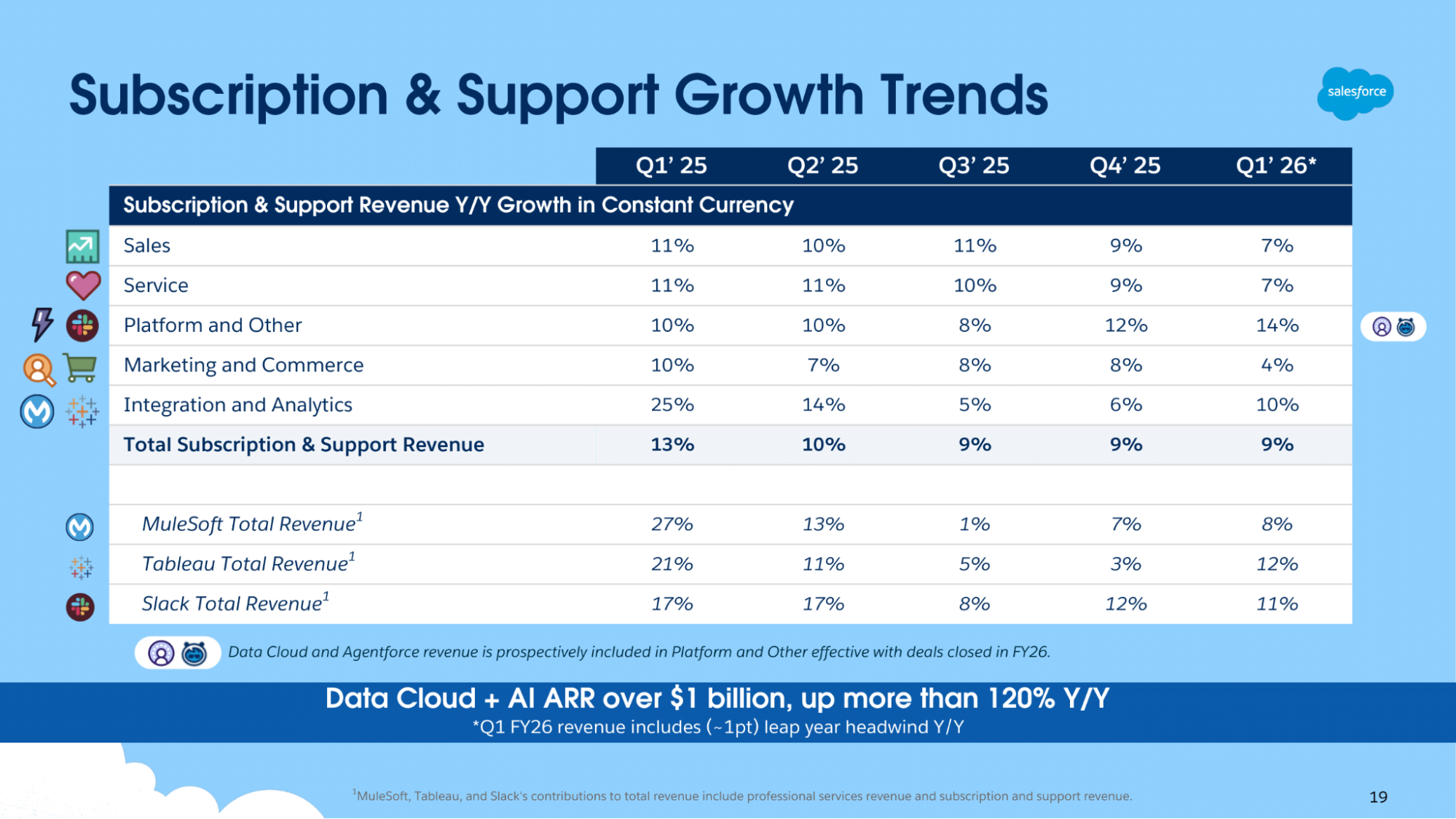
When Salesforce’s Q1 FY26 earnings were revealed earlier this year, the company boasted that annual recurring revenue (ARR) for ‘Data Cloud + AI’ was more than $1B – representing a Y/Y increase of more than 120%. Agentforce surpassed 4,000 paid deals and 8,000 total transactions, generating more than $100M in ARR – just two quarters after its launch.
Founder and CEO of Salesforce, Marc Benioff, explained in the Q1 earnings call that 60% of the quarter’s top 100 deals contained both Data Cloud and AI, with half of all the new Data Cloud bookings expansions from existing customers.
As we reported at the time, Data Cloud stored 22 trillion records – up 175% percent versus the previous year, giving Salesforce priceless lock-in.
The figures from earlier this year arguably show how the “flywheel” is at work, meaning that, once customers load records into Data Cloud, they might consider how agents can reason over them, which in turn drives further data ingestion.
While Agentforce is often front and center of Salesforce’s marketing, events, and announcements, it’s also worth remembering that Data Cloud is an excellent measure of adoption for the CRM giant’s products generally.
The amount of data going through Data Cloud will be a good indicator of how healthy Salesforce’s offerings are – with a greater transaction volume meaning a better overall picture for the company.
… But Don’t Forget Core Offerings!
The likes of Agentforce and Data Cloud might be big names in the Salesforce ecosystem these days, but it’s important to remember just how expansive the company’s portfolio is.
We should also keep a keen eye on how Sales, Service, Marketing & Commerce, Integration & Analytics, and Platform offerings perform. Even if the Agentforce figures sing, this is just one part of the picture – and it won’t be much of a sweetener if Salesforce’s core offerings do not perform well.
The Q2 results will be a good opportunity to analyze how platforms like MuleSoft, Tableau, and Slack are doing.
According to Salesforce’s chart of subscription and support revenue Y/Y growth in constant currency from Q1, MuleSoft’s total revenue dipped from a formidable 27% in Q1 ‘25, down to 13% in Q2 ‘25, and then just 1% in Q3 ‘25. There was something of an upturn in Q4 ‘25 with the figure hitting 7%, and then 8% in the most recent figures for Q1 ‘26.
It will be interesting to see if this upward trend continues in Q2 ‘26.
We Must Consult The Oracle (and Other Competitors)
On August 11, investment research website Zacks.com published an article asking whether investors should exit Salesforce amid a stock plunge of 28%, YTD.
They described Salesforce as having “one of its worst years in recent memory”, comparing it to key competitors like SAP, Microsoft, and Oracle – who had seen shares rising by 18.7%, 23.9%, and 50.1% respectively.
Oracle’s First Quarter Fiscal Year 2026 earnings will be announced in mid-September 2025, so it will be interesting to see how these figures compare to Salesforce’s.
One thing to keep an eye out for is how Oracle’s cloud division is faring, especially amid recent news that the company is deploying OpenAI’s GPT-5 across its database portfolio and suite of SaaS applications.
If the partnership with ChatGPT creator OpenAI is paying off, this might spell bad news for Oracle’s competitor, Salesforce.
Final Thoughts
We aren’t able to tell the future, so we’ll refrain from making any solid predictions about what’s going to be revealed in Salesforce’s Q2 results.
But what we can say is that it has arguably been a shaky few months for the company, and some good news in terms of Agentforce deals and Data Cloud figures would be most welcome for the cloud giant – and those of us in the ecosystem.
Salesforce’s second quarter fiscal 2026 results will be released on Wednesday, September 3, after the close of the market. The company will host a conference call at 2PM (PT) / 5PM (ET) to discuss its financial results with investors.
A live webcast and replay of the event will be made available on the Salesforce Investor Relations website.