






With Salesforce busy reinventing itself as the enabler of the “Agentic Enterprise,” a major shift in how success is measured across the ecosystem may have flown under your radar – the so‑called Agentic Work Unit, or AWU for short.
This inconspicuous acronym carries significant weight and could alter the dynamics of the entire ecosystem. Let’s dive deeper into the topic and explore what it may mean for your team.
AWU as a Measure of AI Value
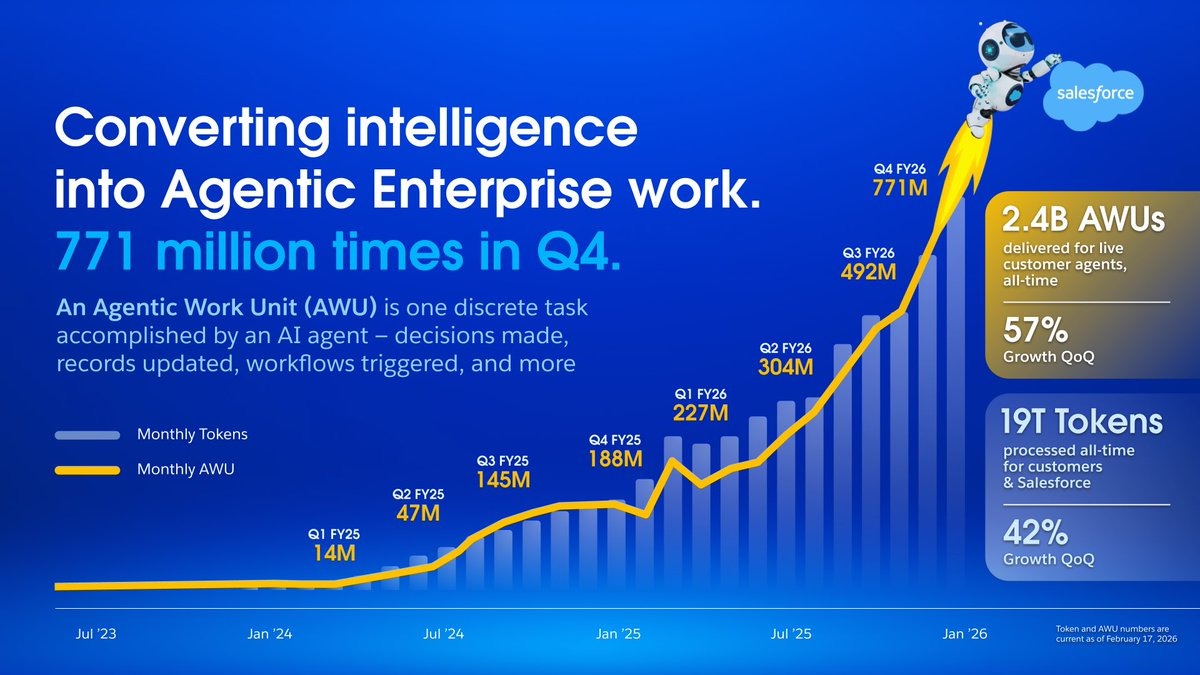
For years, success in the AI space has largely been measured through raw consumption metrics: tokens processed, model calls made, or seats licensed. While useful from an infrastructure perspective, these metrics stop short of answering a more fundamental question: is any meaningful work actually getting done? Salesforce’s answer to this problem is the Agentic Work Unit, which measures value not by how much an AI talks but by what it accomplishes.
At its core, an AWU represents a single unit of completed work performed by an AI agent – whether that’s executing a prompt, completing a reasoning chain, or invoking a flow. In other words, it marks the point where reasoning is converted into action. This moves AI measurement toward tangible business outcomes, aligning more closely with how enterprises evaluate productivity and return on investment.
Most importantly, AWUs introduce an element of efficiency into the equation. The relationship between tokens and AWUs is elastic by design: as implementations mature, the goal is to generate more completed work with fewer and cheaper tokens. In the agentic era, value is not defined by token usage but by how effectively an agent fulfills its job.
Shifting Focus from Partner Attributes to AI Outcomes
Amidst major strategic shifts and market fluctuations, the core of Salesforce’s partner program has remained largely the same. Certifications, projects, and CSAT scores still serve as the foundation of the partner scoring. However, that balance shows signs of shifting.
As Agentforce moves to the center of Salesforce’s value proposition, success is increasingly defined by concrete customer outcomes, with an emphasis on whether agentic solutions are generating value in production.
While AWU has not yet surfaced as a formal, published partner tier metric, the direction is clear: customer value, delivery quality, and partner effectiveness are converging around outcome-based signals. For partners, differentiation will increasingly depend on how well they translate Agentforce into sustained, measurable results. Consequently, the number of delivered projects and certified consultants will likely play a lesser role in this Agentforce-driven landscape.
What Does the AWU Mean for Customers?
As the saying goes, you get what you measure. When Salesforce begins to measure its own and its partners’ performance primarily on agentic outcomes, every project is set to become an Agentforce project by default. Whether the focus is on building agentic foundations, enabling AI‑driven processes, or drawing AI‑enriched insights, “traditional” CRM implementations will become increasingly rare. Personally, I do not think that is necessarily a bad thing.
At the same time, this places greater responsibility on both customers and partners to define success upfront. Clear use cases, strong governance, and a realistic understanding of operational maturity will be essential to ensure that the pursuit of AI development does not come at the expense of pragmatic, fit‑for‑purpose design.
Final Thoughts
The introduction of the AWU is ultimately an attempt to anchor AI adoption in something measurable and concrete. For customers navigating an increasingly complex AI landscape, having a shared unit of value creates a common language between Salesforce, partners, and in-house teams. In theory, this should reduce ambiguity and help ensure that agentic capabilities are introduced with a clear purpose.
That said, the risk I see is that the tail begins to wag the dog. To me, agentic AI is a tool and a method, not an end in itself. When Salesforce and its partners narrow their focus on agentic AI, the “how” may start to outweigh the “what” or the “why.”
While the Agentic Work Unit does focus on outcomes, the emphasis is specifically on agentic outcomes. The elephant in the room is projects without an agentic element. Will this shift steer the ecosystem away from deterministic automation and configuration, even when those approaches make more sense?





Comments: