

In the ever-changing world of Salesforce, staying still is not an option. Admins are constantly adapting, learning, and evolving their skills to keep pace with the platform and the needs of their business. One of the most common ways we demonstrate this growth is through certifications. But what does the certification landscape really look like in 2026, and how has it changed since our 2025 survey? The latest SF Ben Salesforce Administrator Survey provides some fascinating insight.
Whether you’re new to the ecosystem or many years into your admin journey, certifications remain a key part of professional development. But they are not the whole story. This year’s survey uncovers not just how many certifications admins hold, but which ones are considered the most helpful and how certification trends differ by experience level.
Most Admins Hold 1 to 3 Certifications
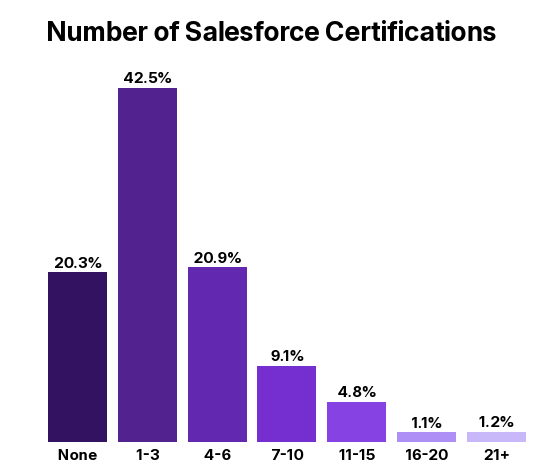
Let’s start with the headline stat: most admins still hold between one and three certifications (42.5%).
In fact, the majority of respondents sit in that lower-to-mid range overall. Around 20.9% hold 4 to 6 certifications, while 9.1% are in the 7 to 10 club. Only a tiny 2.3% have gone all-in with more than 16 certs. And yes, the “no certifications at all” group has grown again, up from 15.3% to 20.3%. So what’s going on here?
Honestly, it looks pretty realistic. Most admins start with the core admin cert, pick up a couple of extras as their role expands, and then plateau somewhere in the “this is enough to do my job well” zone. Not everyone is trying to collect them all like Pokémon, and that’s probably a good thing.
The Certifications Admins Actually Rate as Useful
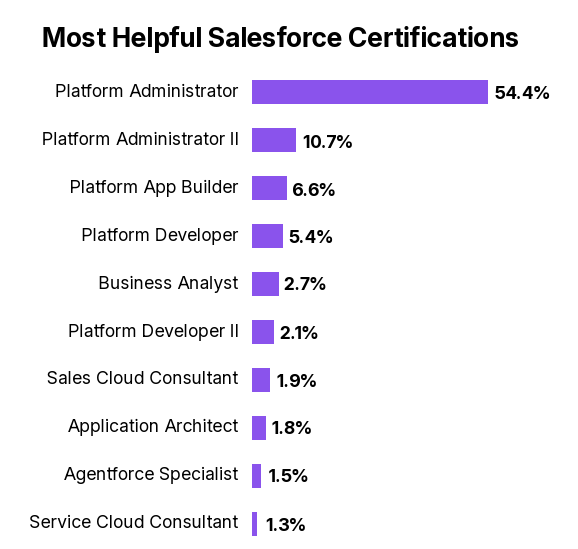
Not all certs are created equal, at least according to admins themselves. The top three most helpful certifications came out as:
- Platform Administrator (54.4%)
- Platform Administrator II (10.7%)
- Platform App Builder (6.6%)
No real surprises at the top, but it’s still telling. The Platform Administrator cert is doing exactly what it says on the tin. It’s the foundation, the entry ticket, and for many people, still the most practical qualification they have.
The Platform Administrator II and Platform App Builder certs follow behind, which makes sense if you think about career progression. More complexity, more automation, more “okay, now we’re building things properly.”
And yes, Platform Developer sneaks in at 5.4%, which is a nice reminder that some admins are quietly inching their way into developer territory, whether they planned to or not.
Certification by Experience Level
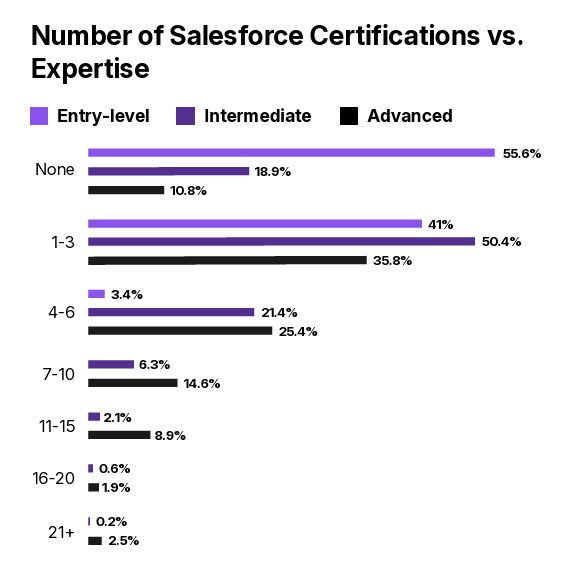
One of the more reassuring findings from the survey is that certification count tends to rise with experience. In other words, people are not just hoarding certs in year one and calling it a career. Most admins are building them gradually as their responsibilities grow.
And that matters, because it pushes back against the idea that certifications alone can substitute for experience. They really can’t. At the entry level, the Platform Administrator dominates, as it should. It’s the grounding point for everything else: security, users, data model basics, and the general “how does Salesforce actually work” question.
As admins move into intermediate and advanced roles, Platform App Builder and Platform Administrator II start to matter more. Less “what is this button?” and more “how do we design this so it does not fall over in six months?”
At the senior end of the spectrum, it becomes less about knowing features and more about judgment calls – scalability, architecture, process design, and knowing when not to build something in the first place. Certifications can help structure that thinking, but they are not the whole answer.
The Rise of AI and the Salesforce Agentforce Specialist Certification
Now let’s talk about the elephant in the room: A. Adoption is already widespread. Around 43.6% of admins say they use AI regularly or daily, and another 41.3% use it occasionally. Only 15% say they are not using it at all.
That alone is interesting, but the real shift is how fast it has happened. Daily or regular usage has nearly doubled year on year, rising from 24.7% to 43.6%. That is not gradual adoption. That is a behavioural shift in how work actually gets done.
And it’s not just early adopters driving it. More experienced admins are slightly ahead here, with 47% of advanced admins using AI daily compared to 34% of entry-level admins. Experience still matters, even when the tool is brand new. So what are admins actually using AI for?
Mostly practical stuff:
- Boosting productivity (64%)
- Brainstorming and problem solving (53.3%)
- Learning faster (52.3%)
- Writing formulas (48.3%)
- General efficiency gains (47.9%)
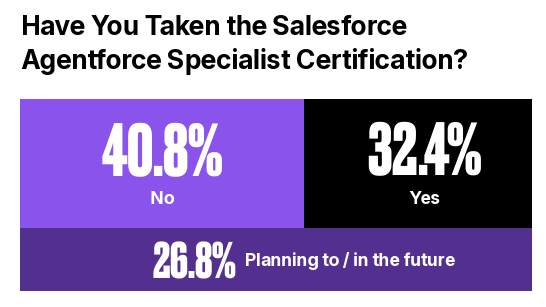
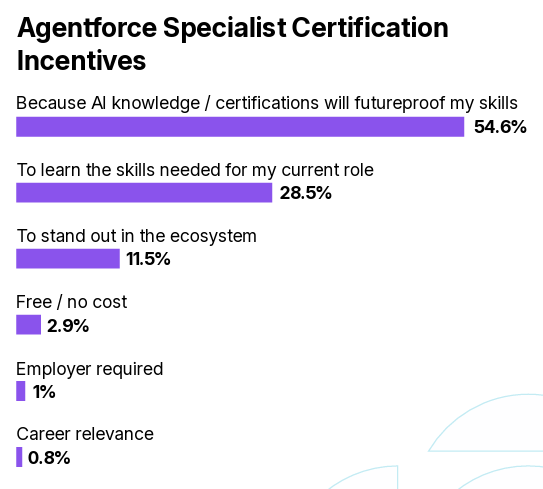
In other words, it is not replacing the job. It is speeding up the bits that admins already spend too much time on. Unsurprisingly, AI is also showing up in certification form. The Salesforce Agentforce Specialist certification is already being picked up by 32.4% of respondents, with another 26.8% planning to take it.
Interest is strongest among admins with 1–2 years and 5–10 years of experience, both sitting at 36%. Meanwhile, those with 15+ years of experience are a bit more cautious at 24%, which probably says more about selective upskilling than lack of interest. The main driver? Futureproofing.
Over half of respondents (54.6%) said they are pursuing AI-related certifications to stay relevant. Which is a polite way of saying: nobody wants to be the person who ignored AI and regretted it later.
Certifications vs. Experience: The Debate That Never Goes Away
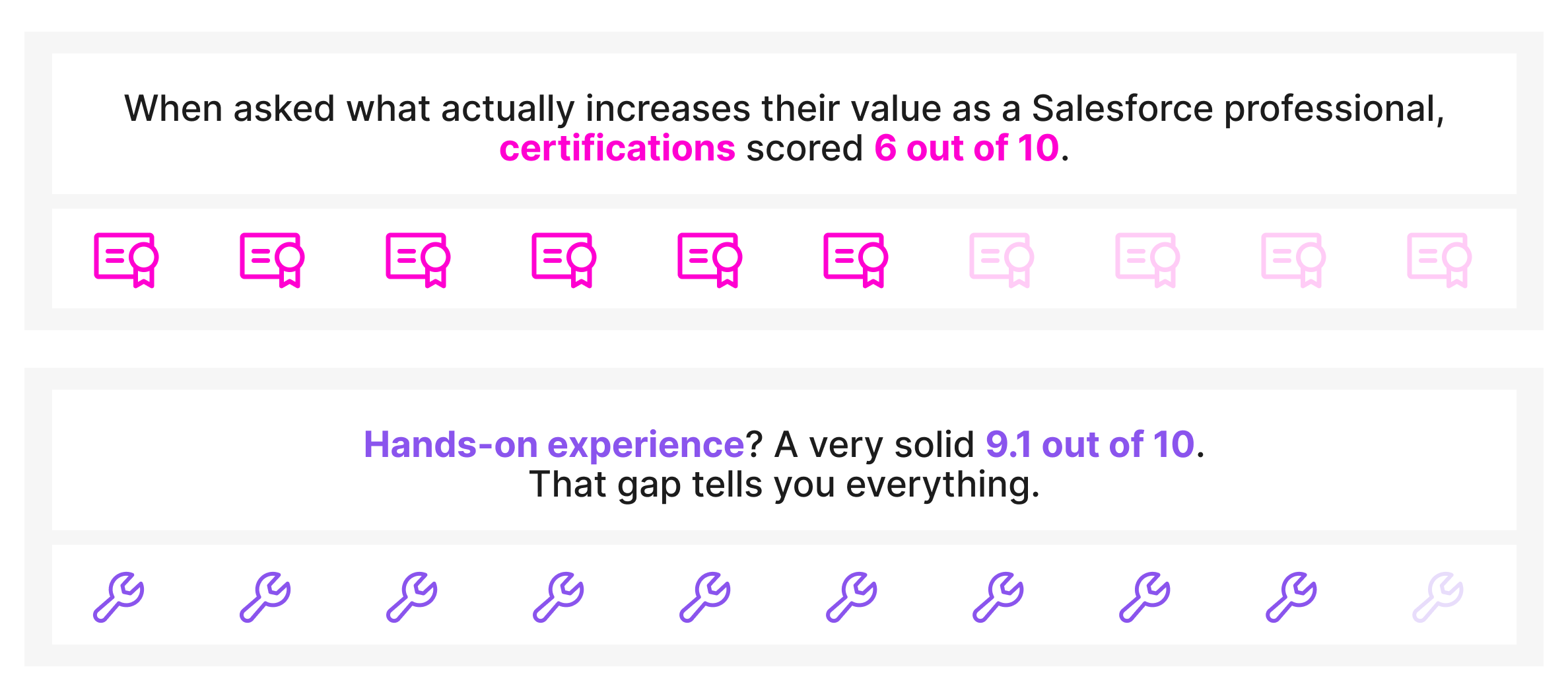
Here is where things get interesting. When asked what actually increases their value as a Salesforce professional, certificationsscored 6 out of 10. Hands-on experience? A very solid 9.1 out of 10. That gap tells you everything.
Certifications absolutely matter. They give structure, they validate knowledge, and they help get past the CV screening stage.
But experience is where the real confidence comes from. Fixing broken flows at 4pm on a Friday. Explaining to stakeholders why “just one more field” is not just one more field. Building solutions that survive contact with reality.
Employers know this. They are not just hiring certs. They are hiring people who can actually work in an org without setting it on fire.
Non-Salesforce Certifications
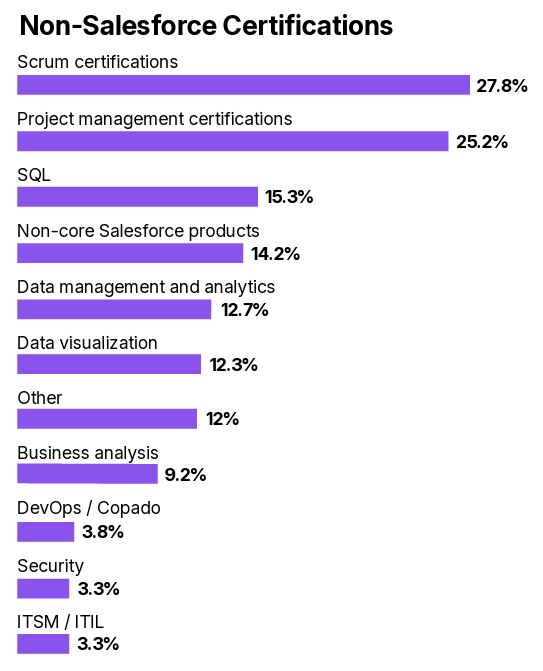
One of the more underrated parts of the ecosystem is how many admins are building skills outside Salesforce itself. The top non-Salesforce certifications include:
- Scrum certifications (27.8%)
- Project management certifications (25.2%)
- SQL certifications (15.3%)
And that makes sense. Salesforce does not exist in a vacuum. The best admins are usually the ones who understand delivery processes, data outside the platform, and how to actually get work across the line in a team setting.
Summary
Certifications are still absolutely part of the Salesforce Admin toolkit in 2026. But they are not the whole story, and they are definitely not a shortcut. Think of them more like scaffolding than a finished building. Helpful while you are learning, useful for structure, but not the thing that makes you effective on its own.
The admins who stand out are the ones combining certifications with real experience, curiosity, and a willingness to keep adapting as the platform (and AI) shifts underneath them. So yes, keep earning certs if they support your goals. But do not stop there. Build things. Break things. Fix things. Learn from them.
That is where the real value is – now over to you. Which certification actually made a difference in your day-to-day work?