
As more businesses move toward subscription and usage-based pricing models, traditional pipeline forecasting is no longer sufficient to accurately predict revenue. Companies now need visibility not only into whether a deal will close, but also into how customers will actually consume products and services over time. That is where Consumption Forecasting in Salesforce comes in.
This guide breaks down what Salesforce Consumption Forecasting is, how it differs from traditional pipeline forecasting, and what organizations need to consider before implementing it. From real-world examples and setup guidance to best practices, limitations, and data architecture considerations, this article provides a practical overview for both Salesforce Admins and business stakeholders looking to better forecast usage-based revenue.
What Is Salesforce Consumption Forecasting?
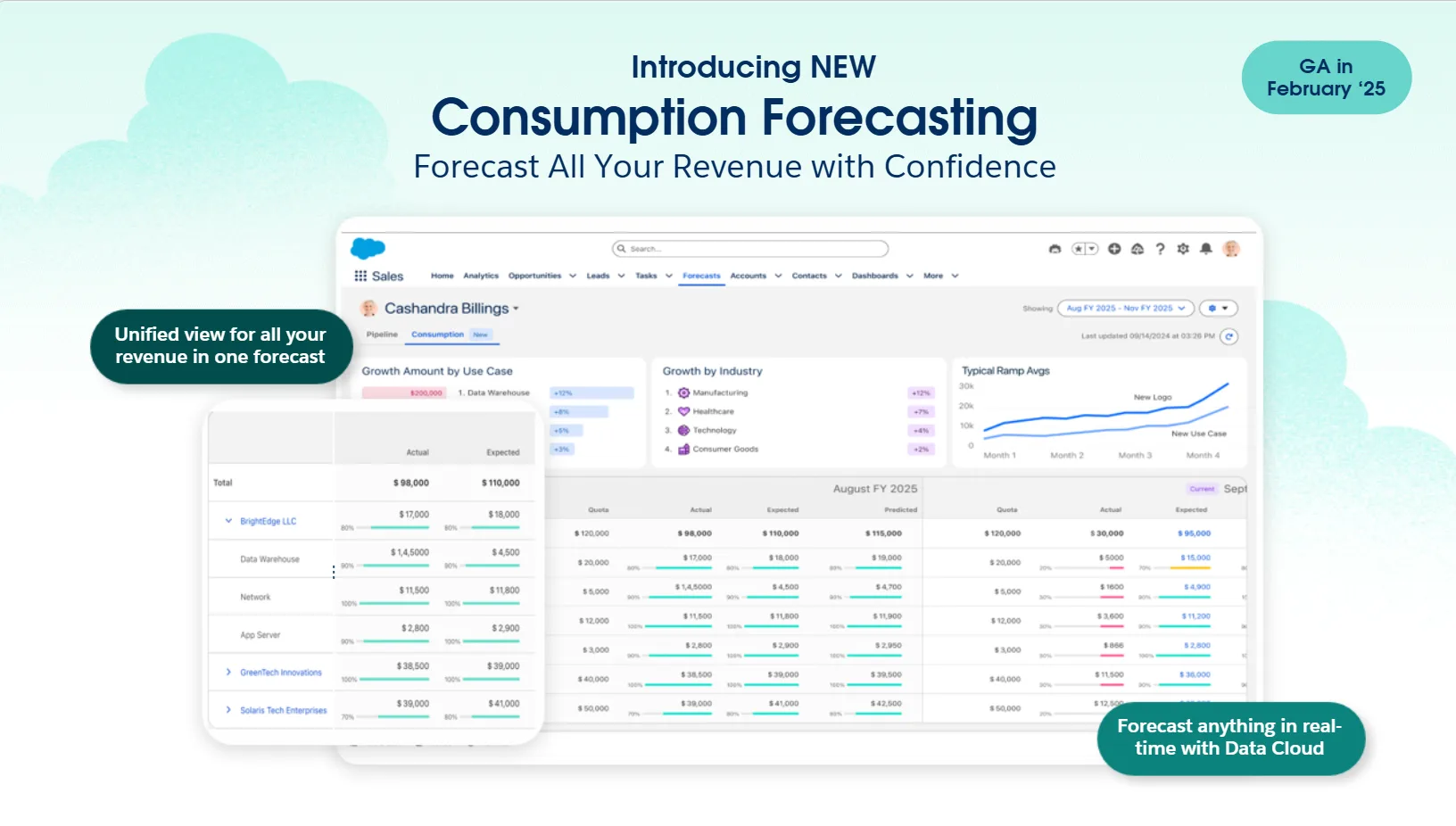
Consumption Forecasting in Salesforce helps businesses predict future revenue based on how much customers are expected to use a product or service over time, rather than simply whether a contract has been signed.
This is especially useful for businesses with usage-based pricing models, where customers pay according to actual consumption. Traditional sales forecasting focuses on whether a deal will close. Consumption Forecasting focuses on what happens after the deal is already won.
A simple real-world example is gas and electricity usage. Imagine a customer signs up with an electricity and gas provider, we’ll call them SaaS & Gas, and agrees to a monthly payment plan based on estimated usage. At the beginning of the year, SaaS & Gas may predict the customer will spend around $2,000 annually. But that amount is not guaranteed. The customer ultimately pays based on how much gas and electricity they actually use.
If the winter is colder than expected, heating usage may rise, and monthly payments could increase. If the customer reduces energy usage, installs solar panels, or spends less time at home, the overall contract value may end up being lower. Consumption Forecasting helps companies predict these changing usage patterns so they can estimate revenue more accurately, plan resources properly (SaaS & Gas will be in BIG trouble if they don’t have enough gas during a particularly cold winter!), and make better business decisions.
In simple terms, the customer relationship already exists. The real challenge is predicting how much the customer will actually consume over time, because that is what ultimately drives the revenue.
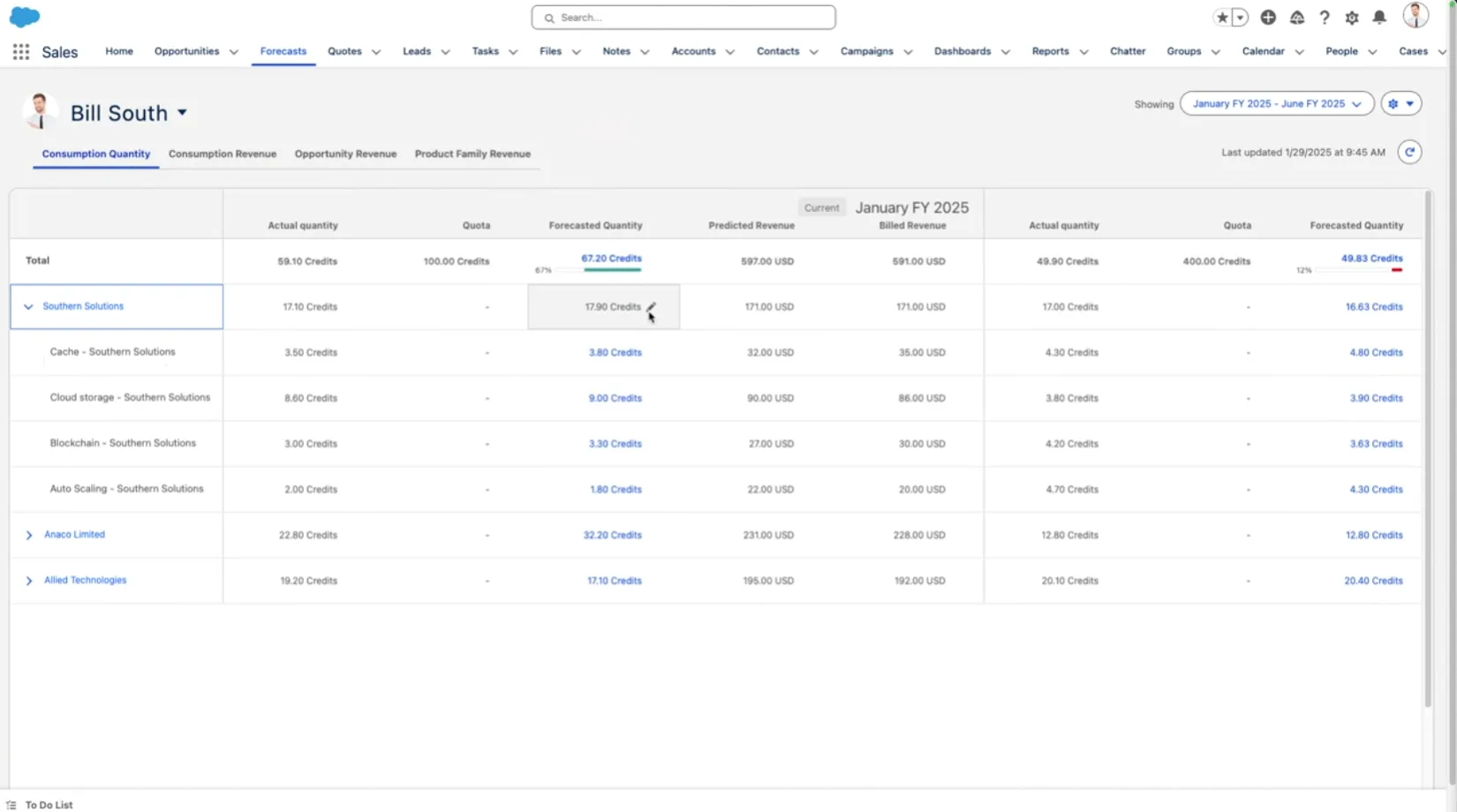
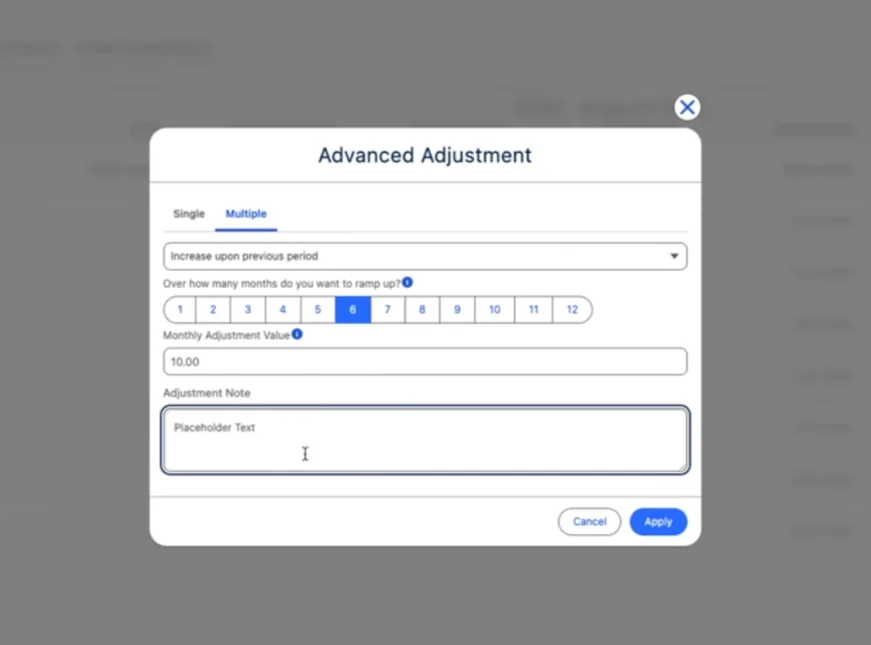
Consumption Forecasting allows reps and managers to adjust consumption values for a single period or across multiple periods.
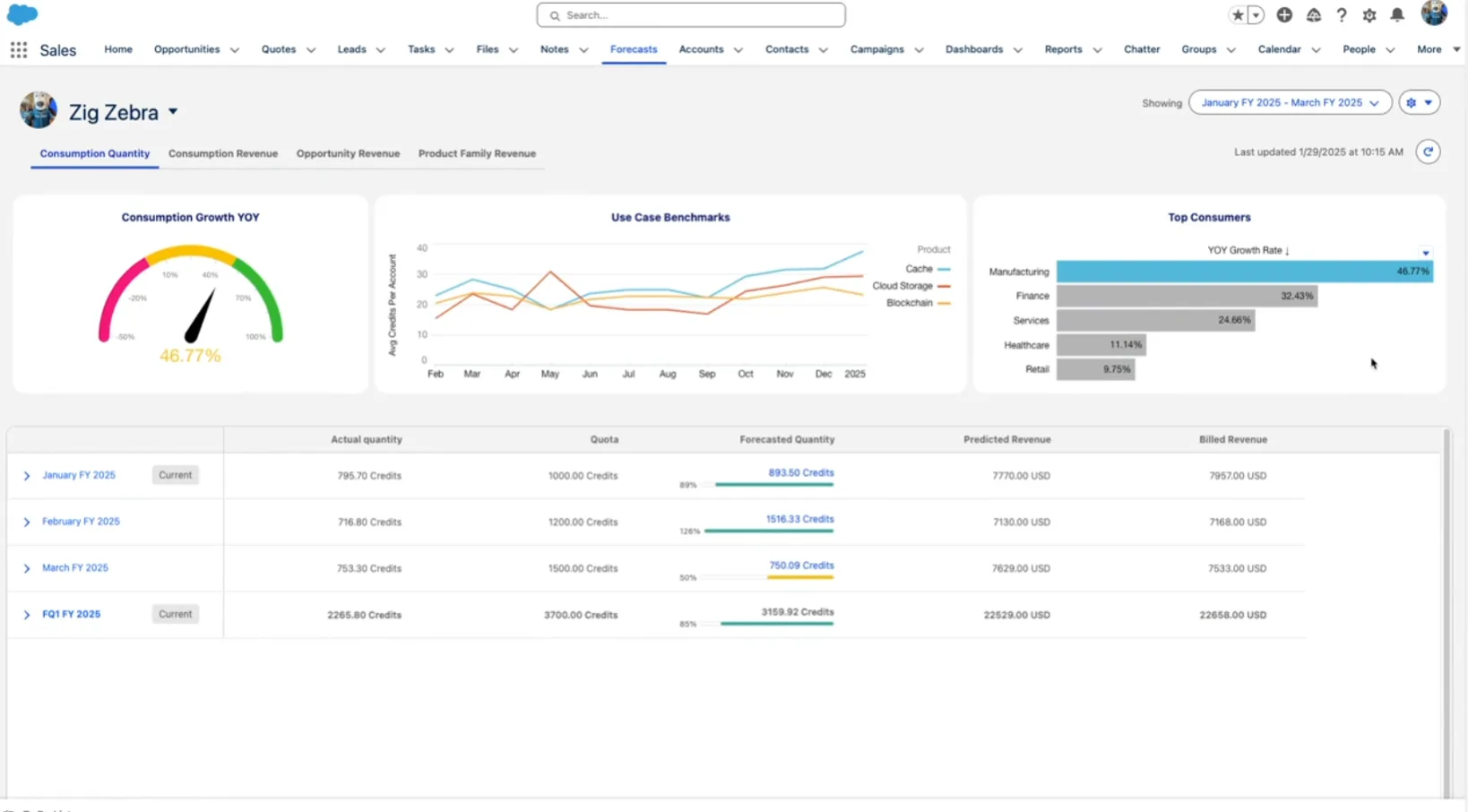
Using configurable Lightning forecasting pages, teams can view both traditional forecasting layouts and dashboards tailored to usage-based revenue models, giving a more flexible and operational view of performance.
Pipeline Forecasting vs. Consumption Forecasting
In Salesforce, pipeline forecasting and consumption forecasting are designed to answer two different business questions. Pipeline forecasting focuses on sales deals that are still in progress. It helps sales teams predict whether they are likely to hit revenue targets based on opportunities in the pipeline, deal stages, close dates, and expected contract values. In simple terms, it answers the question: “Are we going to close enough business?” This type of forecasting is especially useful for tracking sales performance, identifying gaps early, and helping leaders make smarter decisions about quotas and priorities.
Consumption forecasting, on the other hand, is built for businesses where revenue depends on customer usage over time. Instead of focusing on whether a deal will close, it focuses on how much customers will actually consume after the sale is made. This is common in subscription, cloud, and usage-based pricing models. For example, a customer may sign a large contract, but the actual revenue depends on how much of the product or service they use each month. Consumption forecasting helps companies predict usage trends, plan resources, improve customer engagement, and make more accurate financial decisions.
The simplest way to think about it is this: pipeline forecasting predicts sales activity, while consumption forecasting predicts customer behavior after the sale. One helps you understand what business is coming in. The other helps you understand how revenue will actually materialize over time. Companies with modern recurring or usage-based revenue models often need both to get a complete picture of future growth.
| Category | Pipeline Forecasting | Consumption Forecasting |
|---|---|---|
| Core question | Will we close the deal? | How much will customers actually use? |
| Focus | Sales opportunities in progress | Post-sale product or service usage |
| Revenue driver | Contract value at point of sale | Actual consumption over time |
| Timing | Before or at deal close | After the deal is signed |
| Data source | Opportunities, stages, and close dates | Usage, consumption trends, customer behaviour |
| Best for | Traditional sales-led businesses | Usage-based or subscription businesses |
| Example | Predicting which deals will close this quarter | Predicting how much a customer will use cloud storage or energy |
| Risk it helps manage | Missed sales targets | Over or underestimating actual revenue |
How Do I Set Up Salesforce Consumption Forecasting?
Setting up Consumption Forecasting in Salesforce is not just a forecasting exercise. It is also a data foundation exercise. The most important thing to understand upfront is that Consumption Forecasting requires Data Cloud and Data 360 capabilities to work properly. Without a strong data structure underneath it, forecasting accuracy and performance can quickly become unreliable.
1. Start with Data Cloud and Data 360
Before anything else, make sure Salesforce Data Cloud and Data 360 are set up correctly.
Consumption Forecasting depends on:
- Clean customer data.
- Usage or consumption data.
- Consistent product and account records.
- Historical activity trends.
Data 360 helps bring this information together into one connected view so Salesforce can analyze customer usage patterns over time. In simple terms, Data 360 acts as the engine behind the forecasting model.
2. Define What “Consumption” Means for Your Business
Every company measures consumption differently.
For example:
- A cloud company may track API usage or storage consumption.
- An energy company may track gas or electricity usage.
- A SaaS company may track licences, credits, or transactions.
Before building forecasts, clearly define:
- What customers consume.
- How it is measured.
- How often usage changes.
- Which metrics actually drive revenue.
If this is unclear, forecasting becomes inconsistent very quickly.
3. Organize Your Data Models Carefully
Large forecasting models should be broken into smaller, focused datasets.
Best practice is to:
- Separate data by product or forecast type.
- Keep CRM and non-CRM data separate.
- Use separate data spaces for different business functions where possible.
This improves performance, enhances reporting clarity, and increases forecast accuracy. A cleaner structure also makes the forecasting process significantly easier and more efficient.
4. Reduce Unnecessary Data Volume
Consumption Forecasting performs best when the system only processes the data it truly needs.
That means:
- Summarizing daily data into monthly trends where possible.
- Archiving older historical data.
- Avoiding duplicate or unnecessary records.
- Keeping forecasting periods focused, such as three or six months, instead of multiple years.
Smaller datasets typically result in faster forecasting, lower operational costs, and a better overall user experience. It is also important to align forecast logic with real business behaviour to ensure more accurate and meaningful outcomes.
Forecasting is only valuable if it reflects reality.
Make sure:
- Sales stages align with forecast categories.
- Usage trends are based on historical behavior.
- Forecast assumptions are reviewed regularly.
- Teams understand how revenue is actually generated.
Consumption Forecasting is designed to predict how customers behave after the sale, not just whether a deal closes.
5. Test with Real Usage Scenarios
Before rolling consumption forecasting out broadly, test it using realistic customer examples.
For example:
- High usage customers.
- Seasonal spikes.
- Low adoption customers.
- Rapid growth accounts.
This helps validate forecast accuracy, ensure data quality, and assess system performance under load.
It also helps your business teams trust the numbers they are seeing.
Best Practices
Consumption Forecasting works best when data is clean, focused, and well governed. The most common issue is simply too much data. Very large datasets can slow performance and increase cost.
Accuracy also depends on disciplined sales processes. Forecast categories must align with deal stages, and close probabilities should be based on real historical outcomes. Shorter forecasting windows of three to six months generally produce more reliable results than long-range forecasts.
From a data perspective, simplicity is key. Break models into smaller units, separate CRM and non-CRM data, reduce unnecessary granularity, and archive older records. The cleaner the structure, the more reliable the forecast.
Considerations
Consumption Forecasting in Salesforce is powerful for usage-based forecasting, but it still has important operational and enterprise-scale limitations, especially for global organizations, complex sales structures, and highly governed forecasting processes.
- You can’t easily move forecasting setup between environments (like sandbox to production). Much of the configuration has to be recreated manually.
- Sales reps can only view up to 2,000 expanded rows in the forecast grid, which can limit visibility in large datasets.
- Manager and seller overrides are always turned on. You can’t disable manual adjustments to forecasts.
- Consumption Forecasting is not supported in Salesforce Government Cloud Plus.
- Multiple currencies aren’t supported.
- Advanced Currency Management is also unsupported, making historical currency conversion difficult.
- Several traditional forecasting capabilities are missing, including:
- Allow Forecast Submissions
- Enable Adjustments and Judgments
- Manage Forecast Rollup.
- Territory Hierarchy
Resources
If you’re ready to get started with Salesforce Consumption Forecasting, below are some useful resources to help!
- Salesforce Help: Set Up Consumption Forecasting
- Trailhead: Predict Sales and Forecast with Confidence
- 5 Top Forecasting Models to Improve Sales Accuracy
Final Thoughts
Consumption Forecasting represents a major shift in how businesses think about revenue prediction. Instead of focusing purely on sales opportunities and contract values, it helps organizations understand how customer usage behavior drives revenue after the deal is signed. For companies operating subscription, cloud, utility, or usage-based business models, this visibility can significantly improve financial planning, resource management, and long-term forecasting accuracy.
However, successful implementation depends heavily on having the right data foundations in place. Salesforce Consumption Forecasting is not simply a feature you switch on. It requires a strong Data Cloud and Data 360 architecture, clean data models, disciplined forecasting processes, and careful performance management. Organizations that invest in data quality, simplification, and governance will see the greatest value from the platform.