

The role of a Salesforce Architect is constantly shifting, but one thing remains the same: the need for the right tools to get the job done. Whether it’s mapping out a complex solution, digging into data, or guiding a development team, architects rely on a carefully curated toolkit to support their daily work.
So, what does that toolkit look like in 2025? Based on data from the latest SF Ben Architect Survey, we now have a clear view of the most commonly used applications in the architect community. Some tools are unsurprising essentials, while others reflect the growing range of skills architects bring to the table.
Top of the List: SOQL, Atlassian, and VS Code
At the top of the list is SOQL, used by 75.6% of architects. SOQL, or Salesforce Object Query Language, is the language used to search and retrieve data from Salesforce objects. Think of it like SQL, but tailored specifically for Salesforce. It is no surprise that querying data is a daily task for many, whether it is for troubleshooting, validating assumptions, or preparing solution designs. A solid understanding of SOQL helps architects work faster and with more confidence.
Close behind is the Atlassian suite, used by 65.7% of respondents. Tools like Jira and Confluence support collaboration, documentation, and agile project tracking. These are all vital for architects managing cross-functional teams and long-running delivery work.
VS Code rounds out the top three, with 63.6% of architects using it regularly. VS Code (short for Visual Studio Code) is a smart text editor you can use to write, edit, and organize code or instructions that a computer can understand. While not every architect is writing code all day, many use VS Code to review Apex, build metadata, or explore source-controlled projects. It remains the go-to code editor for anyone working in the Salesforce ecosystem.
Design and Development Go Hand-in-Hand
Beyond technical tools, visual design continues to be a key part of the architect’s role. More than half of respondents (54.7%) use Lucidchart to create solution diagrams and process flows. Visuals are essential for breaking down complex ideas and ensuring alignment between technical teams and business stakeholders. In fact, diagramming was ranked the second most important skill for architects, highlighting just how critical clear, effective communication has become.
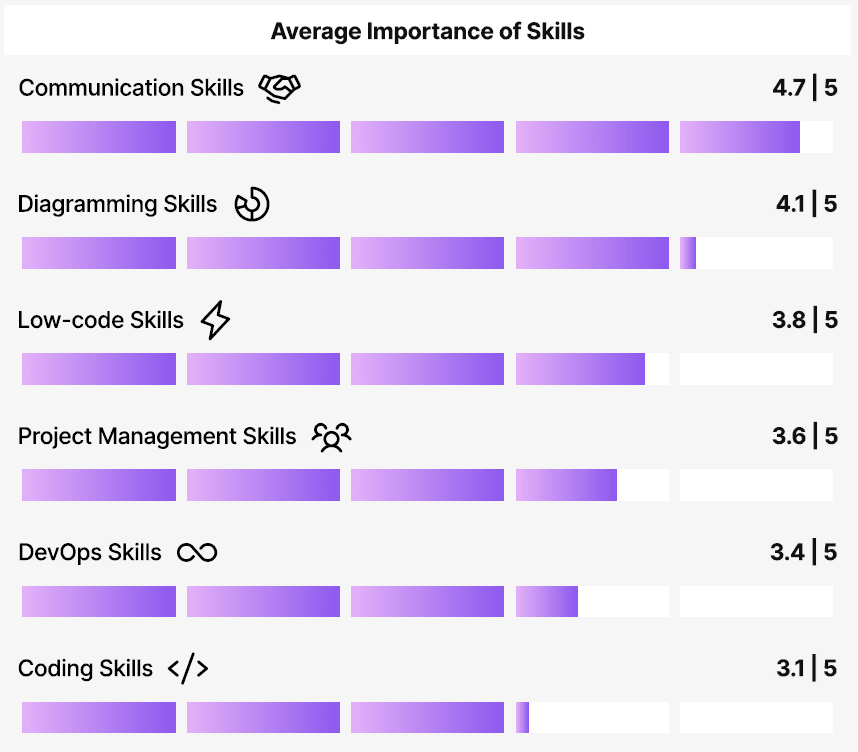
Apex is also widely used, with 52.7% of architects engaging with it regularly, despite coding being ranked the least important architect skill among survey respondents. Whether writing new classes or reviewing existing logic, a working knowledge of Apex continues to be valuable.
Workbench also makes the list, used by 51.3% of respondents. Salesforce Workbench is a free, web-based tool designed for data management tasks like bulk updates, mass record creation, and deletions. If you’ve used Data Loader or the Salesforce Data Import Wizard before, Workbench offers similar functionality with a web-based interface.
Interestingly, a significant portion of architects are also using web technologies. JavaScript (33.1%), HTML (30.5%), and CSS (27.8%) all feature in the results. This points to the growing overlap between front-end development and architectural design, especially for those working on Experience Cloud or custom Lightning components.
Visual Collaboration Tools on the Rise
In addition to Lucidchart, architects are embracing other visual tools like Miro (27.1%) and Draw.io (26.1%).
These platforms support everything from brainstorming to architecture mapping. As teams become more distributed and remote-friendly, collaborative visual tools are becoming essential for real-time planning and alignment.
Summary
There is no single blueprint for how a Salesforce Architect works, but this data gives us a strong sense of the modern toolkit. Architects today combine deep technical skills with visual communication and agile collaboration. From SOQL and Apex to Lucidchart and Miro, the tools they use reflect the wide scope of their responsibilities.
What tools do you use daily as an architect? Let us know in the comments!