

Salesforce introduced pay-per-resolution pricing for Agentforce last month, signalling an interesting shift in the company’s approach to billing. The new model was for a Help Agent intended to solve customer issues.
But while Salesforce was clear with its broad messaging, saying that cost was tied to “outcomes, not activity”, a number of questions still remained unanswered about the finer details of the new model. We asked Prasad Raje, SVP of Product for Agentforce Service, to clear up some of the questions around the new Agentforce pricing model.
When Is Something Resolved?
We asked for a little more definition on how something is determined to be resolved vs. when it is abandoned.
Prasad told us the pricing model for the Agentforce Help Agent is strictly outcome-based, meaning they only charge when the agent successfully resolves an inquiry or request.
“This model operates on a clear, deterministic framework where a billable resolution is defined by prioritizing the customer experience of resolution,” Prasad said.
The formal definition for a resolution during a Help Agent session is when it:
- Has at least two turns of messages between the user and agent (not abandoned).
- And the final feedback received from the user is not explicitly negative.
- And either successfully concludes without the user escalating to a human, or the final feedback is explicitly positive.
This approach is intended to align Salesforce’s incentives with its customers’ business goals. “We are motivated to ensure our agents effectively handle issues as determined by the user’s explicit feedback,” Prasad said.
In the absence of feedback, when the customer incurs the cost of handling an escalation via a human representative, Salesforce does not bill for the Help Agent, even if it may have performed “many valuable activities” for the user, Salesforce says.
How Much Does a Resolution Cost?
A resolution, when billed, costs exactly $2 (or 400 flex credits).
There is no variable cost to consider by way of the number of Agentforce actions performed by the Help Agent or of the Data 360 queries performed by the Help Agent during the session with the user – which would otherwise be individually metered via various flex credit consumption meters.
This allows a business buyer to reason about the cost of Help Agent based on the overall session volume, which is usually well known, and on the estimated resolution percentage.
Salesforce also considers the session duration – for messaging channels, it is two hours, and for voice, it is 10 minutes.
Can the Agent Close a Case When the Customer Doesn’t Say It Is?
We asked whether the agent could close a case and mark it as resolved, ending the chat, without the customer agreeing that it had been.
Prasad said that the agent’s goal is to resolve the customer’s query within the session, but if the customer is unsatisfied and requests escalation, the agent will attempt to connect them with a human rep. If no rep is available, the agent will create a case.
If the conversation has more than two turns, the user does not provide feedback or ask for escalation, and exceeds the session duration time (two hours for messaging channels and 10 minutes for voice), then the inquiry is considered resolved, and $2 is billed.
So, if someone closes a tab and goes to a competitor, does that count as a successful resolution? Prasad tells us that a resolution is determined solely by what happens within the conversation. “If a customer closes a tab, we have no visibility into why or what they do next.”
Disputing Outcomes
We asked Salesforce if an organization has recourse to dispute outcomes that they believe are not positive, but which still consume credits
Prasad said: “We have provided the above deterministic set of rules for determining a resolution to minimize disputes and misunderstandings. If a dispute does arise, we can provide a full report showing session counts, resolution metrics, as well as turn-by-turn transcripts of the actual conversations to verify the rules were applied correctly.
“We want to make sure the rules are always clearly spelled out and are properly applied to customer conversations.”
Traditional Agentforce Pricing
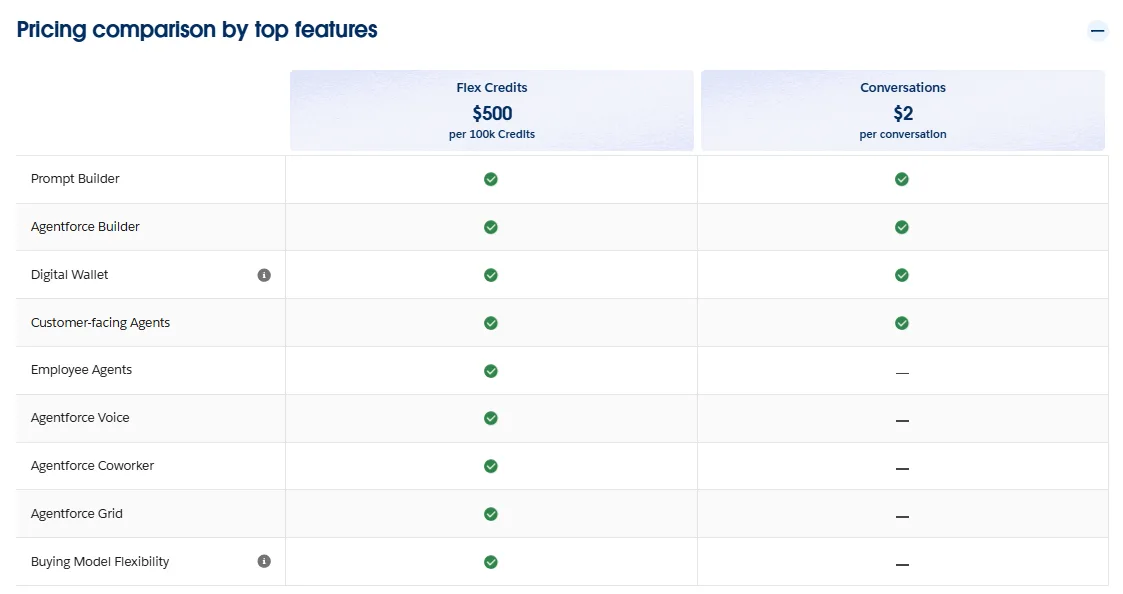
Salesforce offers consumption-based pricing with Flex Credits or Conversations, or per-user licensing.
With Salesforce Foundations, you can add key Agentforce features to your existing CRM, available for Enterprise Edition and above, for $0.
Using Flex Credits, you pay per action, at a cost of $500 per 100,000 credits. With this option, you get access to customer-facing agents, employee-facing agents, Agentforce Voice, Digital Wallet, and Agentforce Vibes.
With Flex Credits, each action draws from a pool of credits which can be applied across teams, channels, and use cases. Each action is metered individually. Agentforce actions are 20 Flex Credits, and Agentforce Voice actions are 30 Flex Credits.
With the Conversations model, you pay $2 per conversation. This package comes with customer-facing agents and Digital Wallet.
Buying Models
With the pre-purchase model, you buy a set amount of usage for the full contract term and pay upfront, with usage drawing down your balance. This, Salesforce says, means you save the most.
The Pre-Commit model means you can commit to a baseline of Agentforce usage, with no upfront payments – and the more you commit, the “more value you unlock”. This is billed after the fact monthly. This is a ‘true-up at term end’ deal, meaning estimated figures are compared to actual amounts, resulting in a single adjustment or payment to balance the books. This model will be widely available later this year.
On the PayGo model, you can start Agentforce usage with no upfront commitments, paying only for what you use. This is billed monthly in arrears.
All models are available with Digital Wallet to track Agentforce usage.
Agentforce Add-ons and Agentforce 1 Editions
Agentforce add-ons and Agentforce 1 Editions offer more ways to buy Agentforce for employee-facing use cases.
Available add-ons for Sales, Service, and Field Service are billed at $125 per user per month. This features unmetered Agentforce usage for employees, Salesforce’s full suite of AI, AI-powered analytics, and Prompt Builder.
Add-ons for Agentforce Industries Clouds are billed at $150 per user per month. This grants access to unmetered Agentforce usage for employees, Salesforce’s full suite of industry-specific AI, along with everything in the Agentforce Sales and Agentforce Service add-ons.
Agentforce 1 Editions for Sales, Service, Field Service, and Industries cost from $550 per user per month. These include Agentforce add-ons and 2.5M Flex Credits per org per year.
And the Agentforce User License lets you deploy agents company-wide for all your employees, running at a cost of $5 per user per month. This option requires Flex Credits, and provides access to Agentforce for every employee.
Final Thoughts
Tying Agentforce’s pricing to how well it resolves issues is an interesting bet from Salesforce. The company clearly wants to stress that customers only pay for value delivered.
But it still feels like something of an experiment from Salesforce. The $2 per conversation drew some criticism, and they introduced Flex Credits. Now, we have the per-resolution model.
To give Salesforce its due, if software costs can genuinely be mapped to real business outcomes, you would imagine Salesforce customers would like that level of predictability. Whatever comes next, the messaging will likely remain: only pay when Agentforce delivers value.