





Salesforce is unveiling the latest version of its AI decision model, Koa Decisions. The latest version builds on the CRM company’s HyperClassifier model, but “dramatically expands” where and how decision models can be used across Salesforce.
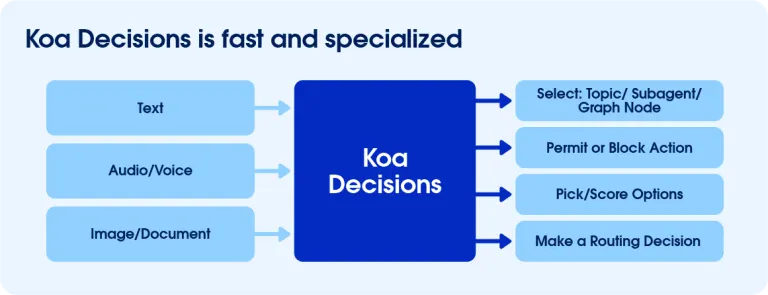
Koa Decisions reads a request and a list of categories that you define, then makes a decision in milliseconds. The latest model adds multimodal support for images and audio. Salesforce’s data science team built it by using novel training techniques on Gemma, Google’s open-weight model.
What Is Koa Decisions?
Koa Decisions is effectively a cheaper, quicker way to make decisions, saving your more general-purpose LLMs for writing and reasoning, so customers get a more efficient process without having to select a model for a particular job.
While LLMs generate text, agents make decisions like which teams receive a request or which knowledge article is best to show. Decision models return choices, like an option from a list, a yes or no, or a score.
Salesforce says that, while a general-purpose LLM can interpret a request from a chat window like “I can’t log into my account”, it is not purpose-built to make quick, targeted decisions – for example, about which team this should be sent to – and can take more than a second to work through it.
A decision model, on the other hand, is made specifically for this job, returning a clear answer in “milliseconds” – without the overhead of a larger, general-purpose model.
One of these answers often costs a single token. LLMs write answers one token at a time, with each new one based on the ones before it, while a decision model reads the entire request at once and creates an answer in one step. A short answer takes less computing to produce, and other software can act upon it immediately.
To take another example: if a sales deal starts slipping, a decision model can flag the risk and decide which team should be responsible for stepping in. Then, the more general-purpose LLM can summarize what changed.
Salesforce says that it measured routing requests in Agentforce, and found that the decision model took roughly 26 milliseconds, compared to roughly 1.4 seconds for a general-purpose LLM.
The company plans to extend it beyond routing, into flows, Apex, and prompt templates for Salesforce builders, plus an API for developers.
You can try out the decision model here.
Final Thoughts
Rather than throwing a general-purpose LLM at every task, Salesforce is betting that specialized models will be able to handle routine decisions more efficiently, leaving the larger models to tackle the work that actually needs reasoning and generation.
Not every problem needs a frontier model. Sometimes, a smaller model that makes one decision quickly and cheaply is exactly what businesses need.