

Highlights
- Artificial Intelligence takes a key focus, but the results aren’t what many expect.
- The CTA credential is still sought-after, but the ROI is questionable.
- The future of the Salesforce Architect role is in question, with Salesforce tooling making up less of the role and architects leaning into other technologies.
- There is more conviction when it comes to the build vs buy debate.
- Data quality and security are key focuses for Salesforce Architects, as they should be.
Salesforce is changing, and fast. The entire tech industry is. The Salesforce Architect role isn’t immune to this, although the changes are quite different from other roles.
In 2026, we put out our annual SF Ben Salesforce Architect Survey and gathered responses from almost 850 Salesforce Architects across the world. Their responses told a clear story and highlighted some trends that I personally wasn’t expecting to see.
The information we uncovered was telling. We learned about the kinds of roles that Salesforce Architects are in and want to be in, the best ways to learn, how they use AI and what for, and many thoughts about the future of the role.
Here are the top 10 insights that I believe had the biggest impact on today’s Salesforce Architects.
1. Architects Use AI Tooling Regularly
What will come as a shock to absolutely no one, the use of artificial intelligence has increased from 2025 to 2026 in the Salesforce Architect role. This is inevitable as a result of AI taking over more and more of our everyday and professional lives, and the gap in competition between those who use it and those who don’t is widening rapidly.
Last year, 88.9% of Salesforce Architects who responded to the survey said they were using it either on a regular or ad hoc basis. This year, that number jumps up to 96.7%. This leaves just 3.3% of Salesforce Architects holding out on leveraging these tools. In 2027, I predict that the remainder will be less than 1%.
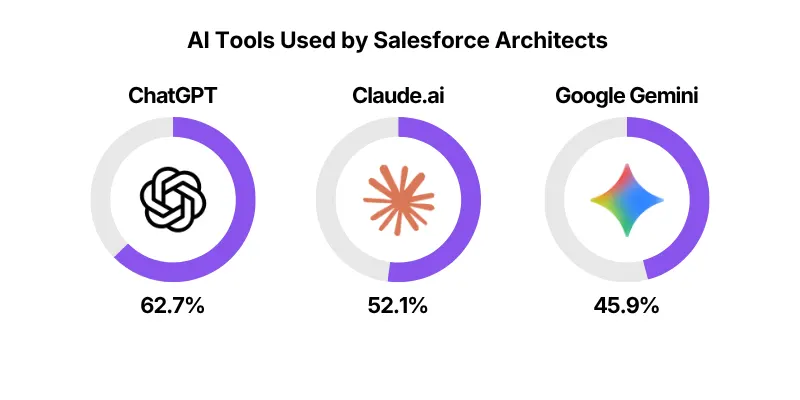
Notably, the most-used tools by Salesforce Architects were ChatGPT (62.7%), Claude (52.1%), and Gemini (45.9%). Sometimes, it’s the simple, off-the-shelf tools that are the most useful.
Actionable Insight: Salesforce Architects who are using AI tooling should continue to do so, and those who are not should really consider how they will keep up with demands in the near future. There are always new tools and new ways to put those tools into practice. As tech professionals, it is our duty to trial new ways of leveraging powerful tooling to make ourselves as impactful as possible.
2. AI Enhances Productivity; It Doesn’t Replace the Architect
No one uses a new technology without searching for some kind of benefit, and no one continues to use it unless they realize said benefit. When we asked Salesforce Architects what the biggest advantage of using AI tooling was, an overwhelming majority (63.9%) said they found it increased their productivity.
As with the first point, this isn’t likely to be a shock to anyone. The promise of AI is that a computer can now reason similarly to a human being, but do it in a fraction of the time. Salesforce Architects who are leveraging AI tools are going to be far more productive when they learn how to do so effectively.
There are no signs that AI is replacing Salesforce Architects yet. This is backed up by some of the tasks that they’re using it for – documentation (54.1%), finding information quicker (53.5%), and brainstorming (52.3%). These aren’t instances of AI replacing architects but instead allowing them to perform faster and take away some of the drudge work.
Actionable Insight: Start not by trying to squeeze AI into your workflows, but by identifying some of the repetitive, tedious tasks that slow you down and take you away from more valuable tasks. Then, investigate AI solutions that can take these off your hands and allow you to become the Salesforce Super-Architect that you could be if you could focus on high-value tasks at all times.
3. Agentforce Is Still Quite Alien to Most Architects
While artificial intelligence tools are adding value to Salesforce Architects’ workflows, Agentforce is still a relatively foreign concept for many architects. The average confidence in architecting Agentforce solutions sits at 61.7%, which is quite interesting given that this is clearly the direction that the mothership is taking the company. This number goes up for more advanced Architects (63.5%), and drops lower for those less experienced (57.5%). This isn’t a big variance, which makes sense given it’s still a relatively new tool for every Salesforce architect.
Of those who do use Agentforce, only 33.4% are finding value in it on the daily. This contrasts with almost double the amount of respondents (62.7%) finding daily value in ChatGPT, an off-the-shelf tool available to the mass market.
Actionable Insight: Salesforce isn’t going to slow down the push for its customers to adopt Agentforce anytime soon. The fact that only a third of architects use it daily and just over half of them are confident in architecting a solution that utilizes it, identifies an opportunity for Salesforce Architects who wish to stay ahead of the pack. Getting upskilled and building confidence in Agentforce is an ever-changing goal, but an important one.
4. Data Security and Quality Is An Issue
When we asked Salesforce Architects what their biggest concerns were when preparing Salesforce data for AI, the top two were data security (58.2%) and data quality (57.7%), both cited by more than half of respondents.
Data security, in particular, isn’t surprising, given the last few years of breaches and data leaks. Salesforce Architects design solutions to put this data to use, so it’s encouraging to see that securing this data is front of mind. Salesforce themselves have also made many changes to ensure the security of its customer data is top of mind.
We also asked respondents for their thoughts on purpose-built data security systems and their requirements for larger orgs. 74.4% of respondents said that they believed leveraging one of these was critical rather than a one-size-fits-all solution.
Actionable Insight: If you’re not focusing on data security and quality, you should be. Between large-scale privacy breaches and the fact that AI tooling is only effective with the right context, your data is key to everything. The success or failure of a business will depend on how the data is captured, organized, stored, and protected. Salesforce Architects are the arbiters of quality business data.
5. Architects Are More Confident in the Build vs. Buy Debate
We asked respondents their thinking around the build vs. buy debate – is it better to construct a solution for a problem, or leverage one that’s already been built? We’ve asked this particular question to Salesforce Architects over two years, and there’s a trend emerging already. Last year, 59.7% of respondents said that the answer depends on the context, whereas this response has dropped to just 42.4%.
This shows that Salesforce Architects are becoming much more confident in their preference for building or buying. Buying edges out building, 30.9% to 26.7%. This also makes sense, given that solutions are rapidly evolving and becoming more effective from year to year.
As Ben Bates points out in his overview of this section of the report, this runs counter to the broader tech trend of AI-accelerated custom development. Just why it is that Salesforce Architects buck this trend isn’t clear, but it is an interesting point to ponder.
Actionable Insight: Given that many Salesforce Architects are getting stronger in their convictions in the build vs. buy debate, it would be a great idea to engage with others in your field. Local or online Salesforce User Groups would be a great place to start. Learn from others’ experience and their reasoning as to why they lean one way or the other.
6. Salesforce Is Less Central to the Salesforce Architect Role
The topic no one wants to talk about – how Salesforce’s place in the Salesforce Architect is diminishing as the world accelerates aggressively into the AI era. We received some pretty clear data on this fact – 45.1% of respondents’ daily work involves non-Salesforce technologies, and 35.4% said that expanding beyond the Salesforce ecosystem is a key career strategy that they’re pursuing.
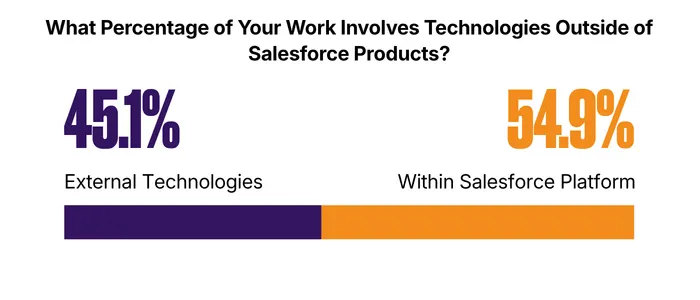
Given that many architects’ projects will extend far beyond Salesforce, it isn’t super shocking to see them using systems outside of Salesforce. What was surprising was to see over a third of Salesforce Architects actively pursuing non-Salesforce technologies.
I remember when I was considering pursuing a career in the Salesforce space, a mentor of mine could see the obsession I had surrounding the brand. He warned me to remember to branch out beyond a single company for long-term job opportunities. Clearly, I didn’t follow this advice very much in my earlier days as Salesforce went from strength to strength. The recent changes to the tech industry as a whole and the rise of AI tools show that becoming platform agnostic is a requirement going into the future.
Actionable Insight: Learn to know all aspects of the force, not just Salesforce! It’s good to gain insight into how other tools work – their similarities and differences with what Salesforce does – as well as understanding how to connect them up to your Salesforce instance. Just like you would use a Trailhead Playground or Developer org to learn Salesforce, see if you can get a trial org or learning playground from other tools to get hands-on experience where possible.
7. Hands-On Experience Trumps Everything Else
That last actionable insight mentioned getting hands-on experience, and it’s because of this next key point: 53.2% of respondents said that gaining hands-on experience is the biggest factor for career growth, above even AI tooling (49.7%).
This is further backed up by the fact that 92.2% of respondents still do some kind of hands-on work in their role. There’s a common misconception that once you move into an architect role, you’re fully hands-off – this is not the case. Salesforce Architects do still tend to get on the tools and do some build work, at the very least in an ad-hoc sense.
Actionable Insight: Not all your work will be strategic or conceptual in nature – there’s a high chance that at least some of it will be hands-on. This is why it is critical to flex those muscles as a Salesforce Architect. Not only that, but studies show that getting practical experience has a significant positive impact on theoretical learning. Hands-on is the way to go.
8. The CTA Debate Rages On, ROI Is a Key Question
Of those who responded to our survey, less than 5% (4.7%) had already achieved their CTA credential. A further 48.4% either had begun their journey or planned to work toward achieving the credential in the future. This leaves almost half who either didn’t have it, weren’t planning on it, or didn’t know yet.
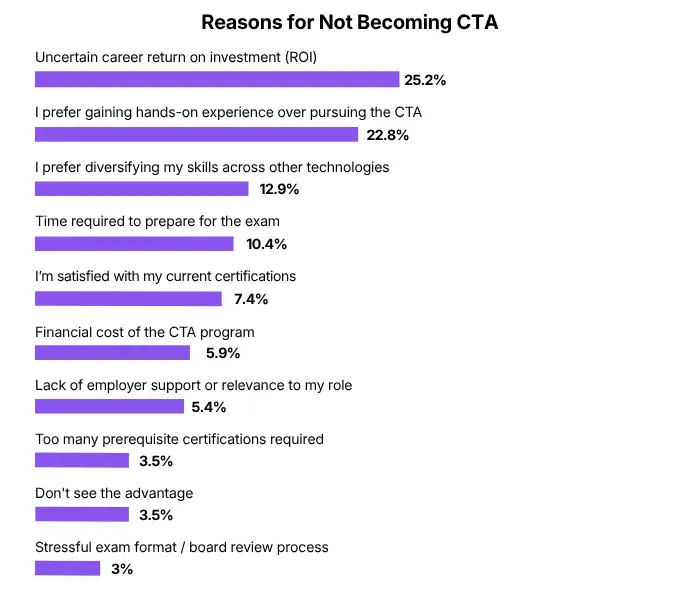
Interestingly, of those who weren’t planning on pursuing it, the largest reason given (by 25.2% of respondents) was that they were uncertain about the ROI of investing the time, energy, and cost of achieving the credential.
This is a debate that has raged on and that our team has kept a close eye on for a while now, and it’s not one with a definitive answer. Personally, I think it’s circumstantial as to what each individual’s priorities are in their careers.
Actionable Insight: As I said above, it’s a personal decision as to whether or not you should pursue the CTA credential yourself. The best thing you can do if you’re considering your next steps in the Salesforce space is to clearly understand what you will learn while preparing for it, and whether any future roles you’re considering have a requirement for it. Personally, I think one of the most valuable things that you can get from any Salesforce Certification is the skills and knowledge you develop while pursuing it.
9. A Majority of Salesforce Architects Question the Future of the Role
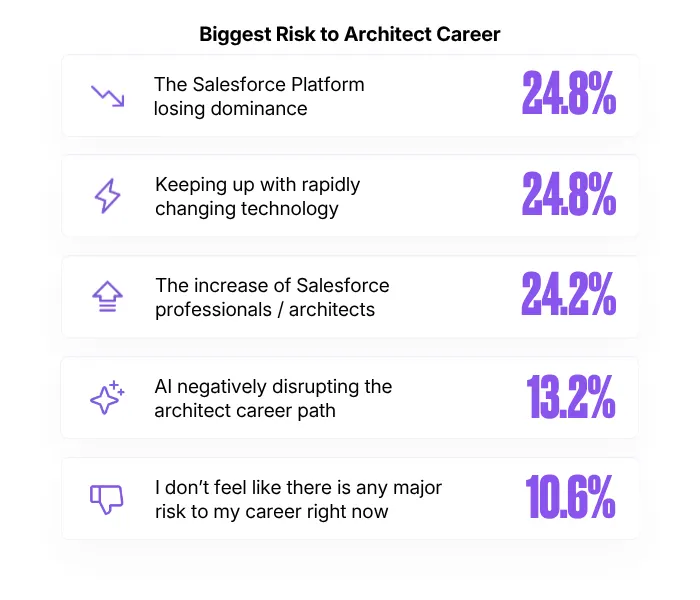
Salesforce Architects are not as confident as they once were about the future of their roles. This is a sentiment that is shared across the Salesforce space, and indeed across technology as a whole. We asked Salesforce Architects what they believed the biggest risk was for their architect careers, and the top three risks tied together perfectly: Salesforce platform losing dominance (24.8%), keeping up with tech changes (24.8%), and market saturation from more architects entering the field (24.2%).
This tells a clear story: Salesforce Architects are seeing a big shift in the space, with only 10.6% of respondents saying that they didn’t believe there was any risk at all. This group is in a significant minority. Interestingly, AI negatively disrupting their career path was only a concern with 13.2% of respondents. It appears that a vast majority of Salesforce don’t seem to fear AI itself as much as other pressures in the ecosystem.
Actionable Insight: Something else that I noticed was that Salesforce Architects were pragmatically focusing their learning – 41.9% said that they were learning new tools based on the needs of their current roles or projects. This would be the recommendation that I would give here as well. The tech space, Salesforce included, is evolving at a rate we haven’t seen before, and keeping on top of it all is not something that most architects can do. At any one time, try to keep on top of only a small number of news tools and trends, learning them deeply one at a time. Keep your finger on the pulse of what is happening, but don’t try to master too much at once.
10. Client-Side Is the Preferred Place to Be for Salesforce Architects
We asked Salesforce Architects what kind of company they worked for currently, and a majority came from either a consultancy (42%) or a customer (40%). That’s today. However, when asked about their preferences for where they’d like to work, a whopping 52.7% said they wanted to be client-side, vs only 12.3% who wanted to be in a consultancy.
There are so many assumptions that we could make as to why there’s a preference for client-side work as opposed to consulting, and only one that I’m willing to mention here, as there’s data that backs it up. Respondents showed concern about keeping up with rapidly changing technologies (24.8%). Given that consultancies need to become masters of many of these new clouds and tools, it can be a lot for consultants to keep up with, overwhelming even. Client-side Salesforce professionals still have a lot to keep their eyes on, but the scope is significantly smaller.
Actionable Insight: Consider your workload and the tools that you’re trying to stay on top of. Consider whether or not you feel as though you’re spread too thin, or if you’ve got the capacity and drive to take on more. Everyone is different in this sense, and only by truly understanding yourself and your own circumstances can you become the best Salesforce Architect you can be. The next step is to identify what opportunities are available to you and how they fit into your future career plan.
Final Thoughts
The evidence is clear – the Salesforce Architect role is changing, but in a very different way from other Salesforce roles. Architects are seeing a big shift in the Salesforce ecosystem, and are mastering other technologies in addition to core Salesforce.
The threat of AI replacement is minor, but its benefits are easily recognised by our respondents. Salesforce Architects expressed concern about the future of the role, but are taking steps to make themselves more skilled and effective across multiple areas in the face of these risks.
There’s a lot more where that came from! Download the full 2026 SF Ben Architect Survey Report to read more.