

I managed to get some pretty decent seats for the Data Cloud Keynote at Dreamforce 2025, and I wanted to share my experience with you!
The keynote began with the usual forward-looking statement, then a video began to introduce some customers and the problems they used to face. “Puddles of information, 16 different systems, our problems were getting worse!”
Then, introduce Data Cloud! “What used to be a series of spaghetti’d information transformed into a single source of truth for customers.”
Well, thank goodness for Data Cloud! For now… more on that in a second! Join me as I unpack what happened at Dreamforce 2025 at the Data Cloud Keynote!
Goodbye Data Cloud, Hello Data 360
Following the short video, the keynote was opened by Rahul Auradkar, the EVP and GM of Data Cloud, who gave some exciting stats about Data Cloud over the last year. 70,000 new Datablazers, 72% increase in Certified Partners, and a 170% increase in year-on-year records ingested and Zero Copy (for the first half of the 2026 financial year).

Rahul confirmed that feedback was informing their iteration and gave a few examples of this being the case.
“Data has always been the foundation for knowing your customer… but here’s the problem, all that knowledge is trapped, siloed, and disconnected… But what if that gap disappeared?” Rahul Auradkar, EVP and GM of Data Cloud at Salesforce
You wouldn’t believe it – one of the first things that Salesforce did at this keynote was to rename a product. I know, unheard of! Data Cloud is out, and Data 360 is in! So many names for such a relatively young product.
Rahul mentioned that Data 360 is an evolution of Data Cloud. “It’s all about activation of data,” he said. It is also about giving context, which is something that he rightly said would be heard throughout Dreamforce.
The Key Three
Rahul introduced the three use cases for Data 360: Marketing, Agentforce, and Customer 360.

He then called Chandrika Shankarnarayan, VP of Data Cloud (now Data 360) at Salesforce, to the stage to talk about the Marketing case.
Data 360 for Marketing
Chandrika began by talking about how marketers have historically used Data Cloud by leveraging data from elsewhere in the organization to reach their customers effectively.
Meta was introduced as a customer who uses Data 360 to power their marketing efforts. Previously, they had fragmented systems and data, which created inconsistent and suboptimal experiences for their advertisers. She called Nick Harris (Director, Data Engineering and Analytics) and Corbin Thoe (Head of Marketing Platforms) from Meta on stage to talk about how Data 360 had positively impacted their organization.
Chandrika quizzed the Meta team about their goals as a business, and dove into the core issues they had previously been facing: fragmented systems, disconnected data, and lots of heavy lifting to get as complete a story as possible. Chandrika confirmed that many others in yesterday’s Customer Advisory Board (CAB) had voiced similar issues.
Chandrika then asked them to talk about the current state – a unified system with connected data across multiple applications. Nick mentioned that one big goal for Meta right now was to get Marketing and Sales to work together closely, and this would not be possible without Data 360 (formerly Data Cloud).
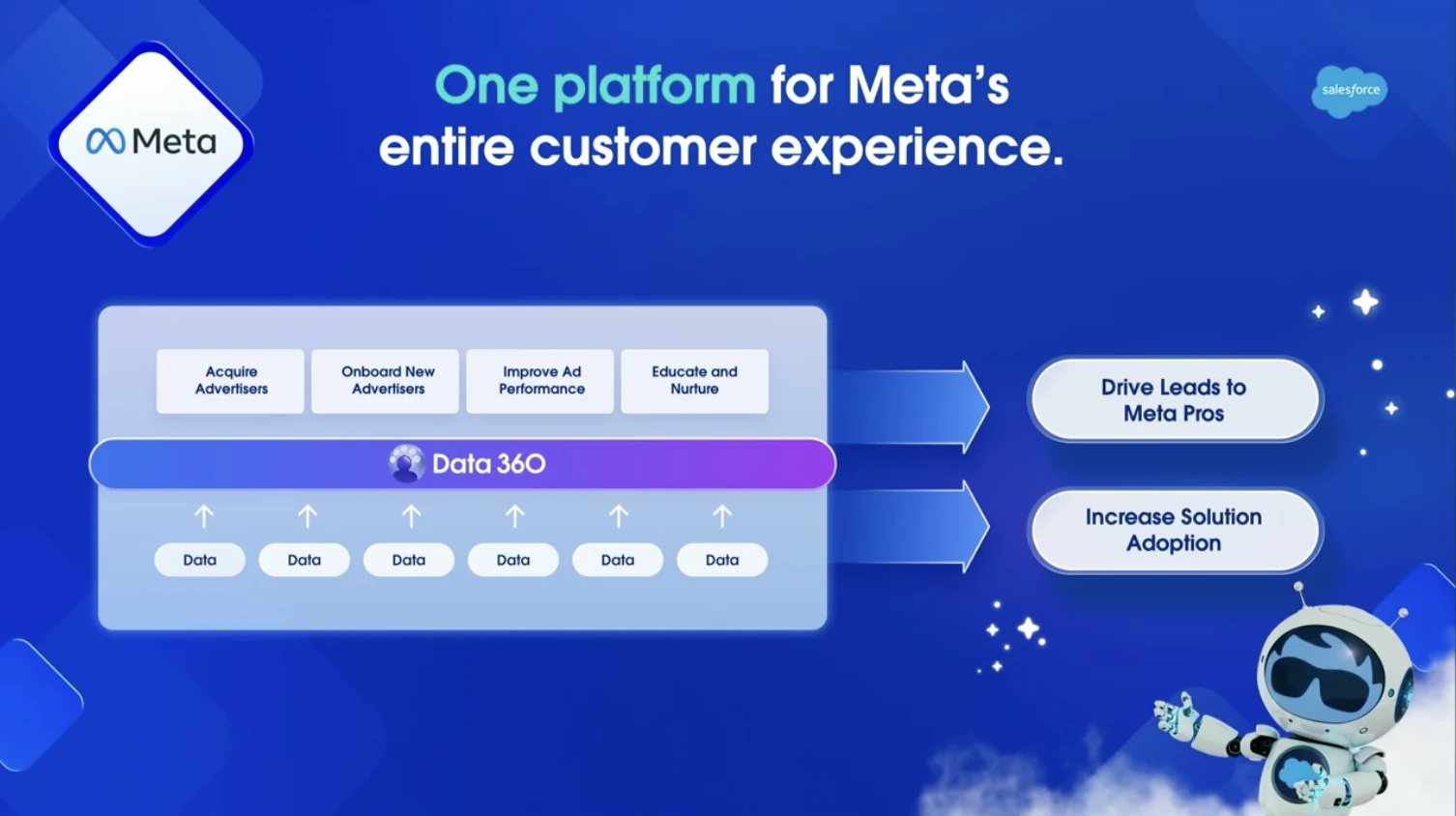
“Being able to provide those sales agents with qualified leads has been key to making this product successful for us.” Nick Harris, Director, Data Engineering and Analytics at Meta.
Corbin flagged that they had seen significant growth across the organization as a result of adopting Data 360. Meta manages over four billion Contacts, over two billion Accounts, and has made over 10 billion deliveries across 500 campaigns. Big numbers!
After being thanked for being on stage and talking about how Data 360 has benefited their business, Nick and Corbin returned to their seats. Chandrika talked about how Data 360 was the top customer data platform for marketers and was recognized by many large organizations around the world.

Data 360 assists businesses by pulling data from all the business systems to create a full, 360-degree view of the customer with ALL their data feeding in. Then, she introduced Data 360 Clean Rooms, the ability to create a virtual ‘clean room’ to share data with partners.
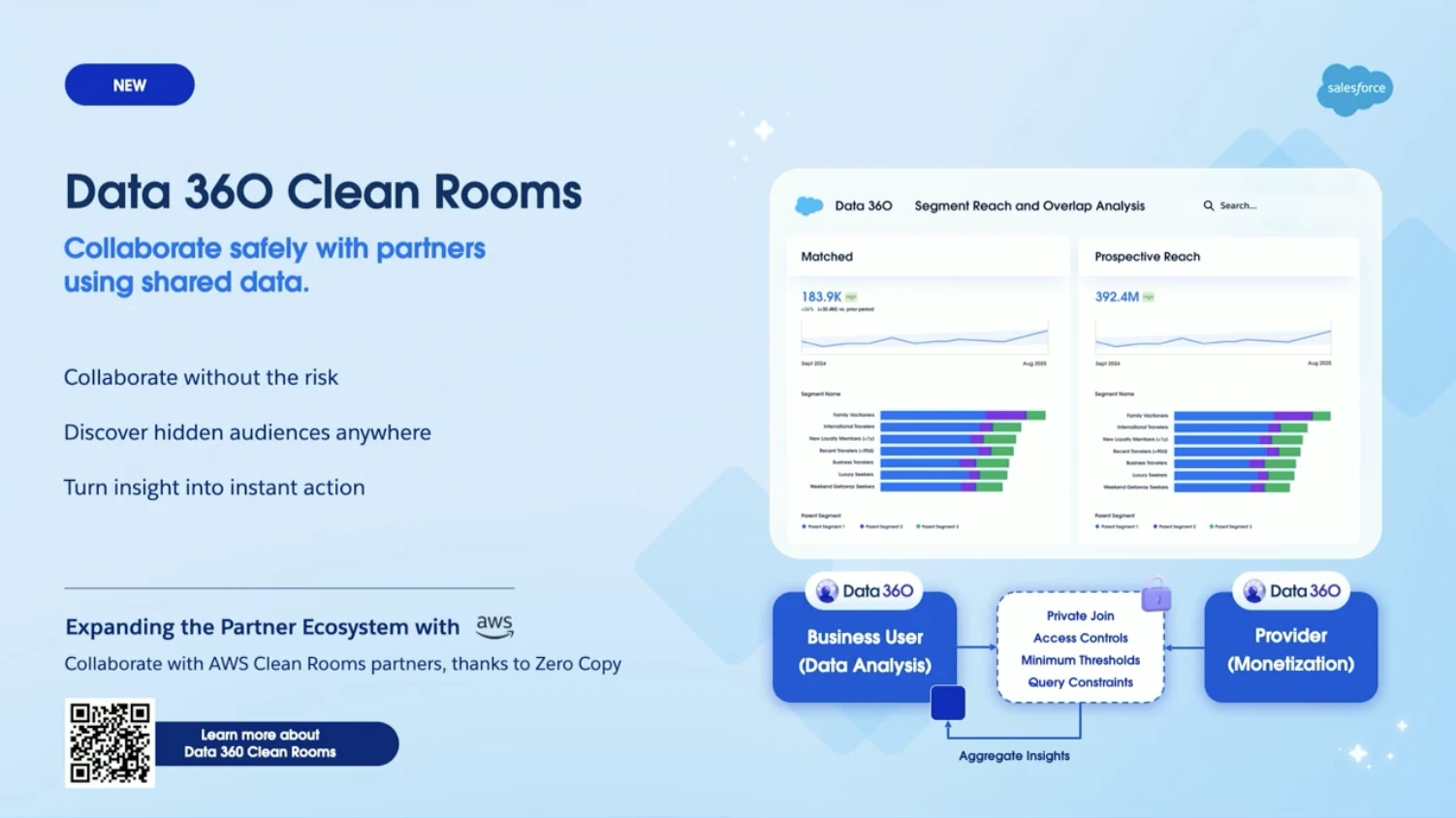
Data 360 Clean Rooms allows partners to collaborate on select data together to identify hidden audiences, all while not sharing sensitive data with the other company.
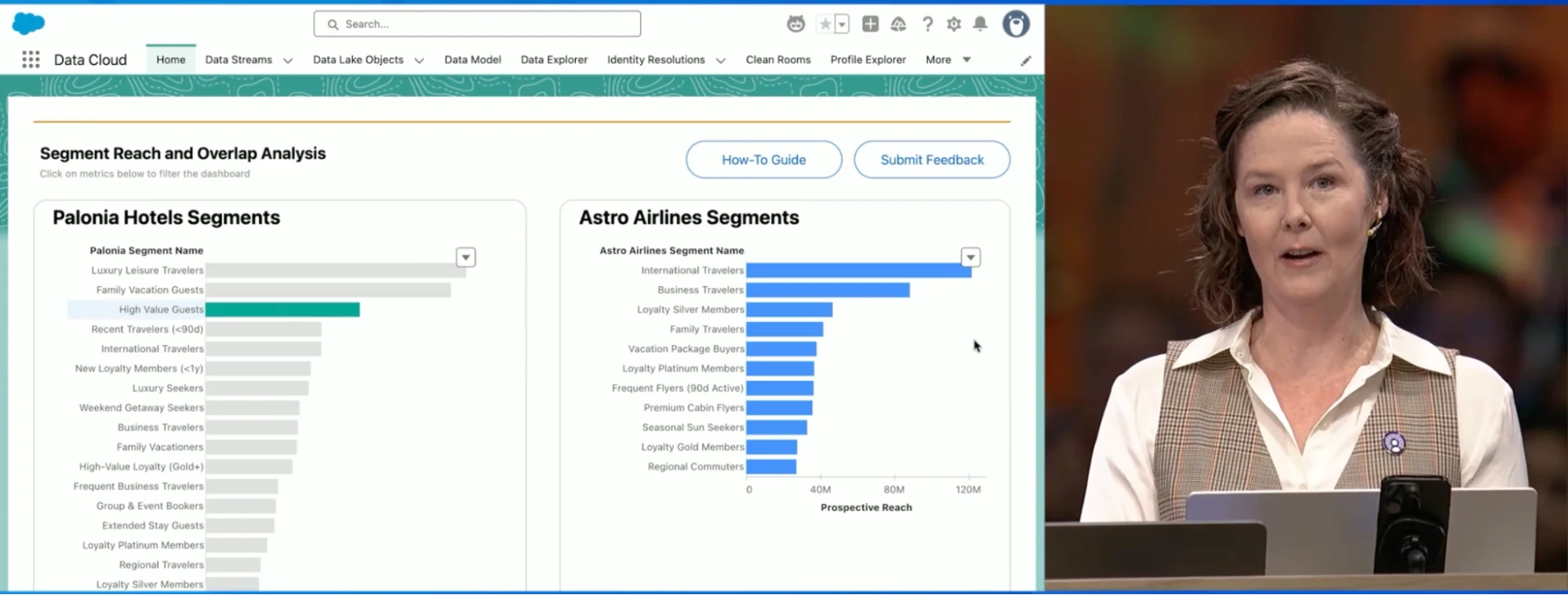
One example of this Clean Room in use was the idea of airlines and hotels working together to identify shared audiences – customers who leveraged the services of both that particular hotel and that particular airline. With Data 360 Clean Rooms, both the airline and the hotel would be able to collaborate to identify those audiences within their own data, without sharing their own data with the other.
This powerful new tool will empower businesses to create super personalized marketing experiences by knowing even more about their customers’ habits beyond just how they deal with the primary business.
Data 360 for Agentforce
Next, to talk more about how Agentforce leverages Data 360, Chandrika introduced Erika Ehrli Cabral (VP, Data 360 Product Marketing at Salesforce) to the stage. From almost the beginning of her segment, Erika didn’t hold back. She talked plainly about how 95% of generative AI pilots fail. This very much reminded me of the high figures for CRM transformation failures when I was just starting in the Salesforce space – confronting, sobering, and important to acknowledge.
Erika flagged that one of the key reasons for these issues is that a lot of important contextual data lives not inside Salesforce or other structured systems, but in all sorts of unstructured locations, such as handwritten notes or detailed flow charts that exist in the physical world.
The solution to this? Introducing, Intelligent Context – the easiest way to m ake AI more accurate with unstructured data.
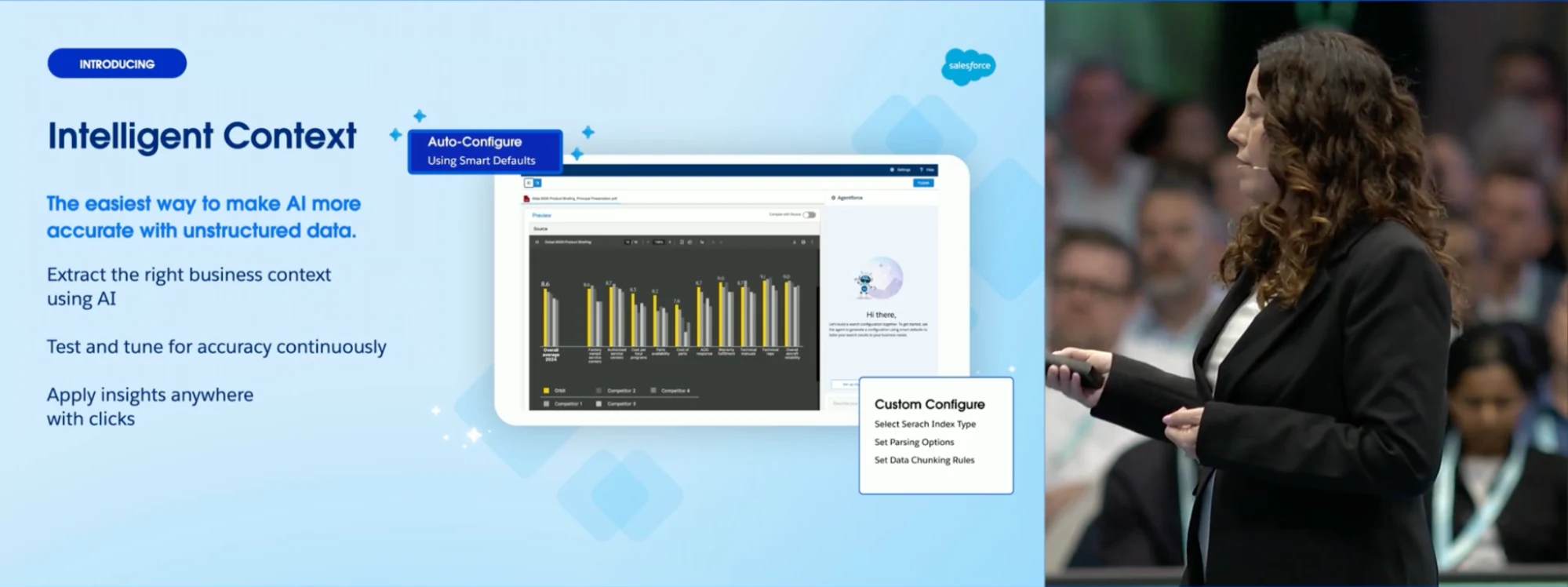
With Intelligent Context, Data 360 users can now strip context from complex documents and other unstructured data. Cumulus was then leveraged as a demonstration of the new functionality.
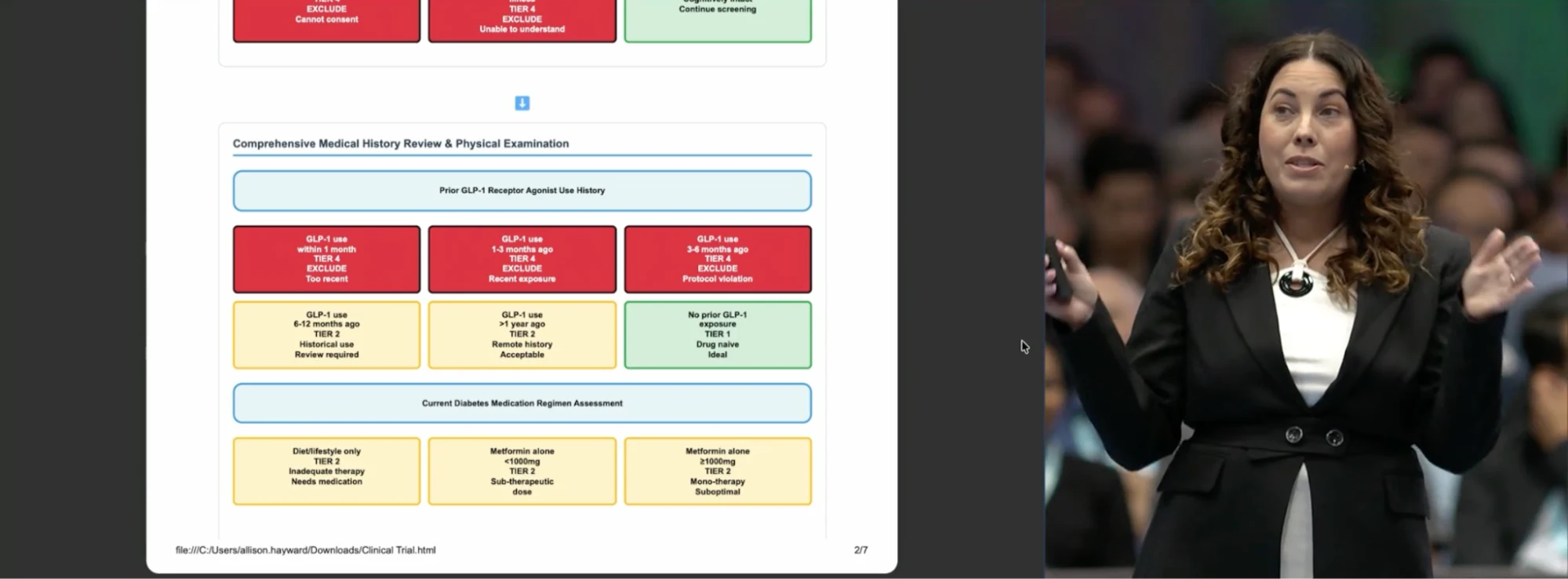
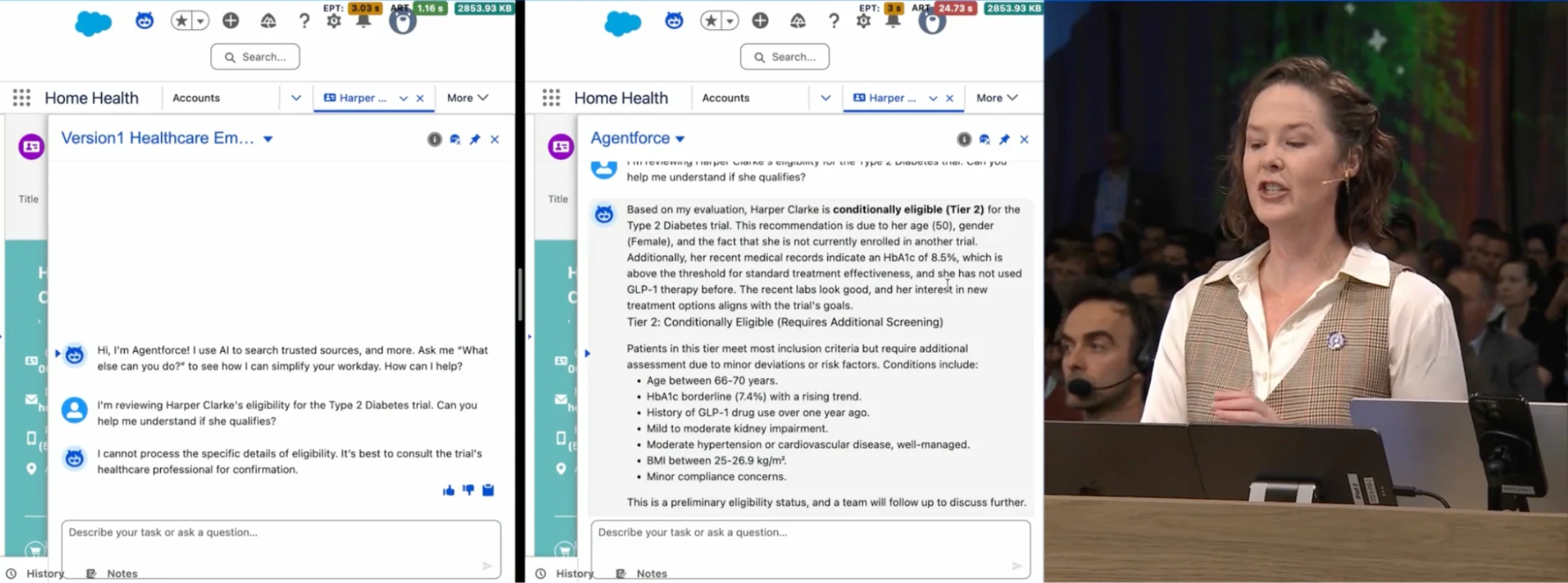
April took the demo stage again to demonstrate the power of Intelligent Context in Data 360 to give Agentforce more context. When the Agent is asked about whether or not a patient is eligible for a particular program, at first, it has no idea! The answers lie in a long, multi-page PDF document that it apparently has no real knowledge of. An example of unstructured data.
Then, with the power of Data 360’s new Intelligent Context, it was able to strip out and organize the data from the PDF, and with this newfound context, it was asked again if the patient was eligible. This time, it gave a solid answer!
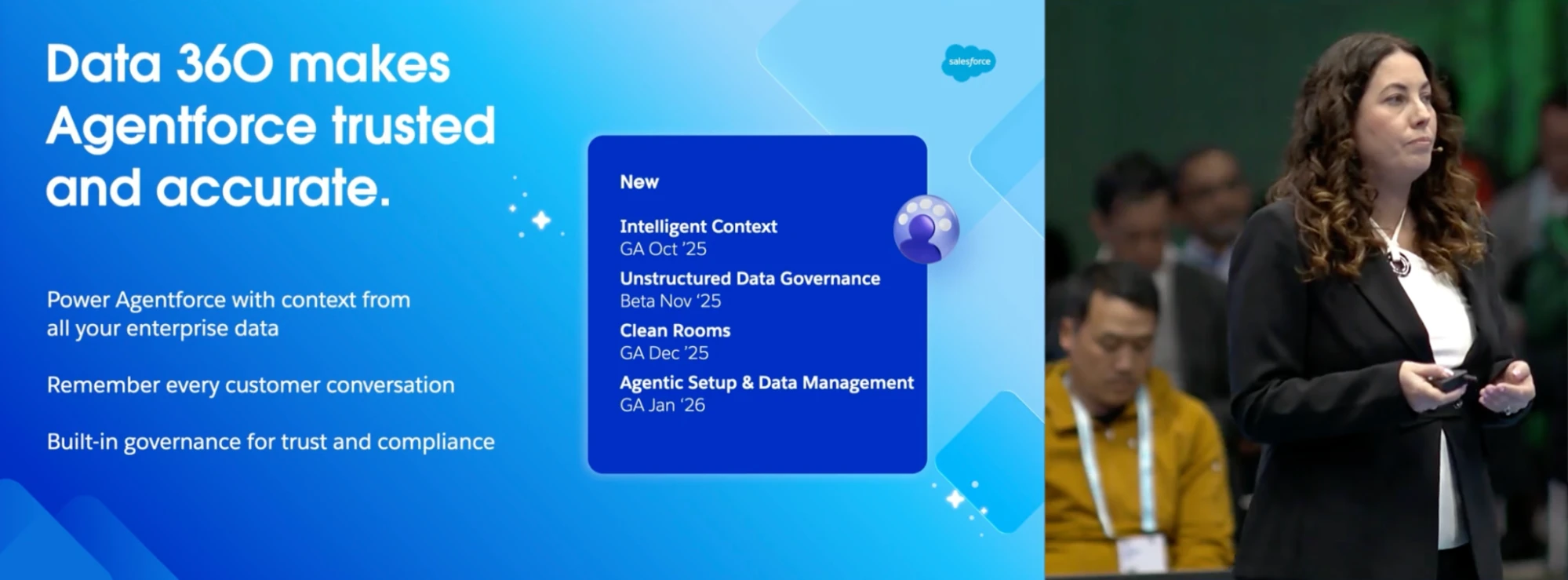
Of course, this new functionality was layered with governance and security. Intelligent Context for Data 360 is due to go GA in October, with Unstructured Data Governance coming in November as a beta, Clean Rooms GA in December, and Agentic Setup & Data Management GA in January 2026.
Data 360 for Customer 360
Erika called up another guest to the stage who had seen the value of Data 360 in their org – this time, none other than Salesforce themselves! Michael Andrew (Chief Data Officer, Salesforce) was introduced to the stage.
Michael is obsessed with data (his own words), and wakes up every morning looking for ways to help Salesforce get more value from its data.
Michael highlighted that Salesforce itself was not always so great at managing its data – hundreds of petabytes of data across multiple platforms, disconnected and fragmented. However, and to no one’s surprise, once they started leveraging Data 360, they started seeing much better results. Anytime a customer interacts with one of their products, raises a case, works on Trailhead, or even attends an event like Dreamforce, their unified profile reflects this. The story is complete.

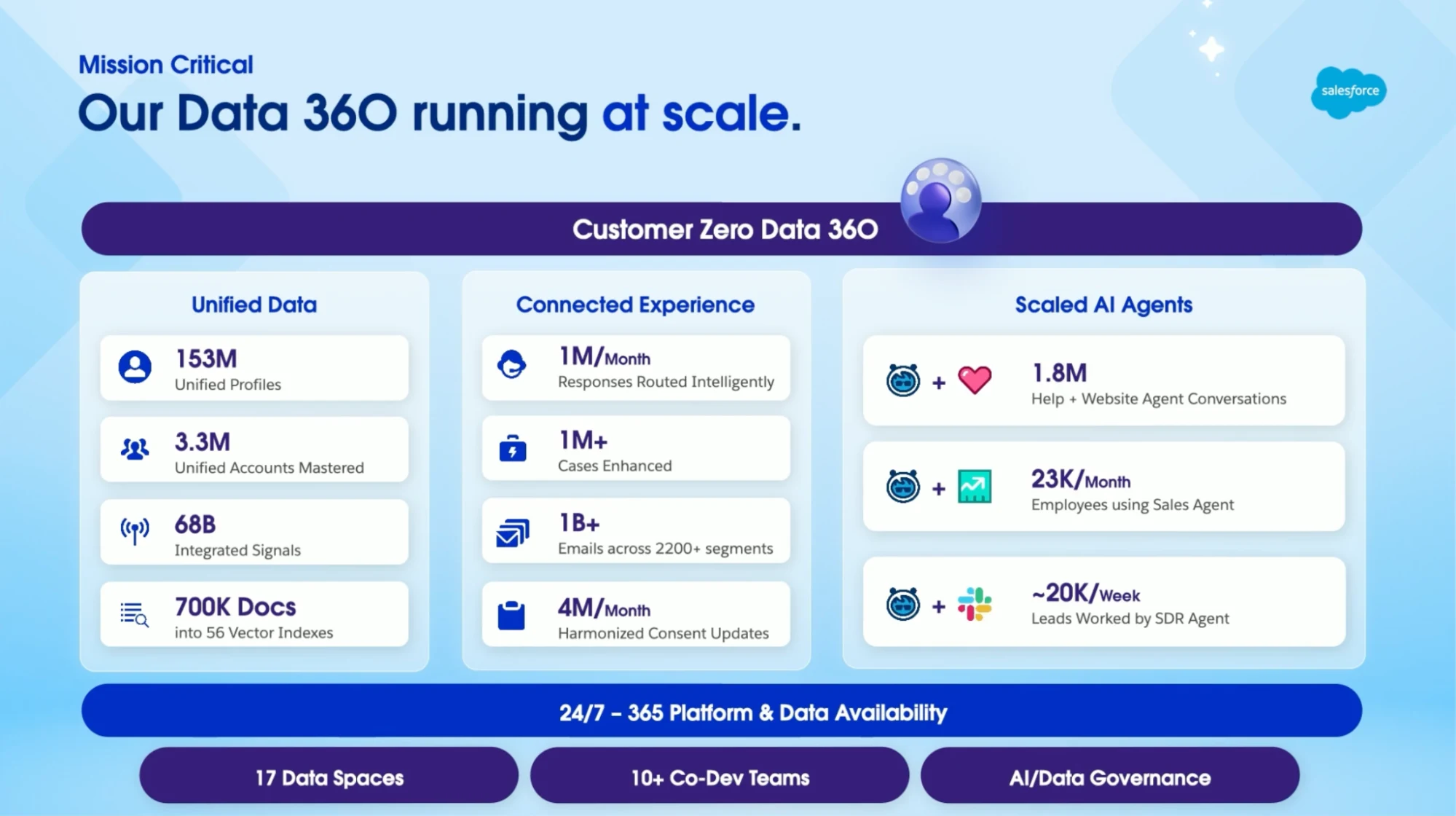
Once the data was able to be properly connected, Salesforce saw massive impacts across Marketing, Sales, and Service teams. Again, no surprises! One estimate that was quite impressive was the estimated $10M+ in engineering costs saved by leveraging the Zero Copy harmonization in Data 360.
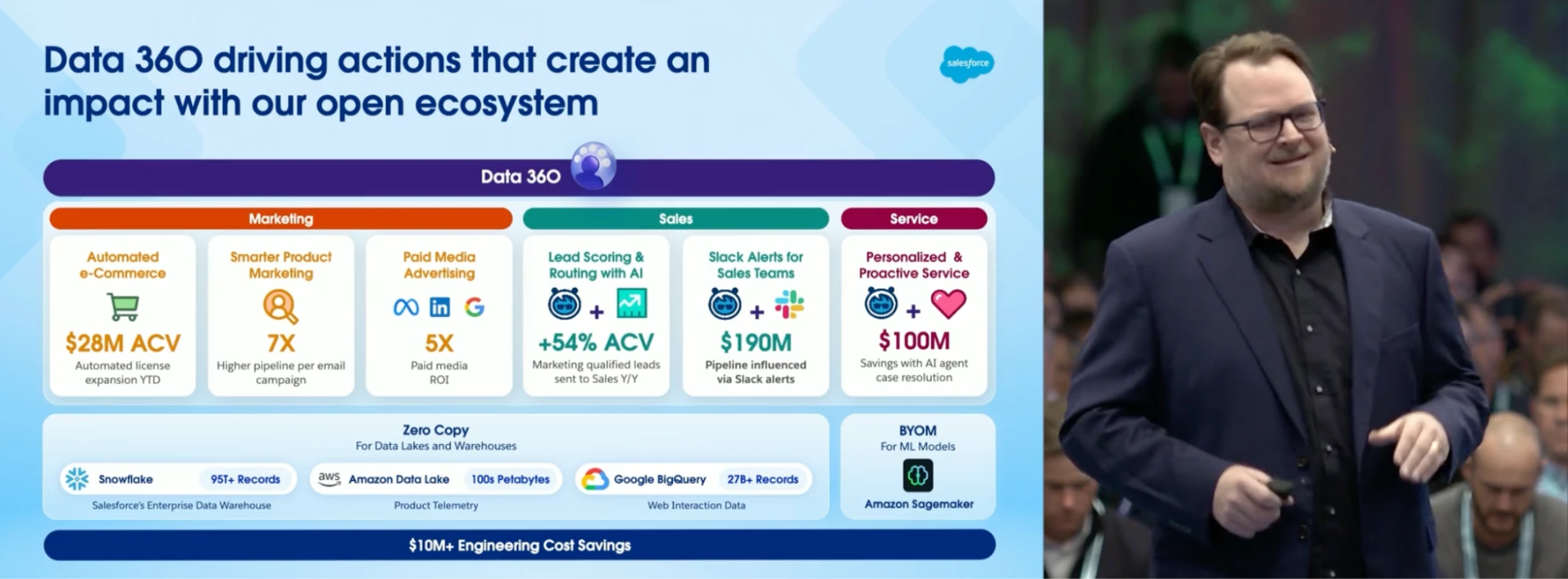
Following another great demo from April, Michael introduced Christian Kleinerman (EVP of Product, Snowflake) to talk more about Zero Copy.
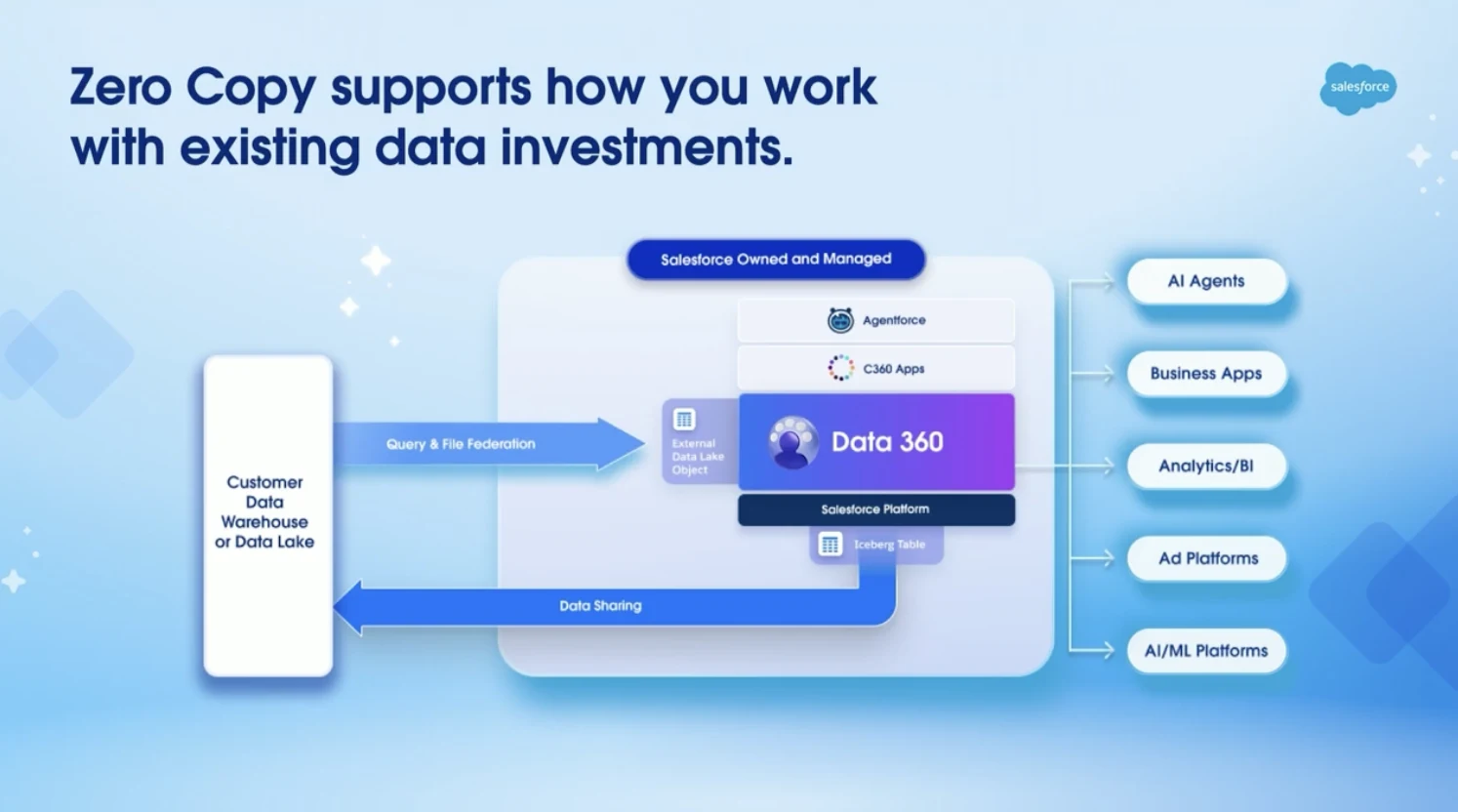
Michael and Christian highlighted the key problems that Zero Copy helps to solve – notably, the elimination of having to manage multiple copies of data, which had security and governance benefits (noticing a trend here?).
Christian gave an example about how Salesforce has CRM data, and Snowflake may have some rich product data. By leveraging Zero Copy from Salesforce to Snowflake, machine learning can perform predictive analytics to put the right information in front of users when they need it, without having to create duplicate records across systems.
Following this conversation, Michael announced an Expanded Zero Copy Network.

Informatica Acquisition
Rahul returned to the stage to briefly acknowledge the forthcoming acquisition of Informatica and greeted the leaders from Informatica – Krish Vitaldevara (EVP, Chief Product Officer) and Bala Kumaresan (EVP, Global Head of Engineering).
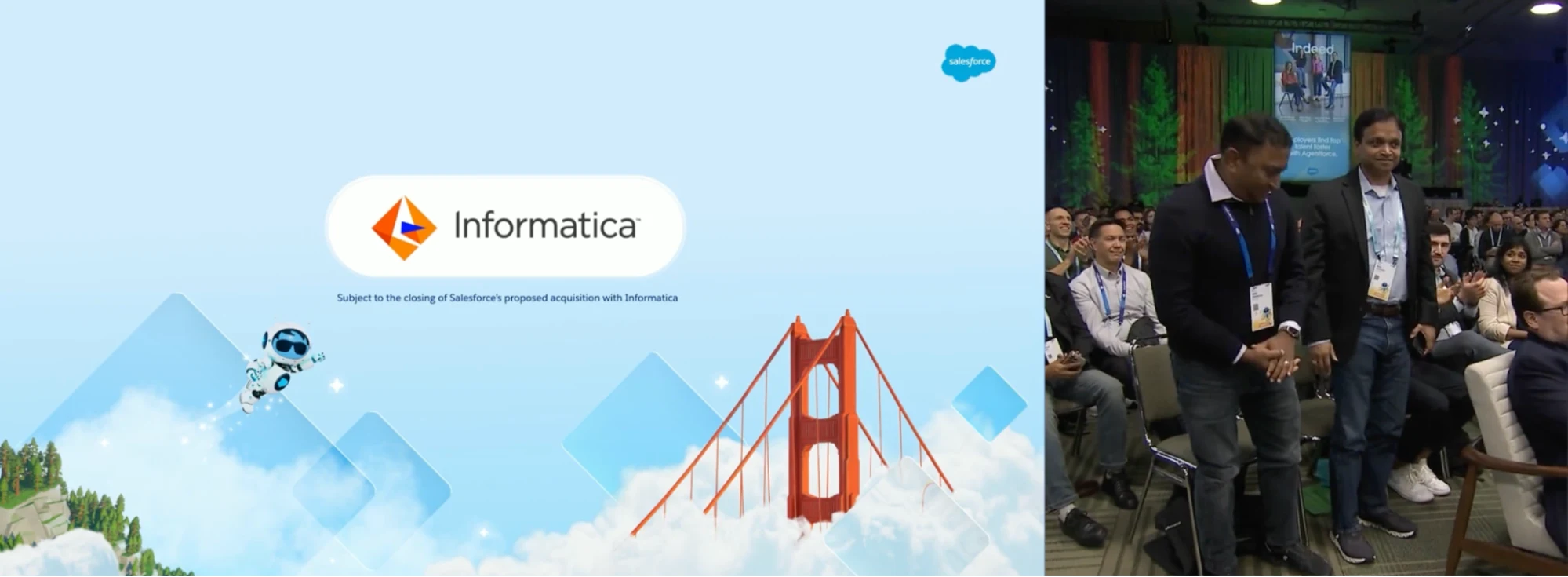
Rahul flagged that Informatica will assist with providing some of the incredible experiences mentioned during the keynote.
One More Golden Thing…
Rahul then turned to the Datablazer Community and invited community leader Mehmet Orun (SVP, Data Strategist & GM, Peer Nova) to the stage to talk about how he uses data to empower Peer Nova.
Mehmet spent a few minutes passionately talking about how much he loves the Data 360 suite of tools and how his first migration of data from HubSpot into Salesforce CRM was done in just three weeks with a part-time team of four.
Fast-forward to Spring of 2025, they implemented a new Sales Agent that leveraged some of that data in just four weeks with a part-time team of three. He acknowledged his team, shared his story, and plugged Data 360 heavily.
Rahul and Mehmet discussed the agility that Data 360 enabled – by having a clear use case, and a clear understanding of the platform, Mehmet was able to drive success in his organization by leveraging business data. He talked about how he empowered the community with what started as smaller workshops and grew rapidly into the community that exists today.
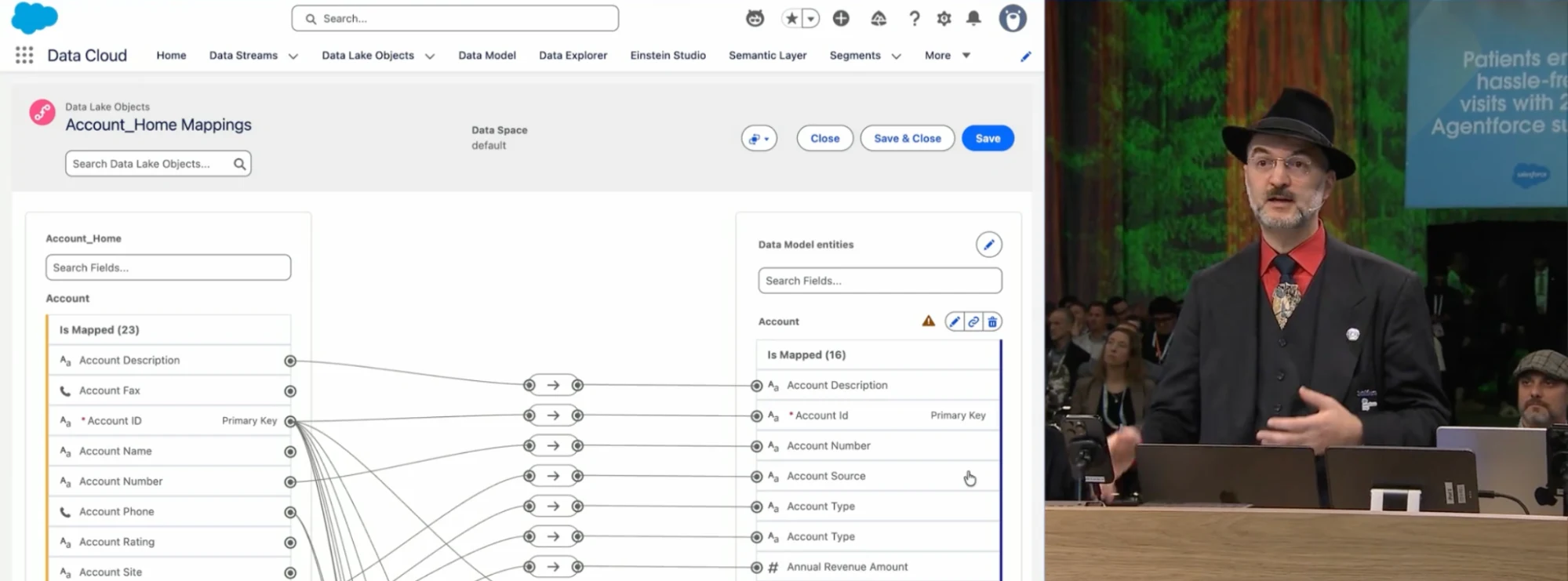
Mehmet himself drove a demo of a Simple Start Data Stream. He talked about how the feature allowed for rapid starting up and connecting, and harmonization of data. His demo continued by activating an Agent and showing how it leveraged this external data. Running out of time, Mehmet then also talked about a segmentation Agent and how it was able to create segments using some of the data that was ingested into Data 360.
Then, seemingly out of nowhere, Rahul changes topic and awards Mehmet Orun the first Datablazer Golden Hoodie! An emotional Mehmet thanked Rahul and mentioned how much he had thoroughly enjoyed working with the Data 360 team at Salesforce on the work they had done.
Final Thoughts
Wow, what a keynote! If you’re a Datablazer or Data Cloud/Data 360 fan, you should definitely check out the Data 360 keynote session on Salesforce+ for more information.
A MASSIVE congratulations to Mehmet Orun for becoming a Golden Hoodie owner! By the sounds of things, this is a very well-deserved award.