






This year’s True to the Core session was always going to be a little tense. Although many Trailblazers who stepped up to the mic offered genuine praise for Salesforce, the topics of discussion hit many people in the audience and watching worldwide very close to home.
Topics included Salesforce’s accessibility, security concerns, and persistent confusion over the company’s habit of renaming. Here’s what you need to know.
Key Highlights From True to the Core
This time around, Salesforce highlighted that it had delivered more than 445 ideas in the past 18 months, compared to the 365+ ideas it said it had delivered in the past year at TDX in April. Interestingly, Salesforce said it had also delivered over 1000 idea updates from Project Managers in the past year, although at TDX this figure was over 2,000.
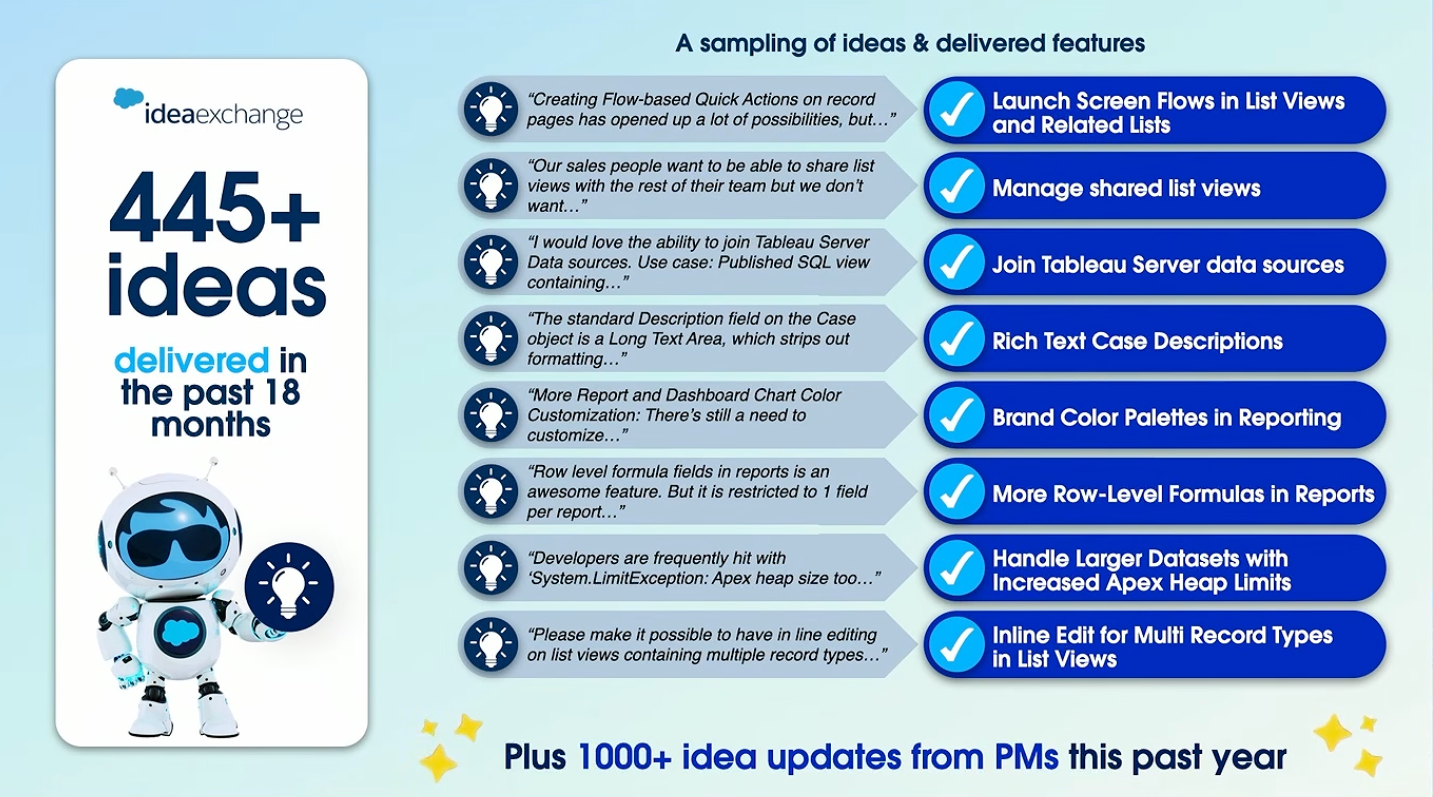
That being said, the delivered ideas were still significant. These include:
- The ability to launch Screen Flows in List Views and Related Lists.
- The ability to manage shared List Views.
- The ability to join Tableau Server data sources.
- The introduction of Rich Text Case Descriptions.
- The introduction of brand new color palettes in reporting.
- More row-level formulas in reports.
- The ability to handle larger datasets with increased Apex Heap Limits.
- The introduction of Inline Edit for multi-record types in List Views.
‘60% Say AI Skills Are The Biggest New Gap’
Although this year’s Dreamforce was packed to the brim with AI announcements, it was clear that the community still wasn’t as up to speed with AI skills as they needed or wanted to be.
Meredith Brown, the SVP of Trailhead and Community at Salesforce, highlighted an important statistic that came out of customer and community engagement over the last year: over half of respondents said that AI skills are the “biggest new gap”.
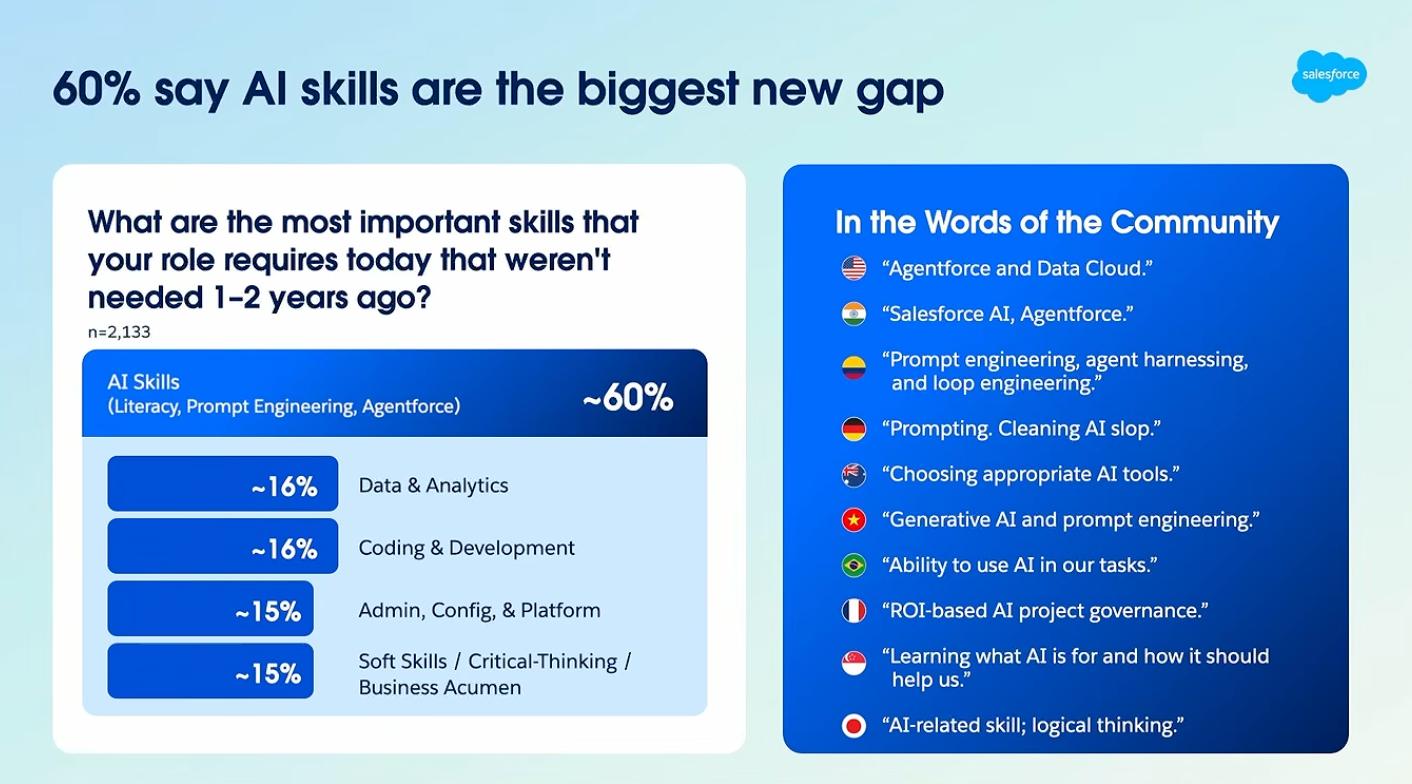
“60% of you said that the most important skill is around your AI skills,” she said.
This should be one of the most important data points for Salesforce. Its customers and its community recognize the importance of AI skills – especially as the pace of innovation speeds up – but have they got all the resources they need to close that gap?
Solving the IdeaExchange’s Stagnation… With Claude?
If you needed any more clarification as to where Salesforce’s loyalties lie, then True to the Core should have finished the job.
As it does in almost every TTTC session, the IdeaExchange was brought up – particularly the IdeaExchange ideas that had been there for a decade or longer, untouched. In a bizarre turn of events, this led to a live demo of Claudeforce sorting through these ideas, revealing that 43% of 10+-year-old ideas still got upvotes in the last year.
The promotion, admittedly, felt a little out of place and almost out of touch initially. This particular gripe was not a new one, and it almost felt like Salesforce was chucking a new AI tool at it in the hopes that it would stick. However, a Claudeforce Product Manager in charge of the demo made a commitment that, if followed through, could finally put this query to rest.
“We’re going to look at this backlog,” she said. “We’re going to go through the 10+ year ones that we have, and we’re going to process all of them. And we’re going to either close them out and tell you exactly why we’re closing them out, or we’re going to put them on the roadmap in the next year.
“By TDX, we’ll have [closed] the 10+ year ones.”
“How Are You Measuring Whether The Benefit Outweighs The Confusion?”
When a commenter on Salesforce+ asked this question, I knew it was one that many people in the room and beyond had been thinking about.
The question was: “Salesforce has changed the names of so many products and capabilities that it is becoming difficult for customers to understand what they actually own and which documentation applies to them. What customer problem is being solved by the frequency of these renames, and how are you measuring whether the benefit outweighs the confusion?”
Everyone knows Salesforce has a renaming problem – you know, I know, and Salesforce knows too. Patrick Stokes, the President of Applications and Marketing at Salesforce, responded candidly, saying, “This drives us nuts too, if we’re being honest,” explaining that renames are meant to signal “what’s new” but that teams “overindex on it” and try to update everything, causing inconsistency.
“We like to put some sort of word either at the front or the back of [a product or tool name] that implies what’s new about it,” he explained. “It’s all about making it seem like it is a new version.”
“They’re a moment in time. They’re meant to communicate what’s new, but they’re not actually real changes in the products where we’re going to go and update the header and the website and all of these things.”
So, when you see the next version of Agentforce, for example – whether that be Agentforce 4, AgentClaude 360, or ClaudeAgentForce 4.0 – keep this in mind.
Challenging Salesforce’s Accessibility
What I liked particularly about this session was that it put the spotlight on Salesforce’s accessibility commitments and challenges. We got to hear from Andrew Johnson, a blind Trailblazer and Salesforce Project Lead Apprentice at the Blind Institute for Technology, Mario Essig, a deaf Trailblazer and Founder of Salesforce Consultancy GeekPanda, and Katie Villanueva, a Golden Hoodie recipient and a member of the Latino community.
Andrew’s question centered around his struggles with Salesforce that had come about due to rollouts and updates that had caused regressions in the platform. It had turned a platform that was, in his words, “so accessible” into one that was now presenting him with challenges.
“Is Salesforce still committed to making the UI a place where people like me can do real work?” he asked.
Thankfully, Bonnie Parisi, who leads Salesforce’s product accessibility team, confirmed that accessibility is the core mission of her team and that Salesforce is “deeply committed” to it. She added that they would try to find ways to use AI in Salesforce’s own development lifecycle to catch accessibility regressions before they ship, rather than after the fact.
Mario drew attention to the growth of Salesforce’s community and their accessibility struggles with AI. “English is not sign language and sign language is not English,” he said. “It is a visual language.”
“How is Salesforce planning to make products completely headless for the deaf community, where individuals can interact with AI in their native sign languages?” he asked.
The answers to Mario’s question were less concrete, but Salesforce did promise to look into it. Patrick implied Salesforce might loop in outside AI partners like Anthropic and OpenAI rather than solve it alone.
Lastly, Katie explained that out of 1922 Trailhead badges in English, only 583 of them (around 30%) are also available in Spanish. Salesforce has had a substantial Spanish-speaking customer and community base for years, which Katie took the time to represent in this session.
“How do we support the individuals who are carrying your product forward in other countries and helping them get all those certifications that you put on there?” she asked. “It is hard to learn Salesforce in native languages with technology going so fast.”
Meredith commended Katie for doing her homework and pointed out that Salesforce launched an MCP server for Trailhead and has been working closely with localization teams because, while technology can help scale content translation, it still needs to actually work for local markets.
She agreed the coverage should be higher, said she believed Salesforce has the technology to increase it “beyond 30%,” and invited Katie to find her at TDX to keep pushing on it.
“The Elephant In The Room” Security Question
The topic of security in Salesforce has been a hot one this year. With confusion and frustration over shifting rollouts and growing concerns over cyberattacks, the Salesforce security team has been busy. It’s also safe to say that the road up to this point has not been smooth.
That’s probably why, when a question from the online audience came in asking how Salesforce was going to “improve the planning and communication of security rollouts” in the future, the room burst into applause.
“Wow, that might have been the elephant in the room,” Joy Shutters-Helbing, the session’s moderator, joked.
Jay Hurst, the Senior Vice President of Product Management at Salesforce, acknowledged it had been “a challenging year,” citing MFA, per-user MFA, and step-up auth changes as examples. He explained Salesforce had to move fast because of an increase in threat actors targeting customers, and admitted the rollout “wasn’t smooth.”
Going forward, he outlined three concrete changes: a new dedicated section in release notes specifically for security control changes, the ability for customers to opt in to pre-testing these changes ahead of enforcement, clearer visibility into exactly when a given rollout will hit a customer’s specific instance, and addressing what he called the previous “scattershot” rollout pattern.
Final Thoughts
As always, there were so many takeaways from this year’s True to the Core that it would be impossible to include all of them in just one article. If you would like to listen to the whole session and see what else was discussed, you can do so here on Salesforce+.





Comments: