






A developer has used Anthropic’s Claude Opus 5.5 to recreate seven of Adobe’s best-known Creative Cloud applications and released the results for free as open-source software.
The project, called Artcraft, includes alternatives to Photoshop, Illustrator, Premiere, Lightroom, After Effects, InDesign, and Acrobat Pro. The apps are still in a very early alpha stage, but their arrival is feeding into a much bigger question being asked across the software industry throughout 2026 – just how much easier is AI making it to recreate established SaaS products?
What We Know About Artcraft
Artcraft was created by software developer Brandon Thomas, who says he used Claude Opus 5.5 alongside the Rust programming language to build what he describes as “clean-room” replacements for Adobe’s software.
The individual apps are called Photocraft, Vectorcraft, Filmcraft, Lightcraft, Effectcraft, Designcraft, and Printcraft, covering much of the same territory as Adobe’s most notable products.
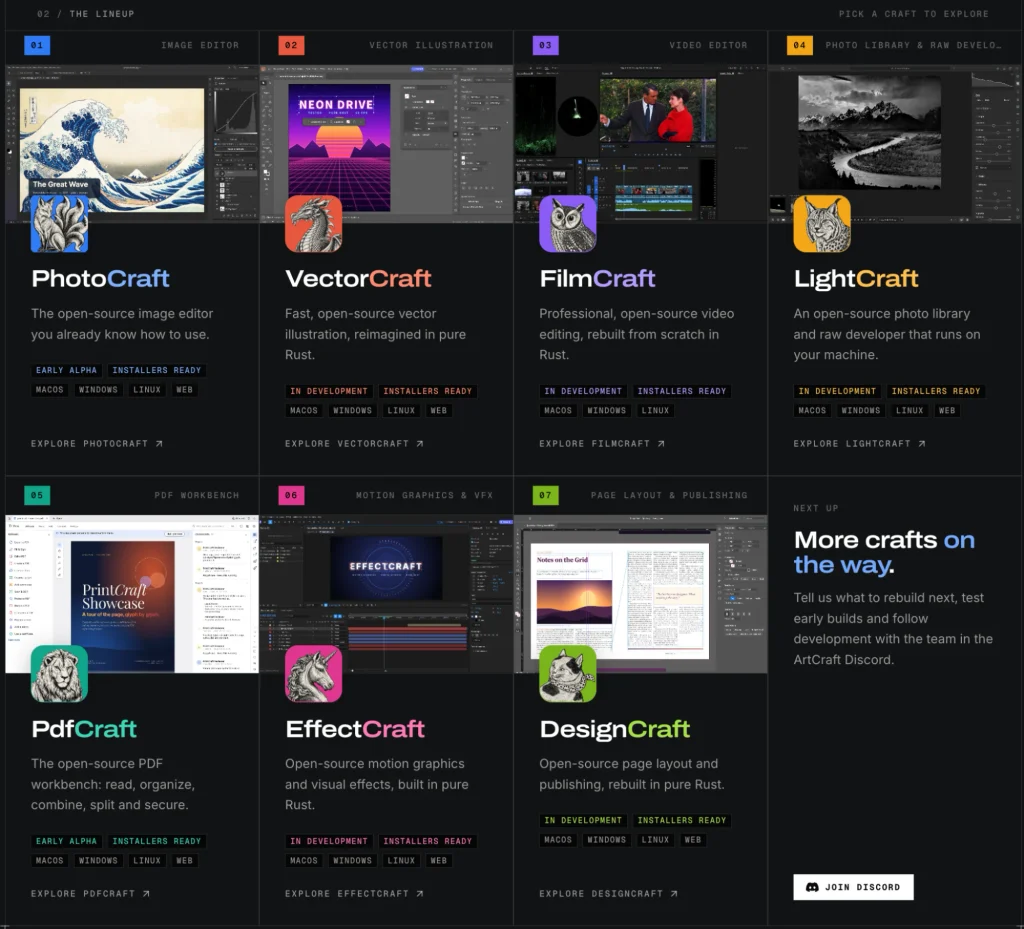
The team built these in Rust, a programming language known for performance and resource efficiency. Some users have already pointed out the relatively small install footprint for certain Artcraft apps, although it’s likely too early to draw conclusions about real-world performance or feature completeness.
Also, these apps are a lot more than just interface mock-ups. The applications can be downloaded and used, while browser-based versions are also available. Thomas has made some extremely ambitious claims about where the project is heading, including plans to reach near-total feature parity with Adobe’s products within months rather than years. This, of course, remains a very big claim to live up to.
Thomas has also been clear that the software is still in its early stages, describing the applications as “super early alpha” and acknowledging that they are nowhere near finished. Early users have already reported issues ranging from Filmcraft crashes when handling larger video sequences to problems displaying MXF files correctly. Effectcraft users have also highlighted missing or incomplete functionality around shapes, expressions, and LUTs.
Still, the immediate similarity to Adobe’s software is instantly noticeable. I downloaded and played around with Photocraft briefly, and the interface looks clean and very familiar, with many of the tools sitting roughly where an experienced Photoshop user would expect to find them.
Others have used the tools more extensively, and it seems that the possibilities are limitless. Developers are experimenting with everything from putting Minecraft mechanics into Elden Ring and Skate-style movement into Call of Duty, to recreating Mario-style platformers and other full 3D games with heavy AI assistance.
The next step is whether Artcraft can move from an impressive and enjoyable alpha to something professionals can genuinely use day-to-day. But the fact that these applications exist at all means we’re moving further away from vibe coding as a speculative conversation.
Why This Matters to Salesforce
The obvious question for Salesforce readers is what any of this has to do with CRM software. The link is the so-called “SaaSpocalyse” – the idea that as AI tools grow more capable, it could make it easier for companies to build their own software or use free tools rather than paying for established SaaS products.
Throughout 2026, that argument has fuelled plenty of speculation around companies like Salesforce, and whether the growth of AI-assisted development poses a real risk to adoption.
What Artcraft has achieved doesn’t instantly mean the likes of Salesforce, Adobe, or any other major software company is about to be replaced, but it does provide a more tangible example of the trend behind those concerns.
Until now, much of the SaaSpocalypse discussion has been theoretical, or focused on relatively simple applications. Adobe’s products are mature, complex, and deeply embedded in professional workflows. The fact that one developer has been able to produce recognizable alternatives with heavy assistance from AI is therefore noteworthy.
For Salesforce, the bigger question may not be whether customers can recreate the entire platform, but whether AI could reduce the cost and effort required to build alternatives to specific parts of it.
Final Thoughts
There’s also some important context around why Adobe makes such an interesting target for a project like this. The company hasn’t exactly enjoyed universal goodwill from its customers in recent years, with frustration around subscription pricing and cancellation fees eventually contributing to a $150M legal settlement over its subscription practices. In more blunt words, plenty of Adobe users already have reasons to look elsewhere.
That arguably makes this a slightly different proposition from Salesforce. Replacing a CRM that sits at the center of a company’s entire workflow comes with an enormous amount of friction. Adobe has a substantial moat of its own, but for an individual creative deciding whether they really need another Creative Cloud subscription, the hurdle is much lower.
For the most part, I still wouldn’t be rushing to vibe code replacements for established software. Reliability, security, maintenance, and long-term support matter enormously.
But if AI can help produce something that looks this convincing, this quickly, at exactly the moment customers are looking for alternatives, it feels increasingly difficult to dismiss the SaaSpocalypse conversation altogether.



Comments: