


Dreamforce 2025 gave us many big moments. But during the Dreamforce Marketing Keynote, the one moment that marked more than a product announcement – it represented a mindset shift for the entire industry.
With the renaming of Marketing Cloud to Agentforce Marketing, the announcement wasn’t just a new name. It was the first major step into 2026 – the year in which businesses will fully embrace an AI-driven future.
The challenge today isn’t about adopting AI; it’s about understanding how AI reshapes customer engagement, marketing strategy, and the very role of marketers themselves. In a world where speed, relevance, and personalization define success, businesses can no longer rely on traditional marketing playbooks.
25 Years of Salesforce Marketing Innovation
Salesforce has been a defining force in the MarTech space for over 25 years, evolving from a CRM pioneer into a global marketing technology powerhouse through platforms like ExactTarget and Pardot.
But with that growth comes complexity and legacy. Updating these established systems for the age of agentic AI is a complex and challenging task. Agentforce represents this transformation – not just a feature upgrade, but a strategic re-architecture that blends Salesforce’s legacy strengths with AI-native intelligence to power modern marketing in 2026 and beyond.
Before Agentforce Marketing arrived, the story had many chapters. Every acquisition, every innovation, every upgrade led to this moment.
The Five Pillars of Agentforce Marketing
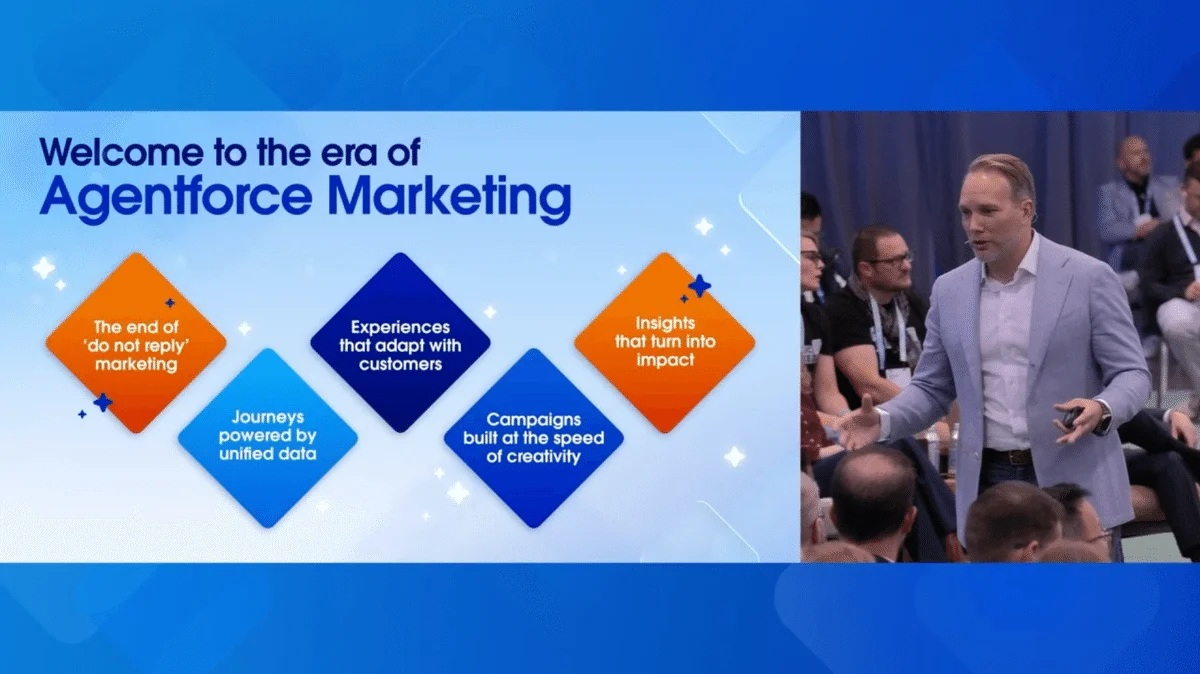
1. The End of “Do Not Reply” Era
‘The Statue of Liberty’ stands for welcome and openness. In the same spirit, Agentforce Marketing moves beyond robotic, one-way campaigns. It enables real conversations across channels like email and SMS, helping brands build more authentic and meaningful customer relationships.
Relying on one-way email communication has become increasingly ineffective. In fact, as of 2024, the average email click-through rate (CTR) stands at just 1.4%, according to the recent Forbes Report. This highlights the growing need for more interactive, intelligent engagement strategies.
Two-way interaction changes what happens after a customer takes action. Today, when a prospect clicks “reply” to a marketing email, that message often lands in an unmonitored inbox or triggers an automated “no-reply” response, effectively ending the conversation. With Agentic Marketing, that reply becomes the starting point.
An AI-powered agent can recognize intent, answer common questions, qualify interest, or route the complex queries to the right sales or service team. For Salesforce customers, this means marketing no longer stops at sending campaigns; it becomes an ongoing dialogue. And for their end customers, it transforms brand communication from transactional messaging into responsive, relationship-driven engagement.
So, no more:
- “Do not reply to this email.”
- No more dead ends.
- No more forcing customers to figure things out alone.
Two-way messaging is out from October 2025, and by February 2026, you will have two-way emails.
2. Unified-Data Customer Journeys
As we all know, ‘The Great Wall’ of China connects thousands of miles of landscape into one seamless structure. Salesforce Data 360 does the same with data, bringing together customer information from across systems into a unified view.
While Salesforce has spoken about unified data and Customer 360 for many years, what’s different now isn’t the vision – it’s the speed, execution, and real urgency driving it forward.
In the past, unified data was largely about integration and visibility, connecting systems so teams could see the same customer record.
Today, the stakes are much higher. Data is no longer just for reporting or segmentation; it fuels real-time decision-making, automation, and AI-driven actions. With Data 360 powering Agentforce, unified data becomes operational, not just informational. It activates insights instantly across marketing, sales, and service. The shift is from “having a single customer view” to “enabling a single, intelligent customer brain”. That’s what sets this moment apart – and why it’s more important now than ever before.
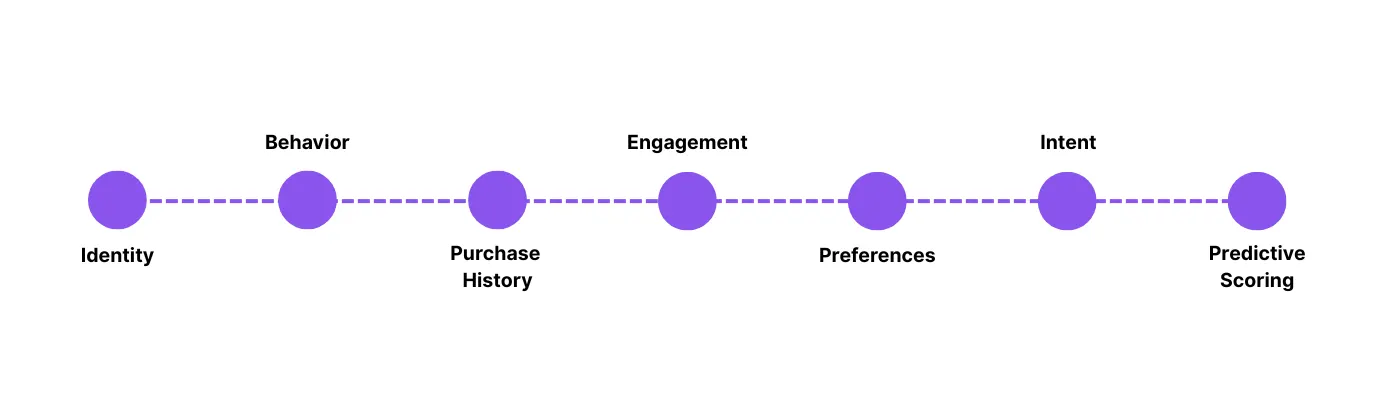
All unified. All real-time. All powering journeys that truly understand the customer end-to-end.
The real challenge for marketers isn’t finding data, but understanding which data truly matters. That’s exactly how Salesforce Data 360 is built, which is known as the world’s #1 customer data platform.
Are you ready to reimagine marketing with:
- Unified Campaign Analytics: Instead of jumping between Email Studio Reports, Journey Dashboards, Ad Platform Metrics, and external tools, marketers can now view cross-channel performance in a more consolidated way. While it may not eliminate every reporting gap overnight, it significantly reduces fragmentation, helping teams make faster, more confident optimization decisions based on shared KPIs.
- Centralized Campaign Management: manage all your activations together – rather than planning and executing campaigns in silos across different tools and teams, marketers can orchestrate Email, SMS, Push, and other Activations from a more connected workspace. In practice, this improves visibility and governance, even though operational alignment and process discipline still play a key role in making it truly seamless.
- Adaptive Journeys: Traditional journeys followed predefined paths. Now, with real-time data signals, journeys can adjust based on engagement, intent, or inactivity. While not every decision is magically autonomous, marketers can design smarter branching logic and event-triggered actions that respond dynamically instead of relying solely on batch updates.
- No-Code Actions: Marketers no longer need to depend heavily on developers for every integration or trigger. With more declarative tools and prebuilt connectors, actions can be configured through UI-based workflows. That said, complex enterprise use cases may still require technical oversight, but everyday campaign execution becomes significantly more agile.
So, Journey Decisioning is already available from October 2025, along with Business Units in February 2026.
Move forward with confidence – not because data risks disappear, but because your data is better organized, governed, and ready to support smarter decisions.
3. Adaptive Experiences
A very famous place, Sydney’s Opera House, that can transform instantly from an opera stage → to a theater → to a conference → to an event. That’s the power of Agentforce – continuously adapting each experience so every customer receives what’s most relevant to them.
Content Changes Based on Behavior
Earlier, personalization largely depended on static segments and predefined rules – “if opened, send X; if not, send Y.” Now, behavioral signals such as browsing activity, engagement timing, product interest, or service interactions can dynamically influence what content is delivered next.
This moves marketers away from scheduled batch thinking toward continuous responsiveness. For Salesforce customers, this means fewer generic follow-ups and more context-aware interactions – but it also requires cleaner data and a stronger content strategy to truly work.
Journeys Reshape in Real-Time
In the past, journey models were mostly linear and campaign-centric. Once activated, changing logic often meant cloning, pausing, or rebuilding flows. With real-time data streams and event-based triggers, journeys can now adapt mid-stream, rerouting customers based on live engagement, intent signals, or even inactivity.
This reduces lag between behavior and response, which is critical in high-intent moments. For marketing teams, everyday work shifts from “launch and monitor” to “design adaptable frameworks” that evolve automatically.
Dynamic Personalization Becomes the Default
Previously, personalization often meant adding a first name, segment-based messaging, or a product recommendation block. Now, personalization can operate at the decision level – selecting offers, channels, timing, and even tone based on customer state.
This changes the marketer’s role: instead of crafting dozens of manual variations, they define logic, guardrails, and content components that AI assembles intelligently. The workload moves from repetition to orchestration.
Every Customer Sees What They Need, Not What Everyone Else Gets
Earlier, scalability required compromise: broad campaigns delivered efficiently, but relevance suffered. With unified data and AI-driven orchestration, scale and relevance are no longer mutually exclusive. Customers experience communications that reflect their context – lifecycle stage, intent, past behavior – rather than being grouped into broad lists.
For Salesforce customers, this means improved engagement potential, but also a need for tighter alignment between marketing, sales, and service data to avoid inconsistency.
So, Agentforce works on top of Data 360’s unified data foundation. First, Data 360 ingests structured/ unstructured data (such as CRM records, transactions, engagement history, knowledge base entries, and documents) and selected external sources through connectors. It performs identity resolution to unify profiles and applies calculated insights or segments based on defined rules.
Agentforce then uses this grounded customer data, along with connected knowledge sources, to interpret intent and generate contextual responses or recommendations. These outputs can trigger next-best actions, personalized content selection, or journey-based activations within Agentforce Marketing and other Salesforce applications.
While the experience depends on configuration and governance, the architecture is designed to move from unified data to contextual intelligence to orchestrated activation across channels.
4. AI-Speed Campaign Creation
The famous ‘The Burj Khalifa’ stands for ambition, engineering excellence, and unstoppable speed. Similarly, Agentforce Marketing brings that same energy, allowing marketers to build the campaigns at the speed of creativity.
Campaigns that once took 7-8 weeks to plan, build, align across teams, and launch are now being compressed dramatically – not because AI replaces marketers, but because it reduces manual effort across multiple stages of execution. What has changed:
- From manual drafting to assisted creation: Instead of starting from a blank page, marketers can generate first-draft copy and variations instantly. This doesn’t remove creative control – it accelerates iteration and testing cycles.
- From static content blocks to dynamic assembly: Rather than building dozens of email versions manually, teams can define modular content components that are assembled based on audience logic and behavior.
- From spreadsheet-based segmentation to real-time audience building: Audience creation is shifting from static list pulls to continuously updated segments powered by unified data. This reduces dependency on ops teams and shortens turnaround time.
- From channel silos to orchestrated activation: Instead of planning Email, SMS, and Ads separately, marketers can design connected experiences across channels – reducing duplication and improving consistency.
The real shift isn’t that “AI builds campaigns.” It’s that the bottlenecks, copywriting drafts, segmentation delays, version control, and coordination across teams are shrinking. That changes how marketing teams allocate time: less operational assembly, more strategic thinking and optimization.
You still guide the strategy. AI handles the heavy lifting.
Agentforce Marketing gives the AI Agent library:
Campaign Creation Agents
These can help with planning, content creation, and more, supporting marketers at the earliest and often most time-consuming stage of campaign development. They help translate objectives such as a product launch, upsell initiative, or event promotion into a structured campaign framework, suggesting audience criteria, content themes, channel mix, timing, and measurable KPIs.
Rather than starting from a blank page, marketers can generate campaign briefs, draft messaging variations, identify relevant content angles based on past performance, and uncover gaps like missing segments or unclear calls to action. While AI doesn’t replace strategic thinking, it reduces manual coordination, document back-and-forth, and repetitive analysis – accelerating the move from idea to execution-ready campaign.
Why does it matter? It shortens planning cycles and helps smaller teams operate with the leverage of a larger one, while still keeping human oversight in strategy and brand voice.
Orchestration Agents
Orchestration has traditionally been one of the most operationally heavy parts of marketing, where building segments required manual data pulls or reliance on operations teams, and designing journeys meant configuring branching logic, managing exclusions, and constantly updating rules as customer behavior changed.
Static lists needed frequent refreshing, journey logic had to be manually adjusted, cross-channel coordination often remained siloed, and testing variations significantly increased operational workload.
Orchestration Agents shift this from rigid, rule-based execution to more adaptive decisioning by interpreting real-time engagement signals, recommending next-best actions, and dynamically including or excluding customers based on updated data. Instead of repeatedly rebuilding journeys, marketers can design flexible frameworks that evolve automatically, reducing manual effort while improving responsiveness and relevance.
Why does it matter? It reduces manual rework, improves timing relevance, and allows journeys to respond to customers instead of forcing customers into predefined paths.
Campaign Activation Agents
Activation has historically involved exporting audiences, syncing multiple systems, scheduling sends, validating channel logic, and monitoring performance separately across email, SMS, web, and ads – where even small errors like incorrect exclusions or mistimed sends could affect thousands of users.
Campaign Activation Agents streamline this process by activating unified segments across connected channels from a central decision layer, transforming execution from siloed channel management into coordinated orchestration.
By leveraging real-time signals, they can trigger timely follow-ups – such as sending an SMS if an email goes unopened or displaying a personalized web offer based on recent browsing behavior – making activation more responsive, consistent, and efficient.
In practice, this brings:
- Faster go-to-market execution
- Fewer operational handoffs
- More consistent cross-channel messaging
- Better responsiveness to customer behavior
There is a considerable impact on the customer experience. Customers no longer receive disconnected messages from different teams. Instead, communication feels coordinated, timely, and context-aware – reducing fatigue and improving relevance.
The AI Agent Library is available for you now. Agentforce provides prebuilt AI agents designed for specific business use cases – such as campaign planning, content generation, segmentation assistance, and orchestration support.
These agents are not random bots. They are:
- Grounded in your Salesforce data.
- Governed by permissions and Data 360rules.
- Designed to operate within defined workflows.
But before using them, there are prerequisites. You typically need:
- Marketing Cloud (Next / Growth / Advanced)
- Data 360 (Highly Recommended / Often Required): Most agent intelligence depends on:
- Unified profiles.
- Harmonized data.
- Real-time signals.
Without Data 360, agents have limited context.
- Einstein / AI Capabilities Enabled. Ensure that:
- Generative AI features are turned on.
- Trust layer + data governance settings configured.
- User permissions defined.
- Proper Roles and Access. You need:
- Admin access to configure agents.
- Clear data access boundaries.
- Defined prompt templates or guardrails.
Most teams think that AI agents mean magic automation. The reality is that Agentforce works best when:
- Data is clean.
- Use cases are clearly defined.
- Guardrails are in place.
- Humans remain in oversight.
5. Insights That Drive Real Impact
The Pyramids of Giza (Egypt) were built with absolute mathematical precision. Standing strong for around 4500+ years, it is a symbol of engineering intelligence.
Agentforce Marketing brings that same precision to Insights. Let’s look at what has changed:
Predictive Performance
Before:
- Required dashboards built by analysts.
- Data modeling + harmonization effort.
- Predictions visible mainly in the reporting layer.
- Marketer had to interpret and act manually.
Now (with Agentforce Marketing):
- Predictions embedded directly inside campaign workflows.
- AI explains why performance will shift.
- Recommends actions, not just numbers.
- Operates inside Marketing Cloud UI.
What changed? It went from “See prediction in dashboard” to “Act on prediction inside the campaign builder.
It matters, as now Marketers don’t need to:
- Switch tools.
- Ask analysts.
- Interpret complex dashboards.
Forecasting
Before:
- Historical trend forecasting.
- Built by BI teams.
- Static scenario modeling.
- Lag in data refresh.
Now (with Agentforce Marketing):
- AI dynamically forecasts campaign outcomes before launch.
- Scenario simulation inside segmentation/journey.
- Continuous recalibration.
- Natural language interaction.
What Changed? It went from retrospective forecasting to interactive scenario planning.
It matters as Marketers move from reporting to decision simulation.
AI-Based Optimization
Before:
- Einstein Send Time Optimization.
- Engagement scoring.
- Some automated rules.
- But siloed per feature.
Now (with Agentforce Marketing):
- AI Agent monitors cross-channel performance.
- Proactively suggests optimization.
What changed? It went from feature-level optimization to campaign ecosystem optimization
It matters, as Marketers will have less manual tuning and more autonomous improvement.
Real-Time Recommendations
Before:
- Personalization rules.
- Next best action models.
Now (with Agentforce Marketing):
- Context-aware recommendations across channels.
- AI suggests audience refinement.
- Conversational interaction with a marketer.
It matters because Marketing becomes responsive, not reactive.
Cross-Channel Intelligence
Before:
- Datorama aggregated data.
- Tableau visualized performance.
- Still required integration work.
Now (with Agentforce Marketing):
- Native unification via Data 360.
- AI understands journey impact across channels.
- Attribution insights embedded in the execution layer.
What changed? It went from channel performance reporting to journey-level intelligence
It matters, as optimizing a single channel no longer breaks the whole journey.
Automated Reporting
Before:
- Scheduled dashboards.
- PDF exports.
- Analyst dependency.
- Manual narrative creation.
Now (with Agentforce Marketing):
- AI-generated performance summaries.
- Conversational insights.
- Executive-ready summaries.
- Real-time anomaly detection.
Example: “Your APAC campaign dropped 12% CTR due to frequency fatigue.”
What changed? It went from data visualization to insight narration.
It matters, as leaders get meaning, not metrics. Not dashboards that you “check.” But insights that actively guide the decisions.
Paid Media Optimization, Unified Analytics, and Clean Rooms are already available. February 2026 introduced Multi-Touch Attribution.
Final Thoughts
Agentforce Marketing isn’t simply a rebrand or incremental update to Marketing Cloud – it represents Salesforce’s attempt to unify decades of marketing automation, data infrastructure, and AI investments into a more embedded, workflow-driven experience.
For Salesforce customers and partners, the real question isn’t whether the technology is powerful – it’s whether it reduces operational complexity, dependency on technical teams, and time-to-launch.
If Agentforce succeeds in embedding AI directly into segmentation, journey orchestration, and activation layers, it could meaningfully change how marketing teams operate day to day. The opportunity in 2026 won’t belong to businesses chasing AI as a buzzword, but to those that can connect strategy, data, and execution in a practical, measurable way.
You can watch the Marketing Keynote from Dreamforce ’25 here.
