








It’s no surprise that the Salesforce ecosystem is evolving at a rapid pace. And with AI now added to the mix, one can’t deny that the pressure to stay current is greater than ever. This holds true for admins, devs, and other Salesforce roles, but for architects – who sit at the intersection of business strategy and technical execution – the stakes are even higher.
So, how are today’s architects adapting?
We looked at data from our Salesforce Architect Survey 2025, which captured the insights of over 600 professionals across the ecosystem. We’ll explore these findings to understand how they approach continuous learning: the mindsets, preferences, and motivations that keep them sharp in an ever-changing ecosystem.
Increasing Complexity Is a Call to Action
More than 66% of architects agree that Salesforce is becoming increasingly complex to work with. With new products left and right, plus evolving platform capabilities coupled with AI becoming a core part of almost every cloud, it’s no wonder even the most experienced professionals are feeling the shift.
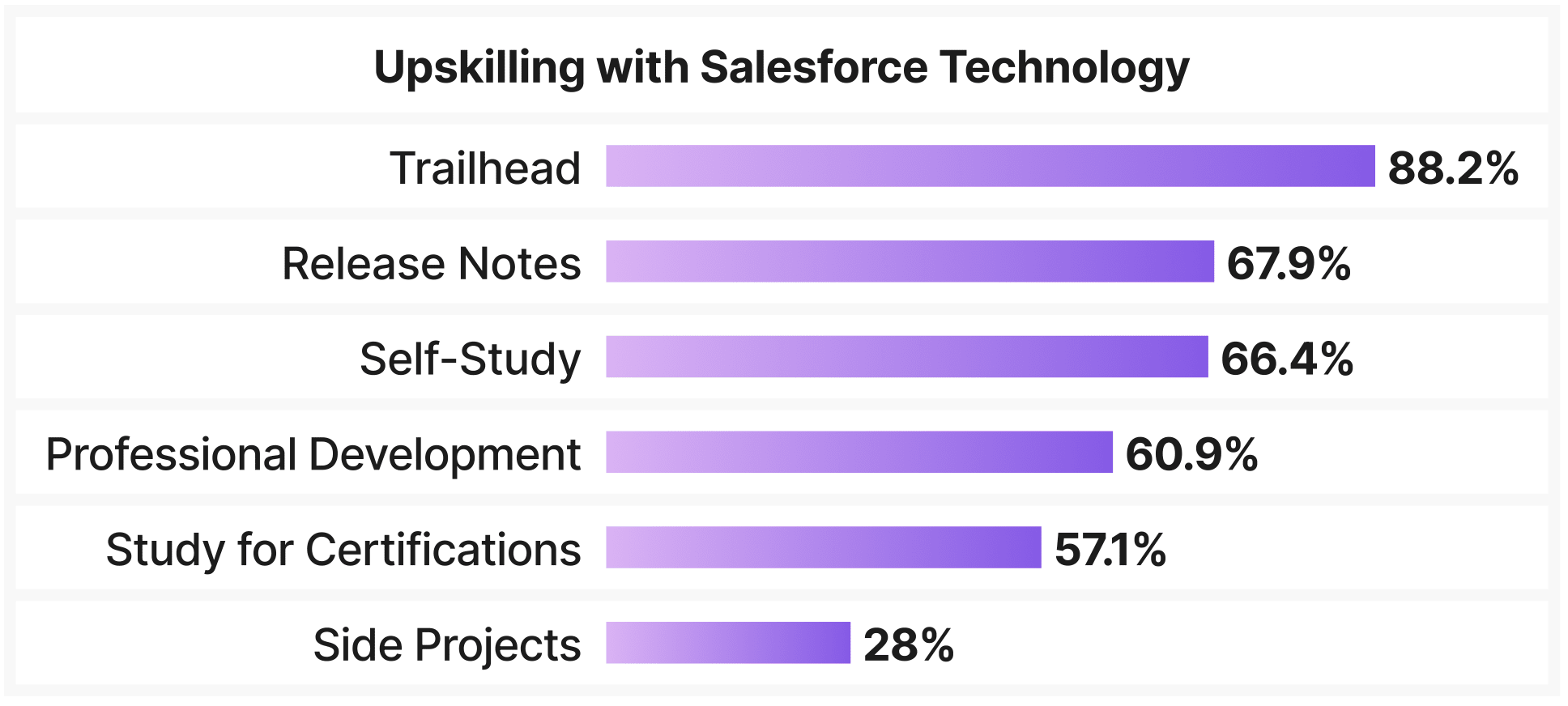
This growing complexity is both a challenge and a call to action, and I think that applies to all Salesforce professionals, not just architects. It’s just that the pressure architects feel may be greater due to the level of technical expertise and amount of responsibilities they have, so doubling down on learning becomes a product of necessity more than curiosity. To stay ahead, they turn to:
- Trailhead
- Release notes
- Self-study
- Professional development programs
- Certification prep
- Side projects
This underscores a culture of proactive learning, with a diverse mix of formats signaling that architects aren’t just learning more, they’re learning smarter.
That’s why Salesforce’s upcoming Well-Architected relaunch at Dreamforce 2025 is well-timed. As the platform grows more powerful and complex, architects need effective, practical guidance on what they’re building and how to build it right.
Confidence Gaps Are Still Common
Architects are seasoned professionals with years of experience. But even with a wide array of skills under their belt, there are still some areas where confidence dips. Survey respondents were asked to select skills they felt the least confident in, and the top three answers were:
- Programming
- DevOps
- Security Management
Far from being discouraging, this actually highlights key areas where architects can brush up, not only to stay sharp but also to stand out. Tackling these areas can give an edge in this competitive and fast-evolving ecosystem. The most effective learning is all about building lasting confidence by filling in those knowledge gaps.
Visual and Hands-On Learning Wins
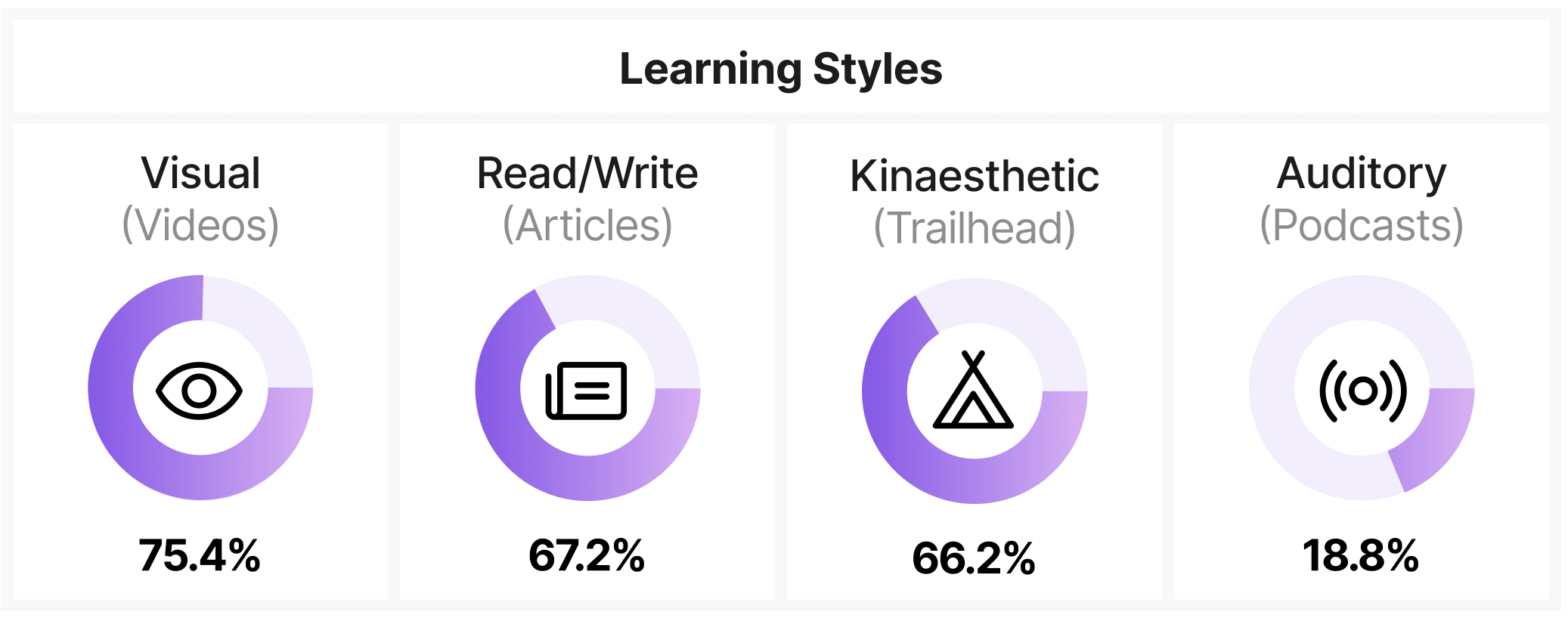
In the survey, respondents overwhelmingly favored visual learning, such as through videos. The next preferred learning styles that are almost tied up are read/write (article tutorials), and kinesthetic (learning by doing, hands-on) approaches.
Auditory learning (podcasts), on the other hand, ranked the lowest across all demographics.
This shows us that architects don’t want to just listen – they want to see and build. Visual guides, diagrams, and hands-on workshops can be far more effective than you might think.
Trailhead Is Popular, But Not Perfect
When asked about how to stay current and continue to upskill with Salesforce technology, 88.2% of respondents said they use Trailhead, which makes it the most widely used learning platform. But when asked to rate its usefulness, the average score was only 6.6 out of 10, which isn’t exactly a great score for something that’s so commonly used.
This reveals a reality that’s layered – Trailhead is the most convenient and super accessible, but…
- It may not always go deep enough for experienced architects, or…
- There isn’t a better medium to go to.
Trailhead could be great for learning the fundamentals, but once you get past that, it can get harder for architects to find what they need.
Career Progression Ties to Continuous Learning
When asked about the single best way to ensure career progression, one answer stood out far above the rest – gaining more hands-on experience.
And honestly, this doesn’t just apply to architects. I believe it’s true for anyone in the Salesforce ecosystem. No matter how many articles you read, videos you watch, or Trailhead badges you collect, nothing compares to rolling up your sleeves and actually working through real scenarios.
Most of the time, implementing a solution in a client org or troubleshooting a real issue teaches you more than any guide or tutorial ever could. Dealing with scenarios first-hand forces you to think critically and adapt, and also truly understand the ‘why’ behind what you’re doing – which can be more difficult to learn if you’re just following steps.
Of course, hands-on experience isn’t always readily available for every feature or topic you want to explore. Personally, I try to work around this by diving into hands-on challenges (like in Trailhead!) or even by replicating scenarios over and over in a demo org until things start to click. It’s honestly not quite the same as working on a live project or troubleshooting a real issue, but it gets me close – plus the repetition helps build muscle memory.
Final Thoughts
Yes, the path of a Salesforce Architect is built on expertise, but behind that, it’s also built on curiosity and consistency. Expanding your knowledge and skillset isn’t a one-off task – it’s supposed to be treated as a lifestyle, and staying sharp means leaning into the resources that align with your learning style and goals. There’s no one-size-fits-all route… but there is a shared commitment to lifelong learning.
While certifications and specialization also matter, it’s clear that a growth mindset is seen as key to staying relevant – that’s where confidence builds and where the real growth happens.