






The past few years have seen major changes in the Salesforce ecosystem, particularly for developers. Firstly, there has been a broad contraction in the number of roles available in the market, especially compared with demand, as highlighted in the recent 10k’s Salesforce Ecosystem Report. With the supply of roles still outstripping their demand, we are finally seeing growth in job demand, but still lower than the supply of available people.
Secondly, there is the continuing limbo due to AI, with 2024 and 2025 being years in which developers were told they were to be replaced by AI in the future, although in early 2026, this has still yet to occur.
Note: The salary survey data for this article, unless otherwise stated, consists solely of the subset of responses from individuals who selected “Developer” in response to the question “Which title is the closest to your current role?”. There are several other titles adjacent or similar to developers, such as “DevOps Engineer”, “Technical Consultant”, or “Technical Delivery”. If these are included in any analysis, we will note it as necessary.
Median Salesforce Developer Salaries
The following salary figures represent the median salaries for Salesforce Developers based on our recent survey of 2,316 respondents across 76 countries and more than 17 industries. If you would like full data for all roles – including junior, intermediate, senior, and director-level positions – download the full report.
North and South America
| Junior | Intermediate | Senior | |
| US ($) | 94,500 | 120,000 | 140,000 |
| Canada (C$) | – | 99,150 | 100,000 |
| Brazil (R$) | – | 141,000 | 221,750 |
Europe
| Junior | Intermediate | Senior | |
| UK (£) | – | 56,500 | 70,000 |
| Germany (€) | – | – | 83,750 |
| Spain (€) | – | 45,000 | – |
| Poland (ZŁ) | – | 140,000 | – |
Asia and Oceania
| Junior | Intermediate | Senior | |
| Australia (AU$) | – | 93,100 | 147,000 |
| India (INR₹) | 500,000 | 1,000,000 | 2,700,000 |
Satisfaction (Somewhat Guaranteed)
So let us begin the review of this year’s data for developers with a positive: we seem to be more satisfied and valued in our roles. In 2024, 82.6% said they felt “respected and valued in their current role”, which increased to 87.8% this year, a statistically significant increase.
Developers are, in general, happy with their benefits package overall, with a little over half (51.4%) saying that they are either “Satisfied” or “Somewhat satisfied” with the benefits package offered by their employer. Overall, I think it is important to recognize that, for the most part, developers feel happy and that they have a satisfactory benefits package.
Sadly, however, fewer developers (45.2%) now feel that their salary is not fair and equal to others in their role, a decrease from the previous year at 48.1%. There are probably a number of reasons behind this. Firstly, nearly half of participants (43.8%) are in their first Salesforce role. As we have noted in previous years, changing roles is a key driver of salary growth.
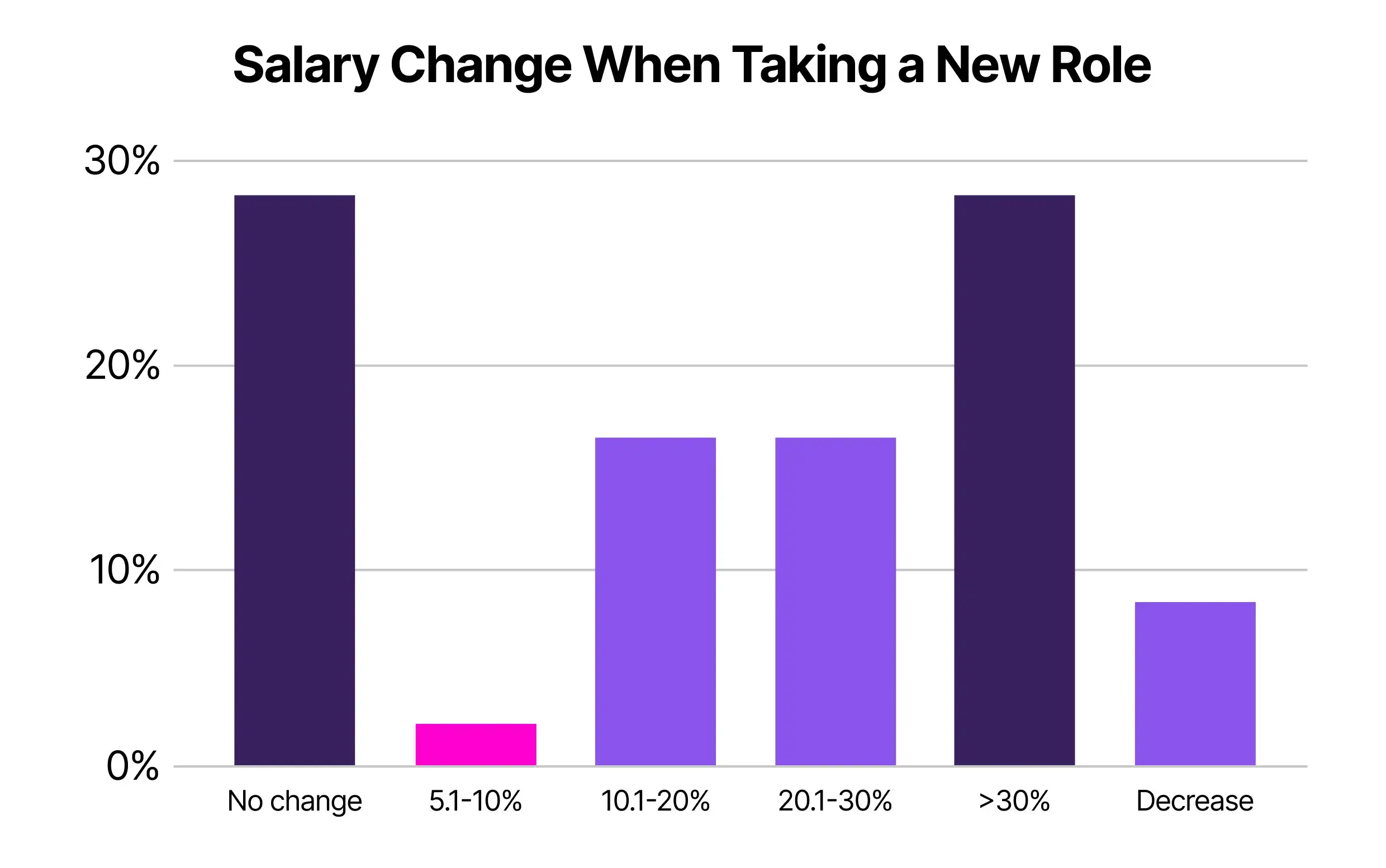
This year, we asked what percentage change people had in their salary after a role change and found that 61% of those who had changed roles had a salary increase of more than 10%, with 28.57% stating they had a salary increase of more than 30%.
The Grass Can Be Greener
In the 2024-25 SF Ben Salary Survey, 57.9% of respondents said they had been searching for a role in the previous 18 months, and 90% stated that they felt “the market has been more challenging than previous years”.
This year, the number of developers searching for a new role in the previous 18 months dropped to 51.7%, while the percentage of those who felt the market had become more challenging rose slightly to 91.3%. What does this tell us when combined with the above data on salary satisfaction and role changes?
Broadly speaking, fewer developers are looking to move, at least in part, believing that the market has become more challenging, meaning the possibility for a salary raise through a job move is reduced. Roughly the same percentage of developers have received a salary raise at their current role in the past 12 months (66.9% in 2025 vs. 67.5% in 2024), with around a third (33.82%) of these being under 5%.
These raises differ across geographies as well, with developers in India more likely than their US counterparts to have received a raise in the last 12 months (75.5% vs. 66.7%) and to have that raise be greater than 5% (87.5% vs. 37.5%), despite a similar proportion of individuals being in their role for more than 2 years (52.3% vs. 53.7%). On the whole, however, Indian developers are less likely to feel their salary is fair compared to others in their role than their US counterparts (22.2% vs. 70.6%).
| USA | India | |
| Have received a raise in the last 12 months | 66.7% | 75.5% |
| Raise more than 5% | 37.5% | 87.5% |
| In role for more than 2 years | 53.7% | 52.3% |
| Feels salary is fair compared to others in their role | 70.6% | 22.2% |
Location, Location, Location
This again reinforces that a key aspect of your salary, and thus your satisfaction with it, depends on geography – with the local cost of living dramatically impacting the amount you are paid. Below, we can see that in general, the higher the local cost of living, the higher the median salary.
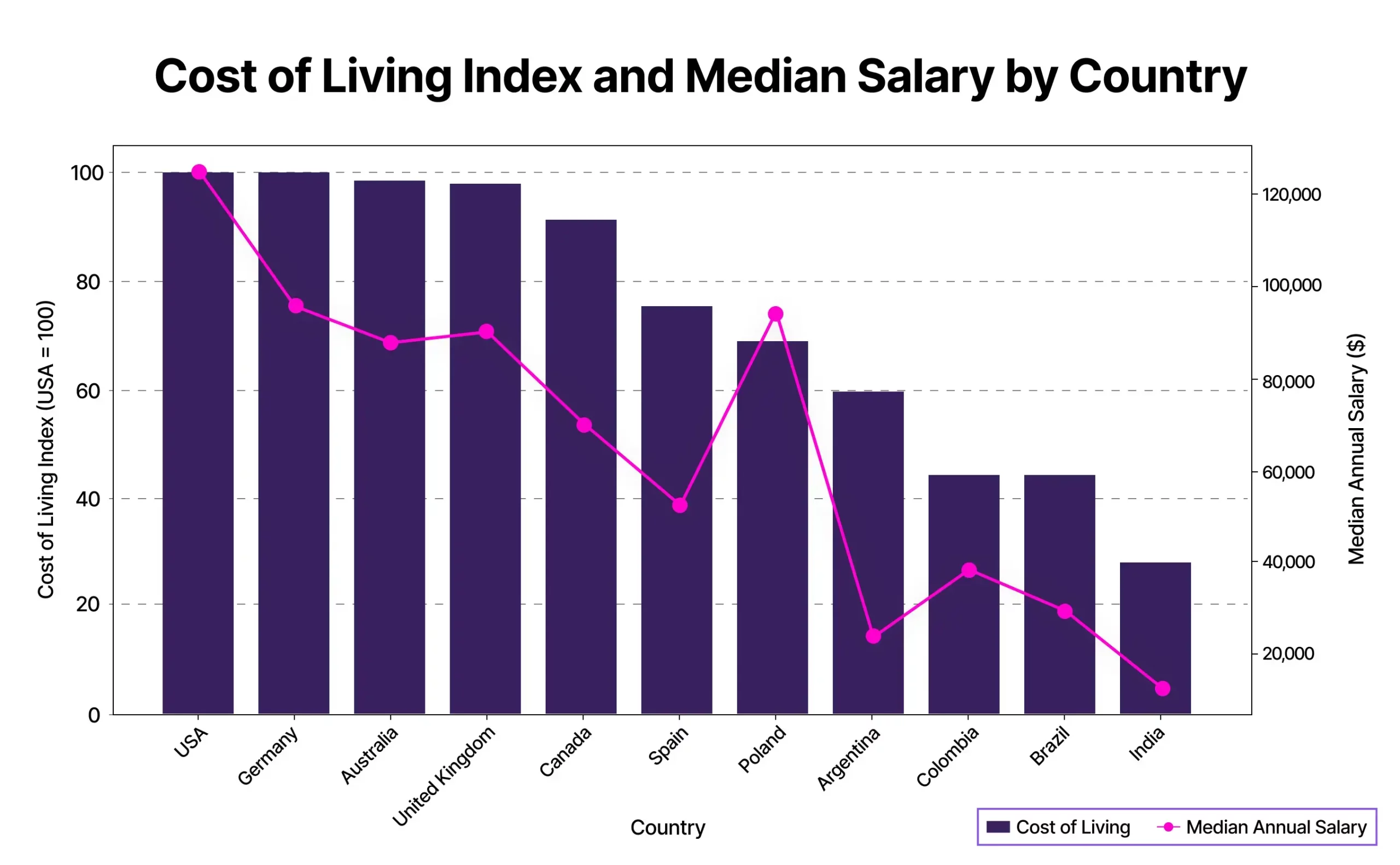
There are a few outliers here, with the USA and Poland paying well with respect to their cost of living index scores, with Argentina, Spain, and India possibly paying below what one might consider salaries should be for the local cost of living. It should be noted that, compared to last year’s chart, we have taken the median salary instead of the average to avoid skew from an outlier, although, as noted, this will still be skewed in smaller sample sets.
The key takeaway, though, is that location does play heavily into your earnings; however, the higher cost of living may negatively impact the increased earnings.
One of the interesting things I found in the survey was that the best company for earnings varies by location. For example, in India, the highest median salaries are at customers/end users, closely followed by SI/consulting partners, before a significant drop to those working for Salesforce and ISV partners, who are earning roughly 70% of those at an SI partner.
Contrast this with the United States, however, where Salesforce employees and ISV developers earn roughly 50% more than their peers in SI and consulting partners. So, if you are considering moving roles to increase your salary, it is worth keeping in mind where you are moving to.
Median Salary per Company Type
| USA ($) | India (₹) | |
| Customer / End User | 125,000 | 1,141,712 |
| ISV / AppExchange Company | 175,000 | 625,000 |
| Salesforce | 178,000 | 700,000 |
| SI / Consulting Company | 115,000 | 1,011,500 |
Skills to Pay the Bills
One of the key drivers that the data shows to build your salary is investing in skills and certifications to highlight and prove those skills.
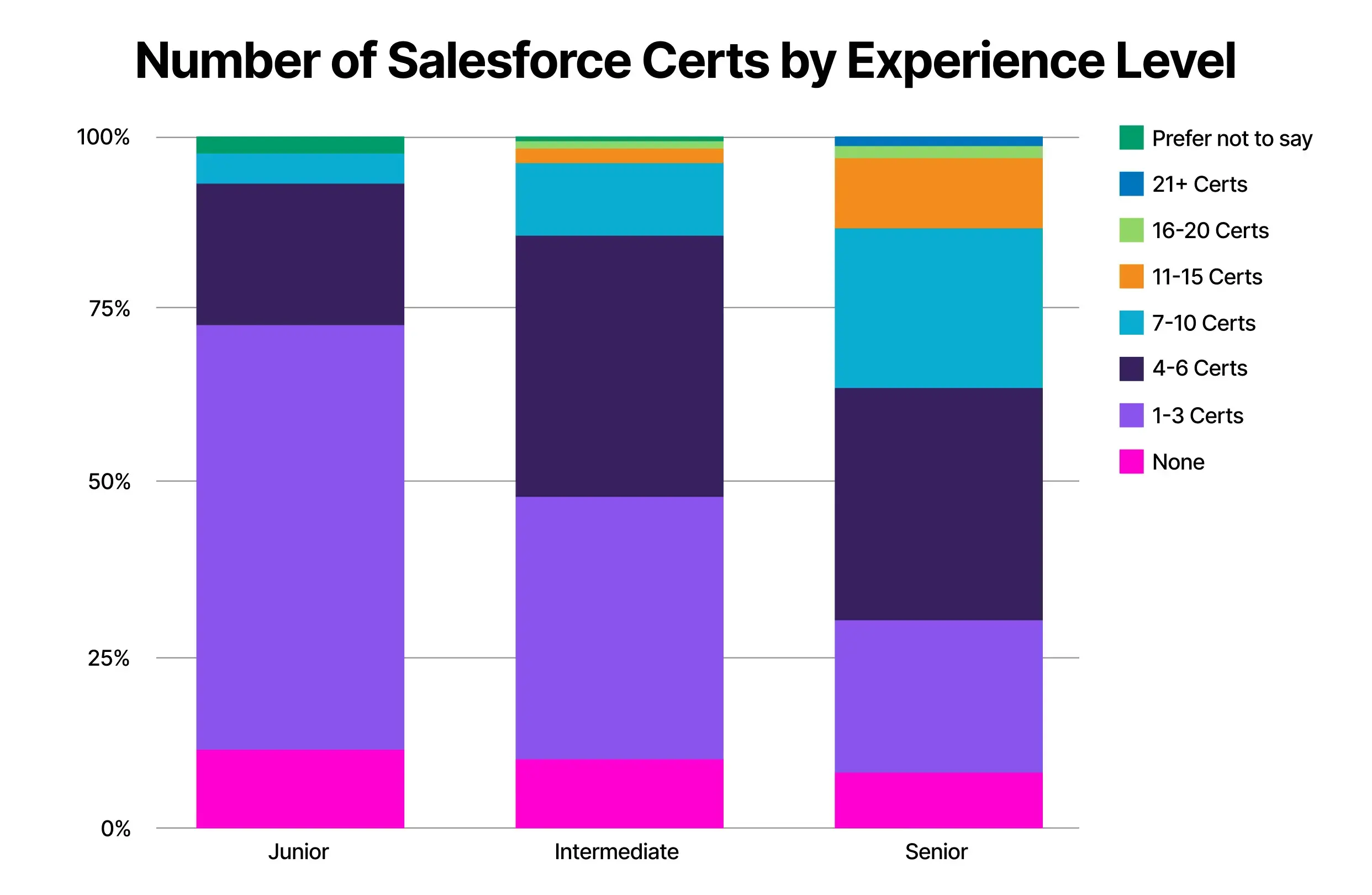
As we can see, there is a significant correlation between seniority – and therefore salary – and the number of Salesforce certifications an individual holds. As shared in the fuller survey, for every jump between certification bands, there is a 6-18% increase in salary.
The majority of respondents do not have any non-SF certifications, with an interesting pattern being that, for those who do, a non-Salesforce AI / ML certification is far more prevalent among junior roles than in intermediate or senior roles. This likely reflects the increased impact of AI on the junior developer role in general, with these respondents working to use AI as a way of enhancing their abilities and ensuring they can stay relevant within the workplace.
We also see that amongst developers, Sales Cloud, Service Cloud, Platform, and Experience Cloud all register above 50% of developers having experience with those products, with Sales Cloud, perhaps unsurprisingly, topping the list at just over 80%.
Agentforce is a new high entrant, with 36.3% of developers having some experience with the tool, and junior developers are more likely (47.7%) than intermediate (39.1%) or senior developers (29.6%) to have some experience with Agentforce.
This poses the deeper question of “what counts as experience?” – a live production deployment or some Trailhead learning experience.
Certifications are still a key part of improving your earnings potential as a developer. As mentioned in the full report, moving between certification bands can significantly improve your salary. Certifications can also make you much more employable: everyone with more than four Salesforce certificates reported finding their last job in less than two months, while a quarter of those with fewer than three Salesforce certifications said it took them more than three months to find a role.
Although this data is not exhaustive, and some people with many certifications may still struggle to find work, the fact that partners value certifications suggests that earning more certifications can increase your earnings and improve your chances of landing a new role.
There is also one other interesting note: for those in the United States, the sweet spot seems to be 7-10 certifications, with a decrease in the median salary for those with more than 10 certifications.
Median Developer Salary (USD) in the United States vs. the Number of Salesforce Certifications
| Number of Certificates | Median Salary in the US ($) |
| None | 117,500 |
| 1-3 | 120,000 |
| 4-6 | 131,000 |
| 7-10 | 155,000 |
| 11-15 | 143,000 |
| 16-20 | 132,500 |
Learning new skills from other clouds and technologies is also a great way to help differentiate yourself in the market, and it becomes ever more valuable as clouds become increasingly interconnected through tools like MuleSoft and Data Cloud. The data supports this as well: those holding certifications in public clouds such as AWS, Azure, and GCP are the top earners compared with any other non-Salesforce certification.
Advice for Managing Your Career and Improving Your Salary
While the data is interesting and hopefully provides some great insights and food for thought, many readers will be wondering how they can increase their salary. To start, based on the data above, we have seen:
- Consider moving roles or at least looking in the market to see how your existing salary compares to what is out there.
- Consider your location and company type. While moving location is not an option for everyone, reconsidering the type of organization you are in, depending on your location, can help impact your salary.
- Get a Salesforce certification. As highlighted, those with more certifications generally earn more, up to a certain point. Greater certifications will help you develop broader knowledge and also assist you towards the architect career path, should you wish to pursue it.
- Consider a non-Salesforce certification. Over half the responding developers had no non-Salesforce certifications, and the data shows how these certifications improve your earnings potential and can help differentiate you in a crowded market.
- Work to gain more experience. Senior developers earn more than intermediate developers, who in turn earn more than juniors. Whilst this is not surprising, improving your experience through certifications, tenure, and exposure to other ideas can help you move up the ladder faster.
I also want to share some additional advice – some from the survey, and some to help you in work towards the recommendations shared above.
Take Control of Your Career
One statistic that leapt out at me was that only 28.2% of developers had sought out Salesforce as a career option themselves. Whilst this was the joint highest reason in the survey, it still indicates that over 70% of developers are in a Salesforce role because of external factors.
| Reason for Entering a Salesforce Role | Percentage of Respondents |
| My employer bought/adopted Salesforce, and I volunteered to work with it | 21.9% |
| I was hired by a Salesforce customer/partner right out of university/college/school | 11% |
| I sought out Salesforce on my own as a career direction | 28.2% |
| I was hired by a Salesforce customer/partner as an experienced technology practitioner | 28.2% |
| I was hired by a Salesforce customer / partner as an experienced technology practitioner | 10.3% |
| I was hired by Salesforce | 0.3% |
This is therefore the first piece of advice: take control of and plan your career. What do you want to do? What technologies do you want to work with? What would you like to build and deliver? If you truly want to maximize your earnings potential, it is up to you to take control of your career and plan for what technologies and tools you want to work with, what you want to deliver, and where you see yourself in the future – rather than assuming that a Salesforce role will always be available to you.
Architect Skills Are in Demand
As highlighted in the 10K report, requirements for architect skills keep growing, and as AI becomes further embedded, this will only increase. The limit for software delivery has never been lines of code (hence why it has always been poo-pooed as a developer metric), but the ability to think and reason out the solution. As AI improves and can begin delivering more code, improving our ability to reason and think in higher-order architectural terms will only become more important.
On top of this, median architect salaries are also at least 33% higher than developer salaries, and even higher in certain regions.
Exposure – an Intangible for Jobseekers
We have noted that changing roles is a key way of improving your salary, but overall, people feel the market is becoming far harder than it was previously. So how do we help find these opportunities for new roles?
A great way is exposure through the community. Over half of the roles I have held in the Salesforce ecosystem have been through connections I made at community events. For freelancers, these events are also a great way to meet potential customers.
Exposing yourself to the Salesforce community is a surefire way to increase the number of opportunities available to you, whether it’s through attending a community event, speaking at one, or volunteering to assist learners or local charities. Making yourself known and connected makes it much easier to access new opportunities, as well as improve your skills and knowledge.
Show, Don’t Tell
We have highlighted the need for broadening your skills, gaining exposure and experience, and growing your network. Often, those looking for new roles or just starting are told to build a portfolio of work to show to potential employers. This is a sound piece of advice and can be very helpful.
However, many overlook the opportunity to contribute to the many great open-source tools in the ecosystem, such as Salesforce Inspector Reloaded, SFDX Hardis, UnofficialSF, FFLib, Apex Fluently, and many others. Not only will assisting in these projects connect you with new members of the community, but it may also allow you to work with new frameworks and technologies to broaden your skillset. These projects can also be a great way of demonstrating your expertise during interviews when looking for new opportunities.
Summary
As we have seen through the data, salary is not determined by a single factor alone, but by a combination of factors that form the basis of an individual’s abilities and skills, helping them demand and earn more in the marketplace. Geography, seniority, certifications, and the macro-economy all have a significant influence on your earnings potential. Even with the best skills, depending on the strength of the market, you may find it harder or easier to find new work.
But it is not all about raw numbers for certifications or years of experience. Putting yourself out there and positioning yourself to be found for new opportunities is also key. Taking control of your career by knowing which levers to use to maximize earnings potential and getting yourself exposed is the best way to keep both your salary and your career growing.
Before we end, I want to briefly pause and note that money is not everything. A poll by HR Software Ciphr of 1,000 UK employees in 2022 found that work-life balance was the most important aspect of their job. In the technology space, we often forget the importance of this balance, perhaps not fully appreciating the blurring of lines as learning and building blend into play and leisure.
I know I enjoy building software and reading about building software outside of my day job, but I also know that I have to be careful to distinguish what is “work” and what is “pleasure.” I encourage everyone to reflect on this as they plan what increasing their earnings may mean for their overall happiness. Taking control of your career also means taking control of your life to give yourself and those around you the life you want.





Comments: