

We’re in one of those rare moments when technology, process, and organizational ambition converge. Everywhere I look on LinkedIn, I see two dominant camps:
- Those excited about the possibilities of agentic AI (for example, Agentforce-style solutions) and the transformational potential it offers.
- Those urging caution, reminding us of the many “too early” technologies and unfulfilled promises of past innovation waves.
Both views are valid – but what both miss is the long arc of adoption and value realization. The truth is: it depends. And the perspective we need is the long one.
For Salesforce professionals, the question isn’t whether agentic AI matters – but how to adopt it without repeating past mistakes.
A Quick Historical Parallel
Let’s look at the most recent enterprise trend: “Digital Transformation.” Analyst commentary began emphasizing this “must-have” capability in the early 2010s, gained broad traction by 2017, and reached full adoption by 2021 as COVID‑19 accelerated enterprise digitalization.
In short: the hype started early, the early adopters raced ahead, and we are still on the journey. And this journey unfolded over many years.
If you look even further back – the printing press, the railroads, the internet, software-as-a-service – each large-scale shift in how economies and societies operate took time, iteration, and adaptation.
With each of these, however, there were early winners who took calculated risks, conducted controlled experiments, and gradually scaled their solutions. By building expertise early, they managed to lower costs, accelerate innovation, and achieve a competitive advantage. Of course, there were also ideas that did not go anywhere.
We have a similar opportunity today – those who combine thoughtful experimentation with strong governance will shape how agentic systems mature and deliver business value.
Salesforce’s Own Journey Is Already Affirming This
Let’s look at Salesforce’s own recent history and what it has already taught us.
Less than two years ago, Einstein Copilot was announced. Early examples, such as AI-generated sales emails that later became the foundation for BDR agents, were grounded in generative AI capabilities. Success depended on reliable CRM data, well-populated metadata (something most orgs still lack), and thoughtfully designed prompts. While those efforts were directionally correct, they were not sufficient on their own.
What was missing was a clear methodology and solution architecture – backed by mature technical capabilities – for incorporating first- and third-party data, handling unstructured content, and governing risk. Many of those gaps, arguably, are still being addressed today.
Fast forward to earlier this year. Copilot demos began to change end-user behavior. Sales reps generate personalized outreach at scale – sometimes using LLMs not approved by InfoSec, and sometimes injecting first-party data in ways that introduce security risks.
These early successes highlighted a critical need: organizations required a platform-centric approach that combined LLMs, structured data handling, permissions, and workflow governance. This is precisely why Agentforce should be viewed as a foundational agentic enterprise platform, not just another AI feature.
Early pilots demonstrated value, even if usage was initially light. Those experiments laid the proverbial railroad tracks. New practices emerged. New roles formed. Communities evolved to define leading best practices, such as those created by the Datablazers community to build trusted data foundations and mitigate hallucination and incorrect-response risk.
Today, agentic processes are being used across both internal and external use cases. We are being reminded that agents, like humans, make mistakes. We are learning from early agentic pilots that technically correct automations fail to gain adoption because underlying data assumptions were wrong – highlighting that even successful builds can miss the mark without data readiness and guardrails.
With experience, we learn. Humans design guard rails informed by what has already gone wrong, and agentic systems improve iteratively – guided by both human judgment and machine feedback. That journey is already underway.
What This Means for Agentic AI and the Agentic Enterprise
If we accept that this wave (agentic AI, autonomous agents, intelligent digital workers) is equally significant, we must approach it with both optimism and humility.
1. The Promise and Selecting the Right Use Cases
The core promise of an agentic solution is its ability to automate repeatable processes that can be improved in meaningful ways – reducing friction, improving consistency, and freeing human capacity for higher‑value work. The opportunity lies not in automating everything, but in thoughtfully identifying where agentic automation can make a measurable impact and designing for continuous learning and improvement.
This means starting small, validating outcomes, and scaling what works. Early projects should target high‑frequency, low‑complexity workflows, or where you have existing process bottlenecks, with clear inputs and outputs.
If you do not know where to start, using process intelligence tools from AgentExchange and analyzing how your employees work in your CRM can help you identify bottlenecks as potential starting points.
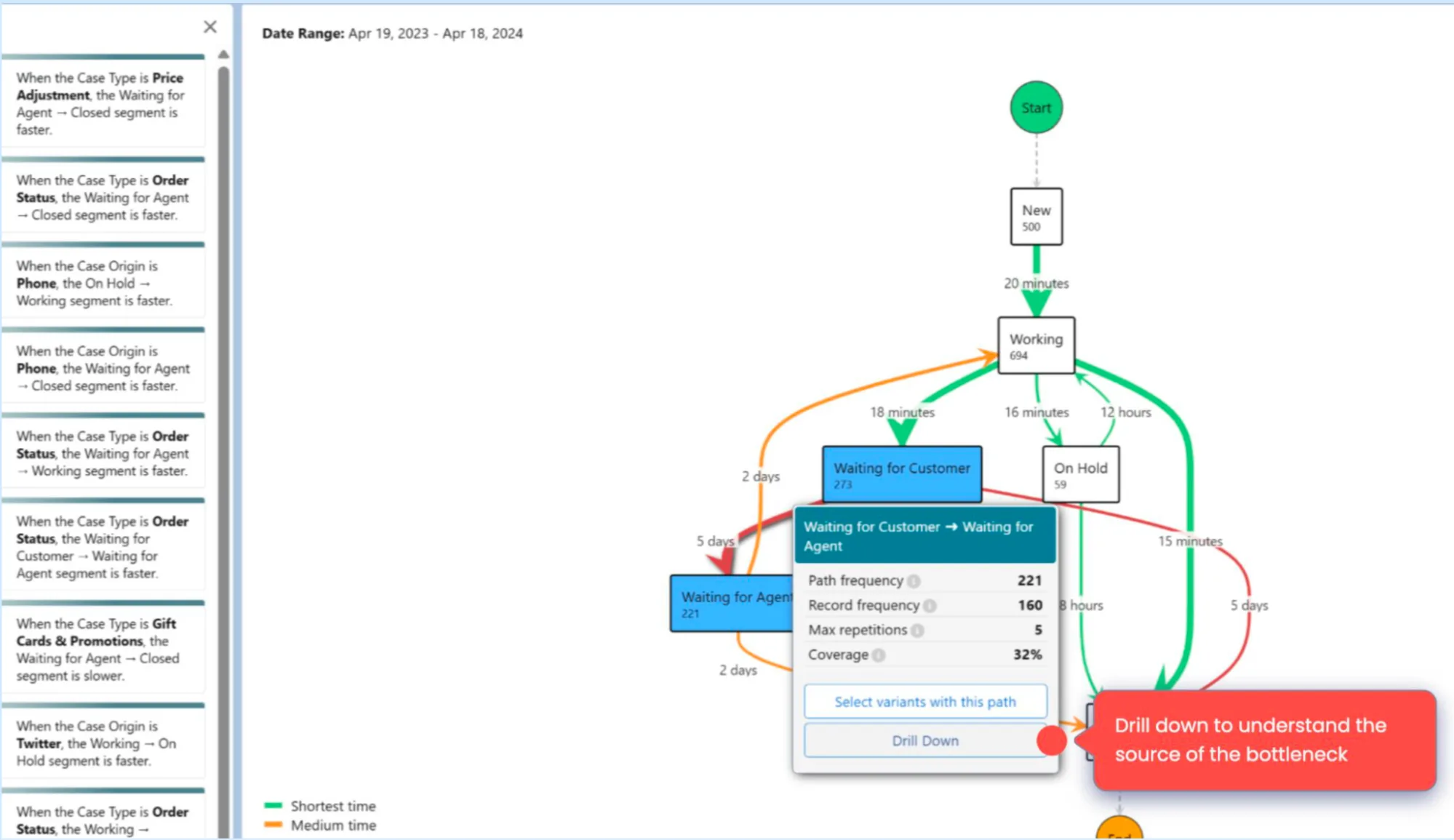
Don’t forget, not every process is a good candidate for agentic automation. Some workflows will be too ambiguous, too infrequent, too high-risk, or too dependent on human judgment to meaningfully benefit from autonomy today. Part of selecting the right use case is validating whether automation will actually improve effectiveness, efficiency, consistency, or scalability in measurable ways. In many cases, the best outcome may be a human-centered process augmented by agents – not replaced by them.
Early successes will build expertise, and your thoughtful approach to evaluation will earn the confidence of your stakeholders for adoption success.
2. Data Readiness Matters
Once we pick our use case, the next step is to evaluate the data that needs to support it to ensure we have the right foundation. This means assessing what data the personas engaged in the process are actually using today and quantifying the issues:
- Are there duplicates or disconnects that lead to missing insights or wasted time?
- Are people being asked to capture information that isn’t readily available to them but could be sourced from other trusted systems?
- What information is essential for automated decisions versus requiring human judgment, and how can we describe these in ways machines can simulate?
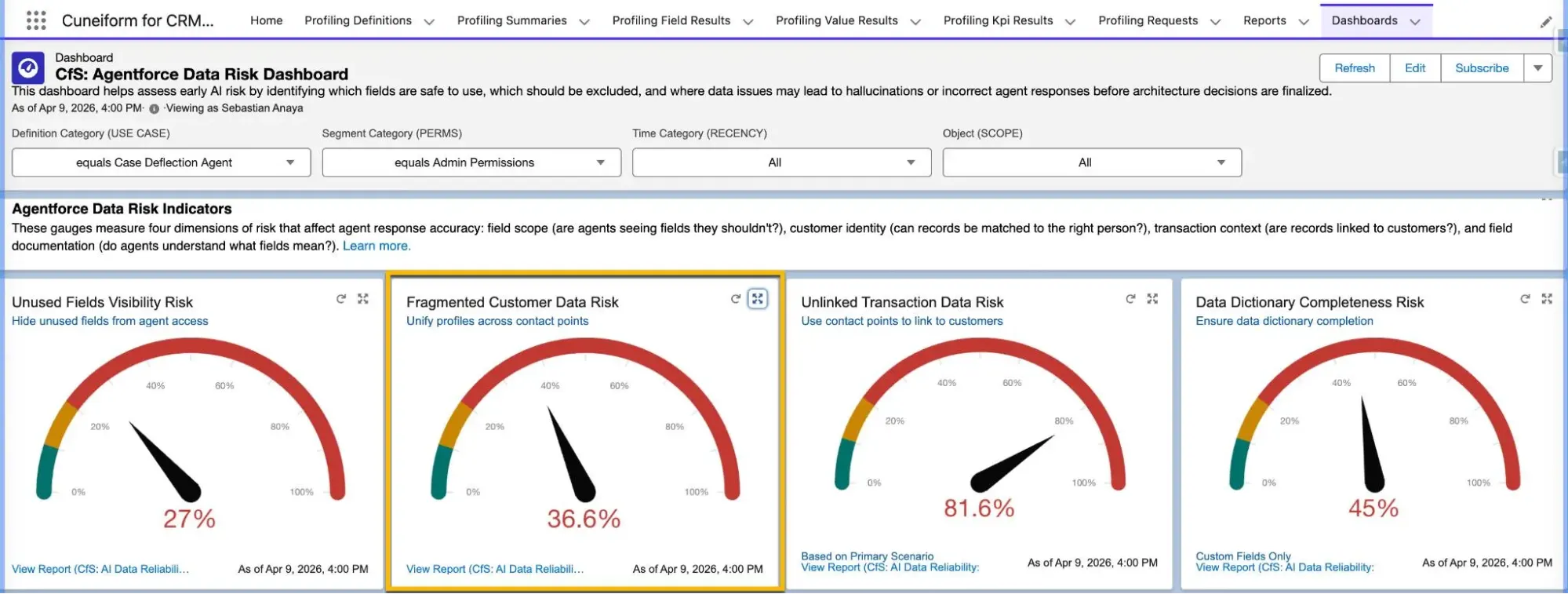
Understanding what has historically limited effectiveness or efficiency is essential input for architectural and design decisions – these insights shape guardrails and ultimately determine how successful the agentic solution can be.
3. Guard Rails and Governance
Agentic systems require strong design discipline. Automation without oversight can amplify errors just as easily as it scales value. Key practices include:
- Limit what fields an agent can access to only reliable, populated data.
- Decide when to use probabilistic vs. deterministic retrieval, ensuring the underlying data supports the choice.
- Use unified customer profiles for a complete, contextual understanding rather than relying solely on LLMs.
- Clearly define when an agent should hand off to a human.
A recent LinkedIn post by Engin Utkan, with commentary by Francis Pindar, highlighted how many Flow implementers still skip fault paths. If that’s common even in basic automation, then disciplined design is critical in agentic systems.
4. Cultural and Organizational Change
Just like the digital transformation era, adoption will be determined first and foremost by how we approach the opportunity. We need to understand the potential to pilot, then embrace and expand. We must measure and communicate the value we deliver and the lessons learned from both successes and failures so that everyone benefits and matures together.
For IT, data, and Salesforce professionals, it’s critical to remember past journeys while recognizing there are new ways to solve old problems – and that some of these new approaches may, in fact, be better. At the same time, we must preserve past best practices. For example:
- DO automate customer data unification with Data 360 instead of relying on error-prone CRM record merges that still fail to provide a complete or contextual understanding of customers across silos.
- DON’T develop or modify solutions directly in production – test them in sandboxes first.
- DO leverage unstructured data sources when summarizing content or uncovering insights.
- DON’T rely on LLM interpretation when consistency is required. Instead, develop and verify structured data extraction processes from unstructured documents.
- DO keep learning – not just new features, but implementation best practices – and share your knowledge to uplift the entire ecosystem.
The agentic enterprise won’t emerge simply from adopting tools; it will arise from the collective discipline, experimentation, and shared learning of everyone involved.
Learn from the Past
If we look back at previous waves of transformation – from Victorian era train routes to early days of cloud or digital transformation solutions – we see a familiar pattern. There are always early winners and early laggards, and the difference is rarely about access to technology. It’s about understanding the journey.
Some organizations move too quickly without grounding their approach, while others hesitate waiting for perfect readiness. At the same time, every major shift follows a recognizable arc: excitement builds, expectations peak, reality sets in, and eventually the technology stabilizes into something practical and productive. Agentic AI is no different – we are simply early in that cycle.
What separates successful organizations is not whether they move first, but how they move. Healthy skepticism plays an important role – asking “are we ready?” is necessary – but waiting for certainty often leads to missed opportunities. The organizations that succeed treat transformation as a continuous investment rather than a one-time project. They focus less on novelty and more on measurable outcomes, linking new capabilities back to real business value. Most importantly, they learn as they go – iterating, refining, and building capability over time rather than expecting immediate perfection.
Final Thoughts
We are at the beginning of a major shift – the move toward agentic enterprises. For those in the trenches – architects, consultants, solution engineers, and data leaders – this means:
- Be bold about opportunity.
- Be rigorous about design, data, and guard rails.
- Choose use cases strategically and deliver iteratively.
- Recognize that readiness is as much cultural as it is technical.
This evolution is as transformative as past industrial, digital, and web revolutions. My invitation to you: where are you on your journey to becoming an agentic enterprise? What lessons are you carrying forward – and what open questions are you exploring?