





Is the Salesforce ecosystem in decline? It depends on where you look. Salesforce itself continues to grow, with billions of dollars in revenue and rapidly expanding AI and data businesses. The consulting ecosystem, meanwhile, has reached record numbers, with thousands of new partners entering the market.
But beneath these figures, demand for Salesforce talent is falling, larger consulting firms are shrinking, and professionals are finding it harder to secure new roles and negotiate higher salaries. These trends raise an important question about the state of the Salesforce ecosystem in 2026. Is it merely undergoing a temporary slowdown, or a more fundamental contraction? By looking at Salesforce’s financial performance, the changing shape of the partner network, and the latest talent and salary data, we can take a closer look at this question.
Salesforce Itself Is Growing, But Losing Market Share
Starting with the ‘mothership’ itself, we see some clear growth. Salesforce’s Q2 ‘27 results revealed revenue of $11.3B, up 11% Y/Y and in CC, including a $456M Informatica contribution. The company raised full-year FY27 revenue guidance to $46.1B to $46.4B, up 11% – 12% Y/Y and 11% Y/Y in CC.
Perhaps more importantly for the future of the ecosystem, Agentforce and Data 360 annual recurring revenue (ARR) reached almost $3.9B, up over 210% Y/Y. Agentforce ARR exceeded $1.5B, up over 240% Y/Y.
It’s worth noting that the Informatica share is doing some lifting in that 11% Y/Y growth figure, but even without it, the company is still growing.
But even so, Salesforce is losing a slice of the CRM market share. The International Data Corporation (IDC) ranked Salesforce the #1 CRM in 2025, leading all CRM vendors with a 20% market share. This is a decrease from 20.7% in 2024.
So, Salesforce the company is growing – but that doesn’t tell the full story.
The Consulting Ecosystem Is Very Healthy
According to the latest 10k Salesforce Ecosystem Report, released in 2026, the number of consulting partners has now hit a record 4,247, an increase of 14%.
That growth isn’t coming from the biggest players. For the first time ever, each of the top System Integrators (SIs) reported a decline in certified Salesforce talent, while small firms with five or fewer certified experts grew 32% – now representing just over half the ecosystem.
The new consulting model consists of more firms but with fewer people and higher output per person thanks to AI, according to 10K.
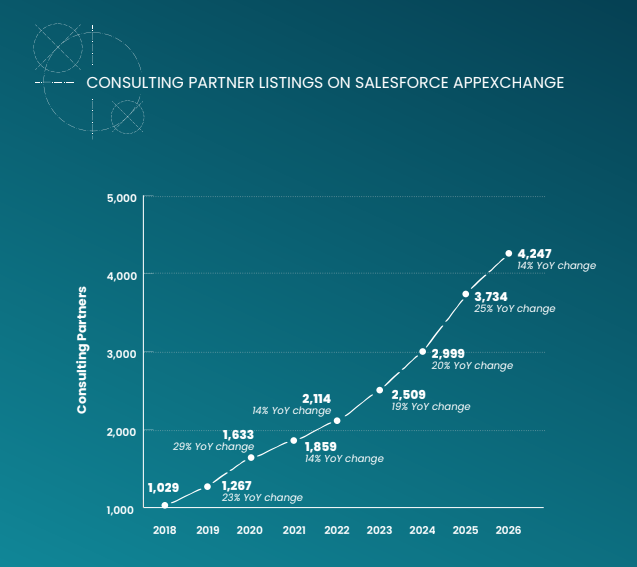
This partner ecosystem growth is entirely concentrated at the small end of the market. Firms with between one and five certified experts grew 32% YoY, now comprising more than half (51%) of all partners. Since 2021, this segment has grown by 1,286 firms, the largest increase of any tier.
When you combine this with the six-to-ten tier – which grew by 11% – almost two-thirds of all consulting partners have 10 or fewer certified experts.
The story is very different for the big players, with every consulting partner tier above 10 experts shrinking:
- 11-50: -2%
- 51-100 -6%
- 101-500 -12%
- 501-1,000 -48%
- 1,000+ -13%
This being said, scale still owns the talent, with the 21 firms that have 1,000+ certified experts holding 54% of all certified consulting talent.
Demand for Talent Is Shrinking
Global demand for Salesforce talent has shrunk. Last year’s 10K report painted a picture of cautious optimism, with an 8% Y/Y increase in demand – albeit somewhat drowned out by a 27% growth in supply.
This year’s figures are back into negative growth. Following 2025’s rebound, overall demand fell 13% Y/Y. AI, data, and specialized industry skills have risen sharply while generalist categories have dropped, the 2026 report’s authors write.
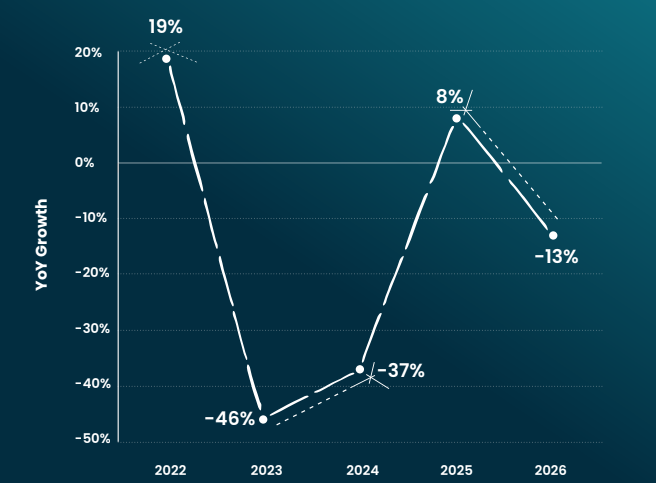
While this might seem like a return to the dark days of 2023 and 2024, with -46% and -37% growth respectively, the 10K report authors insist that it isn’t nearly so dismal.
“The declines of 2023-24 were broad-based pullbacks: nearly every role, region, and category fell together as companies froze digital spending,” they write. “The 2026 contraction is more nuanced. Yes, demand for generalist platform skills slid. But demand for AI, data, and revenue management skills grew dramatically in several categories.”
In other words, companies still need Salesforce talent – but it’s just a different kind of talent.
This is borne out in Salesforce’s own financial results, with Agentforce ARR exceeding $1.5B – up 240% Y/Y – in Salesforce’s Q2 FY2027 results. Combined Agentforce and Data 360 ARR is approaching $3.9B.
Meanwhile, growth in Salesforce’s core Sales and Service products lagged the company average, again showing the same generalist vs specialist divergence which we’re seeing in the job market.
But for the average Salesforce professional, the decline can feel very real. Our Salary Survey 2026 revealed even more difficult realities across the job market as a whole.
As many as 89.4% of respondents said the market was more challenging than in previous years, and 55.2% reported seeing fewer opportunities within their role.
For those who had changed jobs, 41.6% said their salary had decreased, compared to 22.6% who reported an increase.
That’s real evidence for declining worker bargaining power.
Final Thoughts
The evidence suggests that the Salesforce ecosystem is not simply growing or declining. Salesforce is still a substantial and growing business, with an expanding partner network and demand for specialist skills in AI, data, and revenue management creating new opportunities.
But those figures obscure a less comfortable reality for the Salesforce ecosystem: growth is increasingly concentrated in particular areas, while generalist roles, larger consulting firms, and the bargaining power of individual professionals are facing pressure. The ecosystem is changing shape, and not everyone is going to benefit from that.