








For as long as we’ve been doing surveys and writing about Salesforce careers, “who would you hire next?” almost always had the same answer: developer. Last year’s SF Ben Architect Survey confirmed it, with 19.9% of architect respondents saying their team needed a developer, which is nearly double the next closest role (technical architect, at 11%). It wasn’t even close!
This year, though, it’s a different picture entirely. When the 2026 SF Ben Architect Survey asked a question of which role they would hire first if budget wasn’t the constraint, developer didn’t just lose its lead – it fell out of the top three.
Guess what took the top spot instead? Prompt engineer / AI specialist, a role that wasn’t even offered as an option on last year’s survey. What does this signify in the current state of the ecosystem? Read on.
Comparing 2025 and 2026
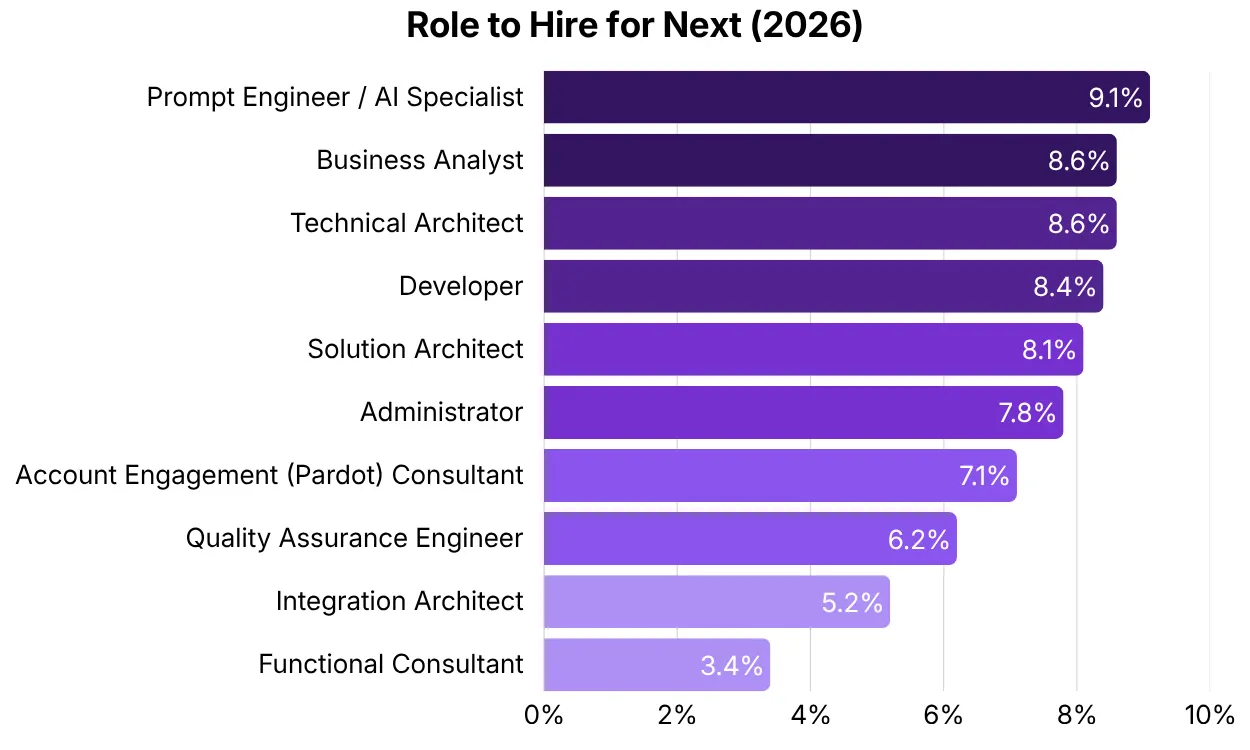
Two things jump out in this year’s results. First, the winner: Prompt engineer / AI specialist, out in front for the first time it’s ever appeared as a choice. Second (and honestly the more interesting story) is how flat the whole list is.
If you notice the gap between first and fifth place, it’s less than a single percentage point. So despite having a new role at the top for the first time, we can’t really say that it’s winning by a landslide. In fact, nobody is actually winning this by a landslide, and it seems the ecosystem’s hiring wish list has fractured into a genuine toss-up.
Compare that to 2025, where the list looked like this:
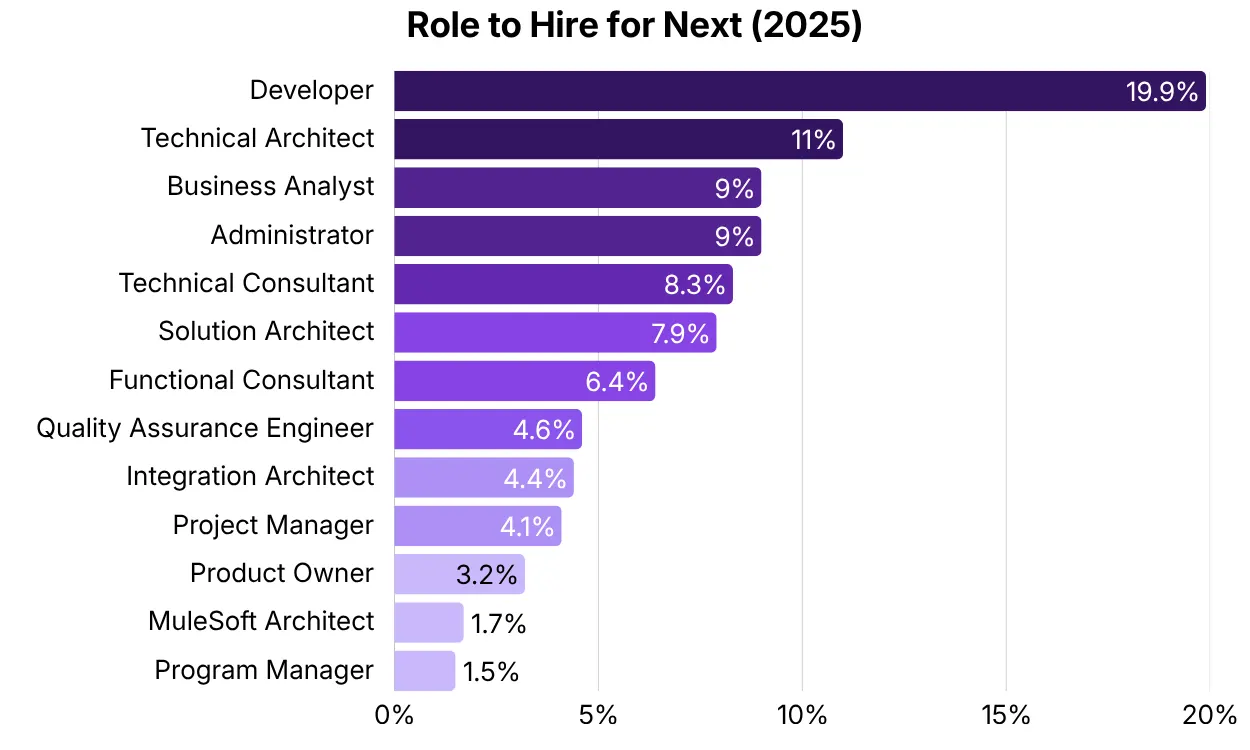
Not only did developer come in at the top, but it was also in a different league, with nearly nine points clear of second place. But a year later, that same role is down to 8.4% and is no longer distinguishable from the pack.
A Hiring Trend, or Is It a Title Still Finding Its Shape?
I ask this question because my colleagues Tim Combridge and Tom Morgan published a piece the same month as the survey results went out, arguing close to the opposite case. Their deep dive found that the dedicated “AI specialist” job title barely registers, and that prompt engineering specifically is being absorbed as a skill inside existing roles (for example, admins learning Setup with Agentforce, or developers picking up Agentforce Vibes and Claude Code) rather than spinning up as its own career track.
They cite an academic study that found just 72 real prompt engineer listings across more than 20,000 LinkedIn job postings. Based on these findings, it seems a bit contradictory to AI Specialists or Prompt Engineers coming out as the most-desired role to hire, right?
So which is it? Well, I think both things are true at once. What architects want to hire or would recommend hiring vs. what companies are actually posting job requisitions for are entirely two different data points, and are actually measured at opposite points in the hiring funnel.
While our survey captured intent, the job-title data captures what’s already been formalized. The survey data only shows where architects feel the gap is widest right now. However, intent almost always leads to formalization, even though it can take years.
The Current State of AI in the Salesforce Ecosystem
A few other data points from the same survey back up why “someone who can actually run AI” would suddenly jump to the top of architects’ wish lists:
- AI usage among architects is basically universal now: 96.7% use AI regularly or ad hoc. This is up from 88.9% last year, and daily/regular use jumped from a minority to 63.6%.
- Confidence in AI hasn’t kept pace with adoption: A third of architects (32.6%) still feel behind their peers on AI skills, and average confidence in architecting Agentforce solutions sits at 61.7% (better than last year, but far from settled).
- The question of “can we afford it” has transitioned to “can we trust it“: In 2025, cost was architects’ #1 barrier to AI success (21.3%). But in 2026, trust has overtaken it (19.3% vs. 16.1% for cost), with skills/knowledge gaps not that far behind at 19%.
- Data readiness is the elephant in the room: 58.2% of architects cite data security, and 57.7% cite data quality as their biggest concerns preparing for AI.
Put together, current teams seem to be already all-in on AI, increasingly nervous about trust and governance rather than budget, and looking for someone specifically dedicated to closing that gap because right now, that responsibility is scattered across whoever on the team has the bandwidth.
The Rise of AI-Assisted Coding
An obvious trigger sitting right underneath these numbers is how good AI-assisted coding got over the past year. If an admin or architect can point an AI tool at a well-specified problem and get back a working Apex trigger or LWC component, then why hire a developer to write it, when you could hire someone who knows how to direct the AI to write it instead?
To me, that’s the plain-English version of what “prompt engineer / AI specialist” represents on this list, and it lines up with everything else in this survey.
But I want to be careful about which conclusion that trigger actually supports, because I think there are two genuinely different ways to read into it, and I don’t think that only one of them is right.
I’ve argued pretty consistently that AI-generated code without a human who actually understands the org, the business logic, and the reasons decisions were made in an org is a liability, not a shortcut. The value a developer brings is the context that lives in their head and nowhere else.
If that’s true, then “hire someone who can control AI perfectly instead of a developer” doesn’t really solve the problem, but instead moves the risk elsewhere. This reading relies on the notion that the AI Specialist is standing in for the developer, that if AI can generate working code, the skill that’s needed becomes directing the AI well.
The second one treats the AI specialist as less of a replacement for devs, but more a new skill set that projects need in addition to devs. It’s a more optimistic take in my opinion, where AI has added a new layer of work (such as prompting well, reviewing AI output, making sure AI tools are well-grounded, etc) that nobody on the team owned before. A new role also means more new job opportunities.
I don’t think the data settles which of these is the more accurate read, but regardless of whether AI-assisted coding is behind this shift at all (replacement or addition), it doesn’t change the fact that code running critical business systems needs someone in the room to actually understand what it does and why. Because either way, the risk of nobody on the team being equipped to catch a seemingly-right AI output is still the same risk.
Final Thoughts
If you’re an architect, admin, or developer reading this and wondering whether to chase an “AI specialist” title: don’t rebrand yourself just yet! The more future-proof move is the one the survey is pointing to, where architects say using AI tools inside real projects is one of the most effective ways to advance a career (second only to general hands-on experience).
In other words: you don’t need the AI specialist title to do the work that it implies. Given how tight this year’s list is and how new the category looks, that work is very much up for grabs.