

One of the common questions and decisions that architects face is, “Should we build this solution from scratch, or buy one that’s readily available?”
The answer usually depends on a lot of factors such as business needs, budget, user adoption, and more. Last year’s survey actually showed that over half of respondents had no strong preference either way. After all, building and buying each come with their own advantages and tradeoffs.
This year’s SF Ben Architect Survey tells a different story, though. Across the wider enterprise tech world, teams are increasingly leaning toward building, and AI-assisted development seems to be the biggest reason why. Salesforce has leaned into this too, with nearly every new Agentforce feature pushing further into AI-assisted build and opening up the gates of custom development to more and more admins.
So, you’d expect this year’s survey to mirror the same trend. But does it? Let’s dive in.
The Numbers Say Otherwise
Turns out, the answer is no.
In last year’s survey, 59.7% of architects said they had no strong preference between building and buying. It was context-dependent, “it depends” territory. This year, that number dropped to 42.3%. And among the architects who do have a preference now, more of them are leaning toward buying (30.9%) than building (26.7%).
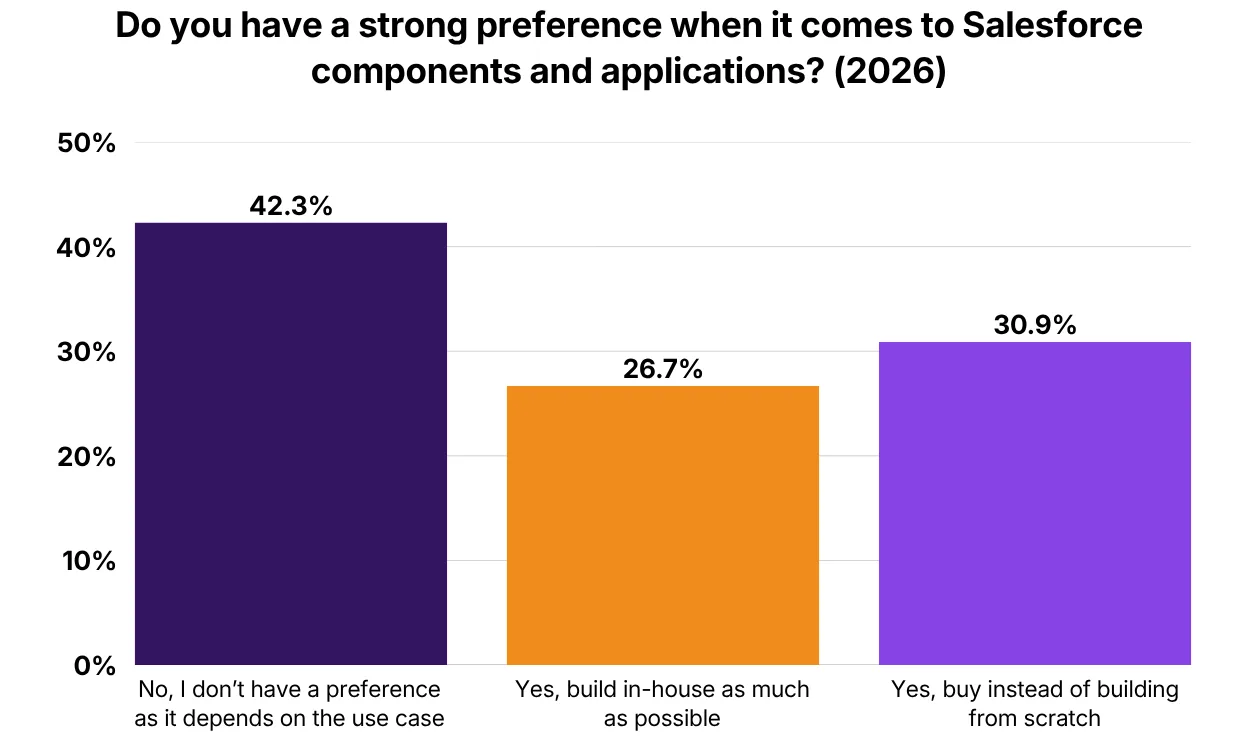
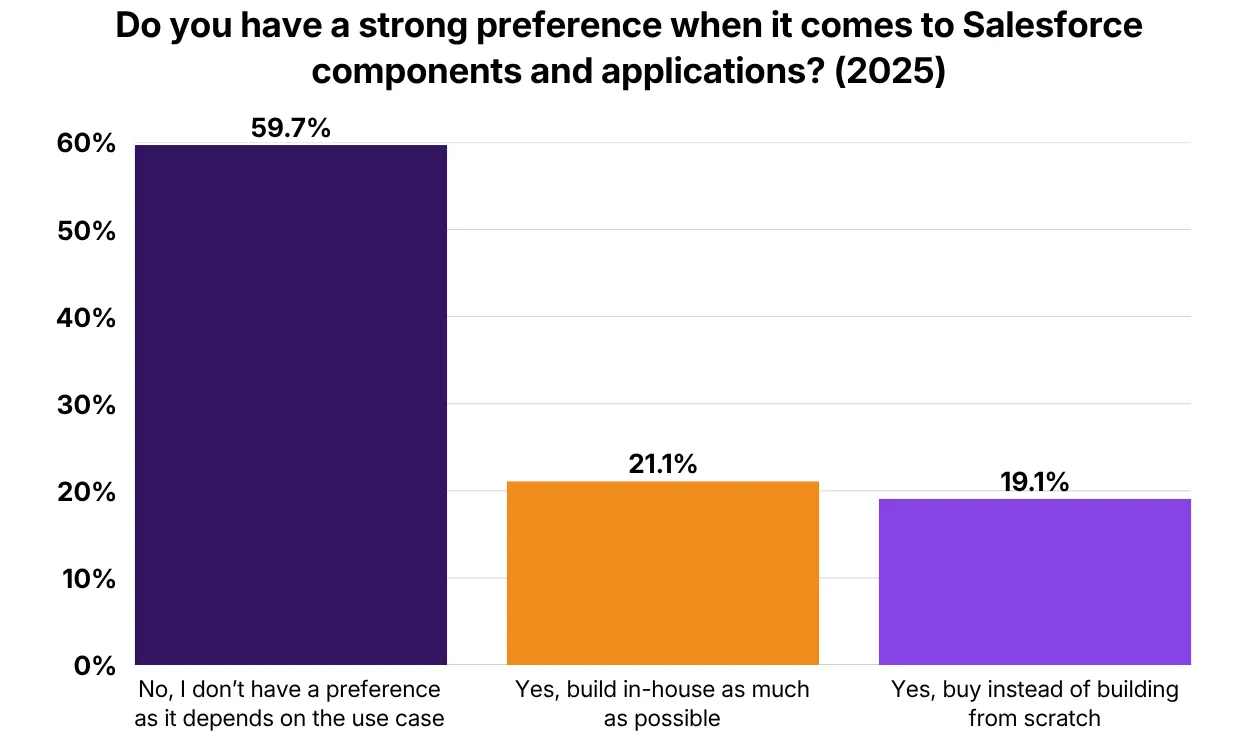
If you noticed, last year’s results show that for those who do have a preference, building edges out buying. But this year, buy has edged out build. So while we watch the rest of the enterprise tech world picking up the pace on custom development, why have Salesforce Architects seemingly tapped the brakes?
For context on that broader trend, Retool’s 2026 Build vs. Buy Shift report, based on a survey of 817 of their customers and builders, found that 78% of teams plan to invest more in custom internal tools this year, and 35% have already replaced a SaaS product with something they built themselves. AI-assisted development is largely credited as the driver for these stats. A working prototype, which used to take months to produce, can now take only a matter of days thanks to AI. And when this is the new reality, the “buy” case gets harder to make.
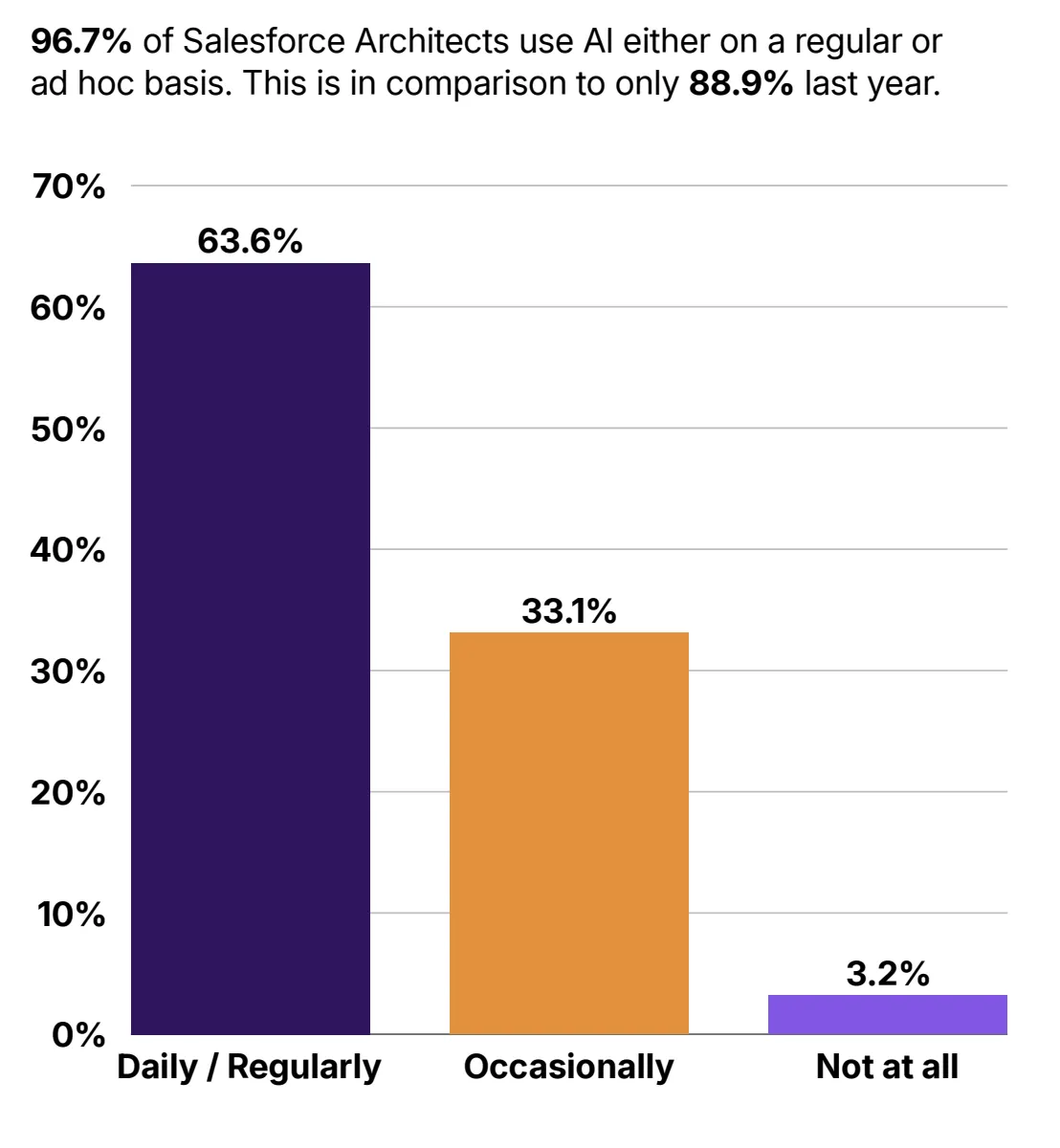
Salesforce Architects have access to the same AI tools. In fact, this year’s survey found that AI usage among architects is close to universal: 96.7% now use AI regularly or on an ad hoc basis, which is almost 10% up from 88.9% last year. So, it’s not that architects were slower to adopt AI. In fact, they adopted it just as fast as everyone else did.
So, why does it seem like they moved in the opposite direction on build vs. buy? We weren’t the only ones who noticed. Ben Bates, Salesforce Technical Architect at Flight Centre Travel Group, flagged the same shift when reviewing this year’s data:
“Broader enterprise trends show custom development accelerating, driven by AI. Yet Salesforce architects are moving the opposite direction.”
Ben Bates, Salesforce Technical Architect
Do Architects Trust the AppExchange More?
It’s easy to immediately assume that this shift means architects are suddenly browsing the AppExchange (it’s AgentExchange now, actually) more often, but the data doesn’t back that up. When asked how frequently they search the AppExchange before building a custom solution, the answers this year look a lot like they always have: 46.8% said “sometimes”, 24.5% said “rarely”, and only a mere 4.2% said “always”.
In other words, the habit of checking the AppExchange first hasn’t really changed. What changed is the preference architects land on once they’re actually deciding. So, this isn’t actually a marketing win for the AppExchange. As expected, it looks like architects are re-weighing what building actually costs them now.
“Buy” Doesn’t Always Mean AppExchange
When architects say they lean toward buying, that also doesn’t always mean installing an AppExchange package. This year’s survey found that 76.4% of architect respondents rely on external partners or systems integrators for at least part of their development work, which could mean project-by-project, for specific functions, or for their entire build.
So “buy” can mean either an app (AppExchange or third-party), or handing the build to someone else. Either way, it shows how architects these days are choosing not to own the full weight of custom development in-house, which lines up with the same story the headline stat is telling. And it makes sense! If Salesforce’s complexity is what’s driving the shift away from building, then handing that complexity to a partner or a packaged app is just another way of buying your way out of owning it.
Salesforce Isn’t Getting Simpler
This seems like the number one reason as to why architects are going against the trend.
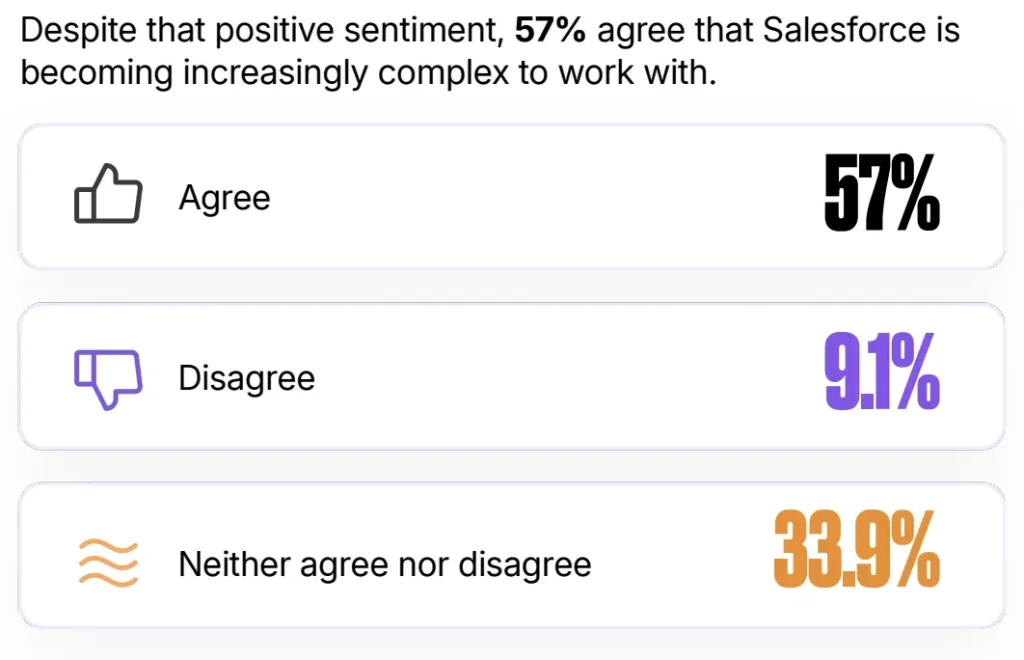
More than half of architect respondents agree that Salesforce, as a platform, is becoming increasingly complex to work with, with only 9.1% who disagree.
AI-assisted development tools are good at generating a Flow or an Apex trigger quickly. But what they’re not necessarily good at is helping you predict how that new piece of custom logic interacts with your sharing model, your governor limits, your existing automation, or the next three releases.
Yes, AI may have insights, which is exactly why Salesforce keeps pushing Agentforce developments, for the exact same reason that your org’s context is one of the (if not the most) important factors in making a successful custom build.
But on most platforms, “building” can simply mean writing code once, or designing the automation once. On a complex platform such as Salesforce, it often means writing code or building something that has to survive years of platform change on top of it.
What’s more is that this is a cost that doesn’t show up on day one, and AI-assisted development doesn’t exactly shrink it either. AI is here to speed up execution, but you can’t generate the years of institutional knowledge required to know it won’t quietly break your existing automations in the next few months.
Final Thoughts
Everywhere else in enterprise tech, AI is lowering the cost of building, and teams are responding by building more. But inside Salesforce, the platform’s complexity is climbing just as fast (if not faster) than AI can bring the cost of building down.
At the end of the day, the question of “build-vs-buy” still depends largely on a whole lot of factors. But those architects who buy aren’t doing so because AI-assisted development failed them.
If anything, it’s actually the opposite, and they might even be some of the platform’s most enthusiastic users. Architects are buying solutions because the platform’s complexity and rapid innovation are something they know like the back of their hand.
It takes an architect’s mind and expertise to know exactly what a custom build costs to maintain on such a platform, even long after the AI-assisted part is done.