

Every revenue motion begins inside Salesforce. An opportunity is created, a quote is generated, a contract is assembled, an onboarding package is prepared, and a procurement request is initiated.
Then the process leaves Salesforce.
Documents are sent for review, approval, negotiation, signature, compliance review, or execution. Information changes while those documents move through the business – new terms are added, approvers make edits, customers negotiate conditions, and legal teams insert obligations.
What happens when the document eventually comes back to Salesforce? Or, more specifically, what happens to the data within that document?
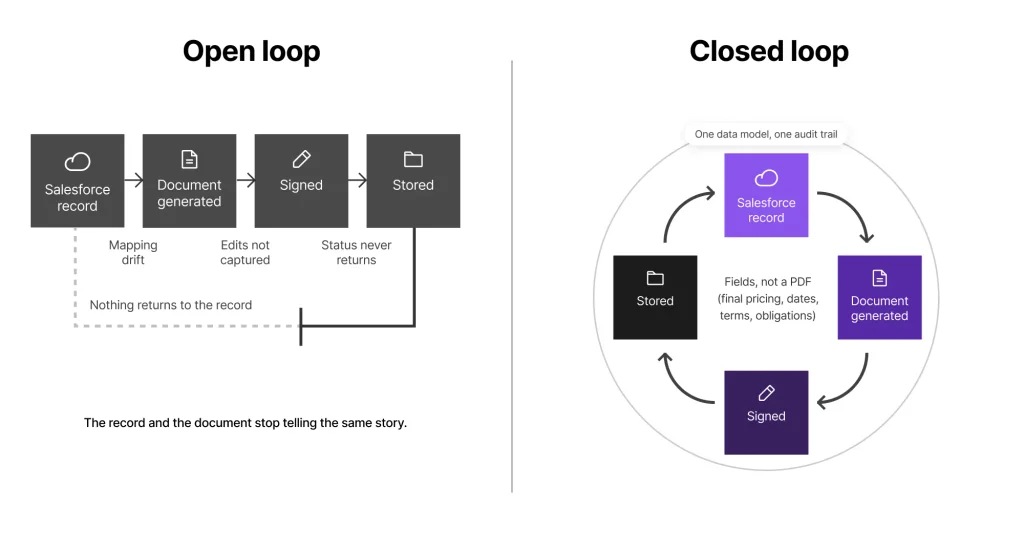
This is where the Salesforce → Document → Salesforce loop breaks.
The challenge facing many organizations in 2026 is maintaining data integrity after documents leave the CRM and return with changes. Every disconnected handoff creates opportunities for information loss, manual work, and inconsistent records.
The result is a growing reconciliation tax that quietly compounds over time.
Where Document Loops Break Most Often
While every organization has unique processes, three areas create the majority of CRM synchronization problems.
1. Execution
Execution is the most visible failure point.
A sales contract, order form, quote, or amendment is generated from Salesforce and routed for review. During negotiations, critical information changes, such as pricing, contract terms, product quantities, and effective dates.
When the agreement gets signed, the final document often contains information that no longer matches the originating Salesforce record.
Someone has to manually go in and identify those differences and update the CRM. That’s an efficiency killer.
In high-volume organizations, that work rarely happens perfectly or consistently. Small discrepancies accumulate across hundreds or thousands of transactions. Forecasts become less reliable. Revenue reporting drifts. Customer records lose accuracy.
The cost is rarely tied to a single mistake. It appears as dozens of small corrections performed every week by sales operations, revenue operations, finance, legal, and customer success teams.
2. Obligation Management
Many organizations treat signed documents as the end of a process when, in reality, execution of a document is often the beginning.
Contracts frequently contain obligations that should drive future activity. Renewal dates, service commitments, pricing adjustments, notice periods, compliance requirements, and customer-specific terms all need to be tracked somewhere.
When those obligations remain trapped inside documents, Salesforce loses visibility into future actions.
Over time, information becomes fragmented across systems and individuals, with data shared in spreadsheets, Slack channels, inboxes, personal task lists, or calendar reminders.
Missed renewals, delayed escalations, incorrect billing, and preventable customer disputes often trace back to obligations that never made the return trip into the CRM.
The document contains the information, but the system of record doesn’t – and there is a significant cost attached.
World Commerce and Contracting research found that poor contract management erodes an average of 9.2% of contract value. Across a portfolio of $300M in contracts, that is roughly $27M leaking out of terms the organization already negotiated.
3. Auditing and Compliance
The third failure point typically receives attention only after a problem occurs.
Auditors, legal teams, and compliance stakeholders need confidence that business processes happened correctly. They need evidence of approvals, version history, policy adherence, and execution details.
When document workflows operate outside connected systems, organizations often struggle to reconstruct what happened. There is no single source of truth that verifies which version was approved, who authorized an exception, when the customer was notified, or which terms changed during negotiation.
Getting accurate information can require manual investigation across email threads, shared drives, document repositories, and disconnected workflow tools.
The direct cost appears during audits, compliance reviews, and disputes. But perhaps more impactful is the indirect cost that comes with reduced trust in an organization’s data.
When leaders cannot easily verify how a transaction occurred, confidence in reporting and operational metrics declines as well.
Why the Costs of Broken Document Loops Compound
The most expensive CRM problems rarely arrive as major incidents – rather, they accumulate quietly.
A sales operations manager spends fifteen minutes correcting a record. A finance analyst manually reconciles contract values at month-end. A customer success team discovers a renewal date was never captured. A legal team searches multiple systems to locate approval evidence.
Each task seems minor in isolation, but when you apply it across hundreds of documents per month, the operational burden becomes significant. Organizations end up paying skilled employees to reconstruct information that should already exist inside their systems.
Industry statistics make the case, but an organization’s own numbers make the budget. To work out how much a broken document loop is costing, four inputs are needed:
Monthly reconciliation tax = (Number of documents executed per month) x (Share that need manual reconciliation) x (Hours per fix) x (Loaded hourly rate of the person doing manual reconciliation).
Let’s say an organization executing 400 documents a month is manually fixing 25% of those, which takes 45 minutes per document at a loaded hourly rate of $65/hour. That organization’s manual reconciliation tax would be: 400 x 0.25 x 0.75 x $65 = $4,900/month or about $58,000/year.
Treat that figure as the floor. It counts only correction labor and excludes expensive failures such as the missed renewal, the invoice built on a stale contract value, and the audit that takes a week to answer.
And unfortunately, the hidden cost is not simply labor. It is the erosion of confidence in the data itself.
When users stop trusting CRM records, they create parallel systems to compensate. More spreadsheets appear. More manual reviews are added. More reconciliation work becomes necessary.
The loop breaks further with every workaround.
A 10-Contract Audit to Find Where the Loop Breaks
There’s no need for a consulting engagement to locate breaking points. Use a simple framework.
Pull the last ten executed agreements and compare each one to the Salesforce record it came from. Ask four questions for each agreement:
- Do the final price, quantities, effective dates, and terms in the executed document match what the record shows today?
- Is every forward-looking obligation, such as the renewal date, notice period, and service commitments, captured as a field in Salesforce, or does it live only in the agreement?
- Is it easy to tell from Salesforce alone which version was signed, who approved any exceptions, and when?
- How many different systems or windows had to be opened to answer the first three questions?
Where failures cluster, handoffs are broken. Mismatched terms point to negotiation changes that never made the return trip. Missing renewal dates point to a post-signature extraction gap. And needing multiple systems to reconstruct one approval points to a fragmented audit trail (which will be just as fragmented in front of any auditor).
The Right Architecture for Closing the Document Loop
Many Salesforce Admins integrate document tools to automate their repeatable processes. The trouble is that most tools automate one or two steps of the document journey, and the loop breaks at the handoffs between them.
Closing it is an architecture decision before it is a tool decision. Regardless of the stack an organization chooses to run, a closed loop is characterized by five properties.
- The write-back is structured. When a document is executed, what returns to Salesforce is not a PDF attachment. It is fields: final pricing, quantities, effective and renewal dates, payment terms, notice periods, and any negotiated obligations, all written to the record where reporting and automation can act on them, and with a link to the executed document.
- Negotiation changes are captured as deltas. Terms often change between generation and signature. A closed loop compares the executed version against the version that left Salesforce and treats the differences as the write-back set. When a human has to re-read redlines, data inevitably gets lost.
- Conflicts have an owner. Decide, field by field, which system wins. Account master data belongs to the CRM, and the document should never overwrite it. Negotiated commercial terms belong to the executed document, and the record should update to match. When the two disagree in a way the rules do not cover, the conflict surfaces as an exception for a person to resolve. A silent overwrite in either direction is how records lose credibility.
- Exceptions and approvals are governed, not improvised. Non-standard discounts, altered terms, and skipped steps trigger defined approval routes with escalation, and each approval is recorded against the Salesforce record, not in an email thread. If an exception can be granted in a channel the system cannot see, the loop stays open no matter what tools an organization owns.
- The audit trail is unified. Every state change, from generated to edited to approved to signed to written back, is logged with actor, timestamp, and version, all in one place and tied to the record. If reconstructing a single transaction means opening the e-signature tool, the storage system, and an inbox, there’s no audit trail; there’s just a series of logs.
None of this requires a particular vendor. It requires that generation, routing, approval, signature, and write-back share one data model, and that the admin who owns Salesforce can change the rules without a developer queue.
This is the architecture altaFlow is built around. Documents are generated from the Salesforce record, routing and approval rules are configured without code by the team that owns the process, and the executed result writes back to the same record through native bi-directional sync, with the audit trail attached to the record.
Because the whole lifecycle runs on one platform instead of a chain of separate tools, the loop stays closed by design rather than by discipline.
Closing the Loop Is an Architecture Decision
In 2026, Salesforce hygiene has become a loop problem. Documents leave the CRM, change, and return with missing or inconsistent information. The resulting gaps erode trust and create downstream costs that touch revenue operations, finance, legal, compliance, and customer-facing teams.
Organizations that close the loop, whether with one platform or a tightly governed stack, will improve accuracy, visibility, and operational efficiency. Those that leave it open will continue paying a reconciliation tax that grows with every document they process.
Learn more about automating your document workflows with altaFlow in Salesforce.