






Salesforce CEO Marc Benioff has said that he will no longer be using OpenAI’s ChatGPT as he is keenly impressed by Google’s Gemini 3 model. These comments follow OpenAI CEO Sam Altman taking a stab at Slack, arguing that it creates “fake work” and could soon be replaced by an AI-equivalent platform.
Gemini 3 has received positive feedback from several tech CEOs, with the likes of Elon Musk, Andrej Karpathy, and even Altman giving Google’s model the public co-sign. Recent figures show the newly released LLM is performing significantly well and is turning a few heads in the process.
What Makes Gemini 3 So Impressive? (And Where It Struggles)
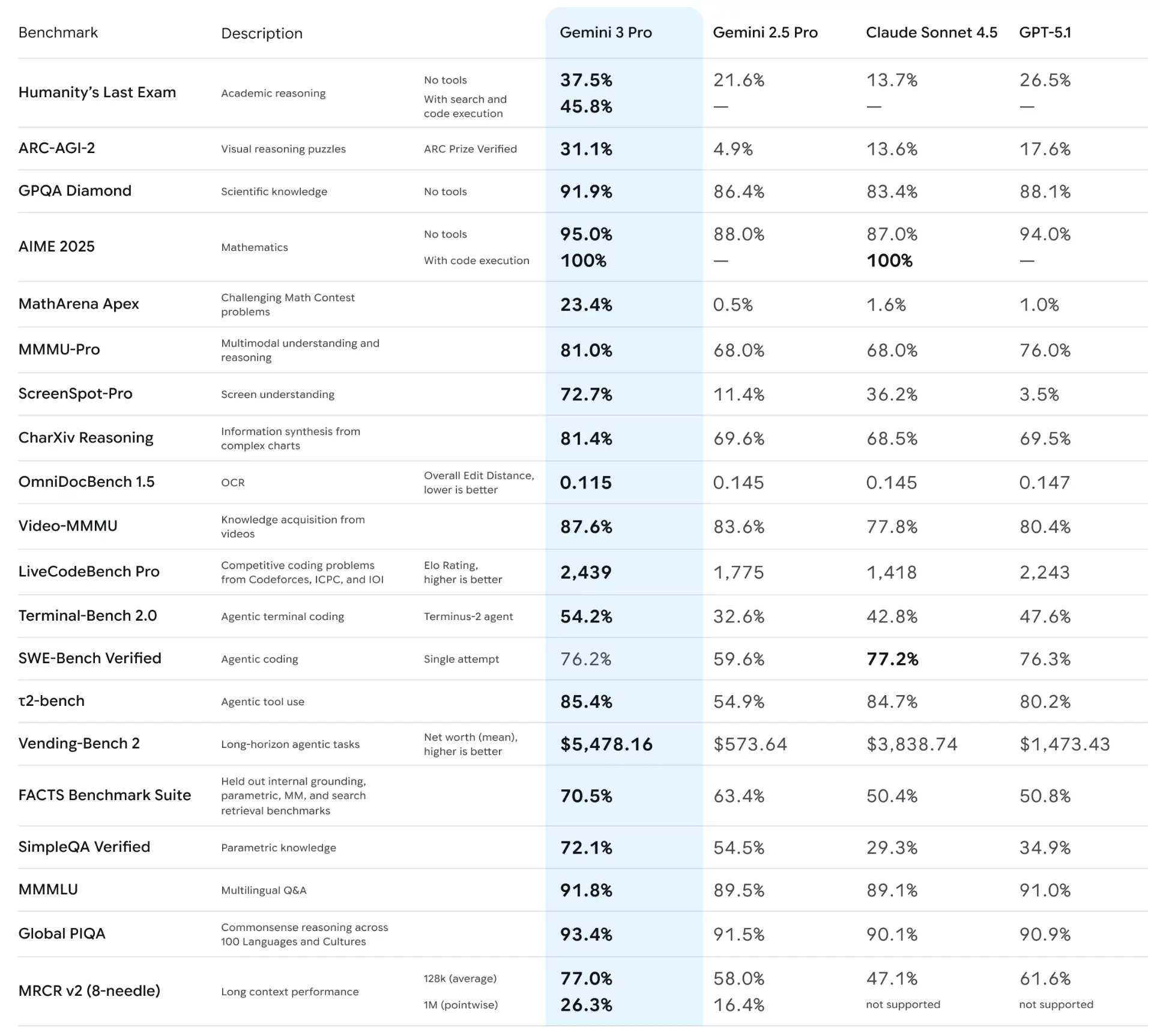
Right now, Gemini 3 is topping almost every leaderboard in the LMArena. Across reasoning, maths coding, video understanding, and more, it outperforms many of the major competitor models.
Google has been raving about it too, with the company claiming that Gemini 3 delivers “unparalleled results across every AI benchmark” compared not only to its previous versions, but to counterparts such as Claude Sonnet 2.5 and GPT 5.1.
Wei-Lin Chiang, cofounder and CTO of LMArena, also recently noted that the new model shows how the “AI arms race” is “being shaped by models that can reason more abstractly, generalize more consistently, and deliver dependable results across an increasingly diverse set of real-world evaluations.”
The hype has been huge, with some researchers framing it as a new frontier for AI. But recently, The Verge came in with quite an important reality check.
When they spoke to people who use AI every day in their work and had experimented with Gemini 3, the verdict was a lot more measured: “Gemini 3 looks impressive, and it does a great job on a wide breadth of tasks, but when it comes to edge cases and niche aspects of certain industries, many professionals won’t be replacing their current models with it anytime soon.”

Looking closer, the reasoning behind this verdict doesn’t come as much of a surprise. It’s a running joke in the AI community that LLMs often suffer from “robotic hand syndrome”, where they’re capable of answering PhD-level prompts extremely quickly, but struggle to respond to queries that should be quite simple to answer. In essence, there’s still a gap between what is generally brilliant and what is specifically reliable.
This contrast is important because it frames how differently AI is evaluated from the top compared to the bottom:
- Executives, labs, and CEOs are looking at the benchmarks, breadth, and big-picture capability.
- Those on the ground are looking at rare edge cases, niche workflows, and industry-specific rules
So the real story here is that whilst benchmark performance is important, it may not always accurately reflect real-world performance. Gemini 3 might be unbelievable on paper – and in many areas, genuinely is – but adoption in highly specialized fields will always lag behind the hype until models prove they can handle the messy, unpredictable corner cases of real business environments.
Benioff, Gemini, and OpenAI
All of this arrives at an interesting time for Salesforce. Just weeks ago, the company announced that it would be integrating Gemini into its platform. At the same time, they reiterated a partnership with OpenAI at this year’s Dreamforce Keynote. On paper, it looks like Salesforce are positioning itself as a fully multi-model.
But then opinions start flying – Altman berates Slack, and Marc Benioff doesn’t want to use ChatGPT anymore. Suddenly, it felt as though everyone was choosing sides in real time.
Holy shit. I’ve used ChatGPT every day for 3 years. Just spent 2 hours on Gemini 3. I’m not going back. The leap is insane — reasoning, speed, images, video… everything is sharper and faster. It feels like the world just changed, again. ❤️ 🤖 https://t.co/HruXhc16Mq — Marc Benioff (@Benioff) November 23, 2025
Benioff’s statement garnered a lot of attention, surpassing a million views on X. It’s a bold statement for the Salesforce CEO to make, given how deeply invested Salesforce supposedly are in OpenAI integrations. But it doesn’t necessarily mean Salesforce are “ditching” anyone, and hints at a much bigger dynamic underneath.
On one side, Altman’s Slack comments could potentially be the early shaping of an OpenAI-built alternative to the collaboration layer.
On the other hand, Benioff talking up Gemini could be strategic framing, especially with Salesforce preparing to roll out more AI-powered workflows and wanting to be seen as model-agnostic, or even aligned with whichever model is winning the narrative at that moment.
The point isn’t that anyone is switching sides. AI power players are very publicly positioning themselves – and Salesforce, sitting between Google, OpenAI, and Microsoft, has every reason to keep its options open.
Final Thoughts
Gemini 3 has certainly hit the ground running, but whether Benioff’s comments are backed by true sentiment or are rooted in marketing motivations remains unclear.
As mentioned, we’re likely seeing Salesforce position itself with the most positive narrative as the CRM giant expands their model-agnostic approach.