





In Salesforce’s consulting world, there have always been the top dogs. Whether you believe the consulting hierarchy has been understated or not, players like Accenture, Deloitte, and Capgemini have long been the top partners in terms of size and growth each year.
This year, the tables have turned. Not only is the number of consulting partners up by 14% YoY (year-over-year), but firms with one to five certified experts grew 32% YoY and now make up 51% of all partners. The boutique-ification of the Salesforce consulting space is happening in real time – here’s what you need to know.
Big News for the Partner Ecosystem
According to the 2026 Salesforce Talent Ecosystem report from 10K, this has been a monumental year for partners. There are now 4,247 consulting partners in the ecosystem, up 14% YoY and up 128% since 2021.
10K explained that even as demand contracted and the largest firms cut certified headcount, more firms entered the ecosystem than left it.
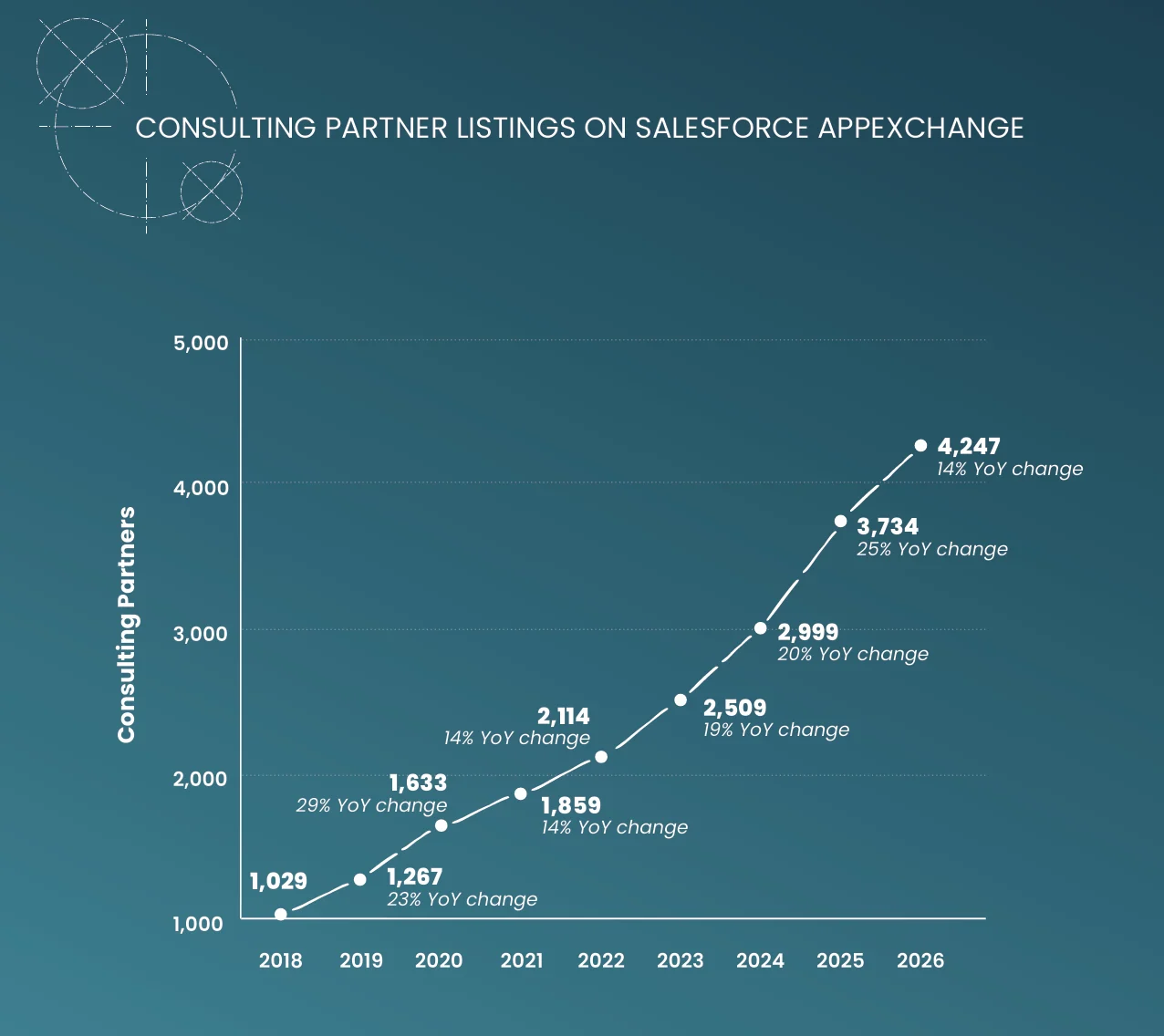
Interestingly, firms with one to five certified experts grew 32% YoY and now make up 51% of all partners, which is the largest five-year increase of any tier (+1,286 partners since 2021).
On the flip side, every consulting partner tier above 10 experts shrank this year. This signals the dawn of the “solopreneur economy” within the Salesforce ecosystem, where the consulting sector is becoming boutique as firms realize they can deliver with fewer people, supported by deep platform knowledge, experience, and tools like artificial intelligence.
It is important to note, however, that according to the report, the 21 firms surveyed with more than 1,000 certified experts hold 54% of all certified consulting talent. Scale still has a part to play in the dominance of partners, but the field is beginning to look a lot more diverse.
Certified Talent Has Contracted
Speaking of certified experts, this year, the number of total certified experts at partners fell to 195,354, down 16% YoY, which is the first contraction in 10K’s history of research. Last year, the number of certified experts had increased by 19%, indicating the end of headcount as strategy.
This is not surprising. 2026 has been significant in terms of restructuring around new budgets and targets – many of which have been focused on AI. This year so far, 144,171 tech employees have been laid off, surpassing 2025’s figures and inching closer to 2024’s figures of 152,992.
More boots on the ground no longer automatically correlates with higher productivity, as many companies investing in AI will have found out by now, and it’s a pattern that extends beyond Salesforce practices. Accenture cut roughly 11,000 roles as part of an AI-focused restructuring this year, and this will likely have a domino effect. If the world’s largest consultancy concludes that AI reduces the number of people its projects require, clients will expect that from every firm they engage.
The Future of Salesforce Consulting
The Salesforce consulting market is an interesting place to be right now. According to our last salary survey, among the 10 most common roles, technical consultants were among the most likely to get a raise when changing jobs. Functional consultants had the highest rate of pay cuts of any of those roles, ahead even of admins at 50.7%. This may have had some impact on the movement and restructuring of the sector, combined with AI influences, layoffs, and general economic factors.
It’s important to remember that there are actually two trends happening at the same time: the number of small partners is growing quickly, and big SIs and private equity buy up the specialists that prove themselves. Last year, 10K found large, well-capitalized partners still growing by double digits and buying smaller firms. 2026 examples include Accordion, a PE-focused financial consulting firm, acquiring Summit Partner A5 in April, and Cloud for Good buying EMS Consulting in March to add financial services, backed by Tailwind Capital.
These two sides suggest different work is happening at each one. The boutiqueification of consulting is opening up the market to solo or small team consultancies, and the big players are leaning into Salesforce’s M&A approach. Consider the two in tandem as a form of sector restructuring, and an inherently good thing for the ecosystem.
10K advises that partners should “think focused and specialized”, as undifferentiated capacity is “being automated out of the market.” This means that if you’re a consultancy that sells generalist delivery, now is the time to pick a specialty. Once you’ve decided on this, the work isn’t done, especially as AI continues to develop. So, on top of this, consultancies will need to be prepared to help customers make sense of what is possible with AI, what is worth investing in, and how it all fits together.
“The strongest partners will move beyond implementation capacity and play a greater role in architecture and strategy, innovation consulting, AI and agent governance, and management of an expanding portfolio of platforms, models, agents, and capabilities,” the report reads.
“Their value will come from reducing complexity, helping customers make better technology decisions, and creating the architecture and guardrails that allow them to continuously adopt new capabilities without constantly rebuilding what sits underneath.”
10K stresses that every firm, regardless of size, should ensure they know how to explain the value of AI, articulate where it can drive efficiency, and indicate where human expertise still matters. This is what will make a successful Salesforce consultancy going forward.
Final Thoughts
The rise of the small consultancy is a fundamental transformation of how Salesforce solutions are delivered. As AI takes over standard build-and-deploy tasks, the market is placing a massive premium on deep domain expertise, high-level architecture, and strategic guidance over sheer headcount. Small, agile practices that can pivot on a dime are finding themselves perfectly positioned to compete alongside – and complement – the industry’s biggest SIs.
Moving forward, success for consultancies of any size won’t be measured by how many certified bodies they can put on a project, but by how effectively they help clients navigate an increasingly complex, AI-driven landscape. Those who master the balance between artificial intelligence and human advisory will be the ones shaping the next era of Salesforce consulting.