







A company may already create invoices from Salesforce, generate a PDF, and send it to the customer. But what happens when a German legal entity needs to issue a structured e-invoice instead?
For Salesforce teams, the e-invoice Europe rollout is complicated by national differences in deadlines, formats, and exchange methods. Salesforce teams therefore need to determine which rules apply to each legal entity and transaction before changing their invoicing process.
Germany and ZUGFeRD give us a good starting point for looking at implementation, while Belgium and France show why the same setup will not fit every European country.
What E-Invoicing in Europe Means for Salesforce Teams
A structured e-invoice contains invoice data in a machine-readable format that receiving systems can process electronically. An ordinary PDF may display the same information to a customer, but it does not provide the structured data required for automated processing.
For an e-invoice in Europe, this structured data is becoming increasingly important, although countries implement the requirement in different ways.
The EU’s VAT in the Digital Age (ViDA) package points in the same direction. From July 1, 2030, cross-border B2B transactions will be subject to Digital Reporting Requirements based on mandatory e-invoicing.
The European Commission estimates that ViDA e-invoicing could reduce VAT fraud by up to €11B a year and lower EU traders’ administrative and compliance costs by more than €4.1B annually over the next decade.
How Mandatory E-Invoicing Requirements Across Europe Differ by Country
Germany, Belgium, and France show how national implementations can differ.
Germany: ZUGFeRD, XRechnung, and the Transition Period
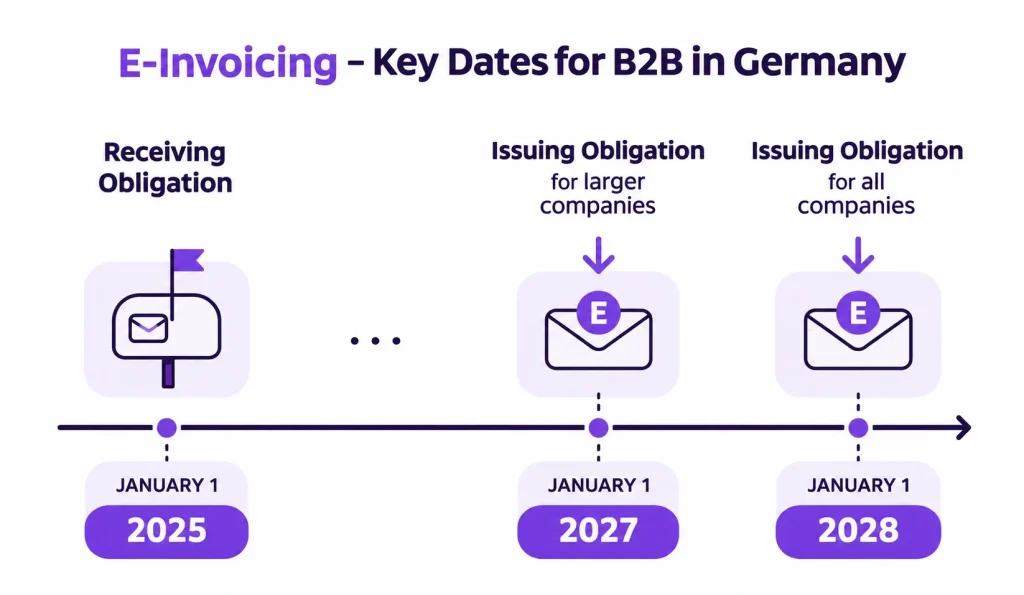
Since January 1, 2025, German businesses have generally been required to receive structured e-invoices for relevant domestic B2B transactions. XRechnung and qualifying versions of ZUGFeRD are among the formats that meet Germany’s VAT requirements.
| Aspect | ZUGFeRD | XRechnung |
|---|---|---|
| Structured data | XML embedded in the PDF | XML file |
| Human-readable PDF | Included | Not included as part of the format |
| Format approach | Combines human-readable and machine-readable invoice content | Structured machine-readable invoice |
Issuing requirements are being introduced through transition periods. Businesses can generally continue using other invoice forms through December 31, 2026. For issuers with prior-year turnover of up to €800,000, that transition extends through the end of 2027. After the applicable period expires, affected domestic B2B transactions require an e-invoice.
An e-invoice can be exchanged through channels such as email, an electronic interface, shared storage, or an online portal.
A 2026 German Confederation of Skilled Crafts (ZDH) survey of 1,926 German skilled-trades businesses found that around one-third were already issuing e-invoices. Among those not yet issuing them, roughly half planned implementation only in the second half of 2027.
Belgium and France: When the Exchange Channel Also Changes
Since January 1, 2026, structured e-invoices have been mandatory for covered B2B transactions between VAT-liable Belgian enterprises. Peppol is the standard exchange route, but businesses can agree on an alternative EN 16931-compliant format and a different secure delivery method. A conventional PDF sent by email does not satisfy the structured e-invoice requirement.
By December 2025, the Belgian government reported that more than half a million businesses had moved to structured e-invoicing.
France follows another model. From September 1, 2026, affected businesses must be able to receive electronic invoices, while large enterprises and intermediate-sized enterprises (ETIs) must also issue them electronically. SMEs and micro-enterprises follow for issuing on September 1, 2027. Under the French system, affected companies use an approved platform to transmit and receive electronic invoices.
In January 2026, the Ministry of Finance reported that nearly 10 million VAT-liable economic actors would need to be able to receive electronic invoices from September 1, 2026. By then, the government had approved the first 101 platforms.
| Country | Key Timing | Key Process Characteristics |
|---|---|---|
| Germany | Receiving requirement since January 1, 2025; issuing transition continues through 2026/2027. | XRechnung and qualifying ZUGFeRD versions are accepted. Transmission is relatively flexible and can use email, electronic interfaces, shared storage, or portals. |
| Belgium | Structured B2B e-invoicing is mandatory since January 1, 2026 for covered transactions. | Structured invoices are exchanged through Peppol by default. A conventional PDF sent by email does not meet the structured-invoice requirement. |
| France | Receiving begins September 1, 2026; issuing is phased from 2026 to 2027. | Electronic invoices are transmitted and received through approved platforms under the French system. |
For Salesforce teams, this means that each affected legal entity may need its own combination of deadline, structured format, and exchange method.
Which Companies Need to Review Their Salesforce Invoicing Setup?
A review is especially relevant for:
- European businesses creating invoices from Salesforce.
- Groups managing several European legal entities in one Salesforce org.
- International companies with European legal entities or establishments involved in relevant transactions.
Germany illustrates why this distinction is important. A business is generally considered domestic for its B2B e-invoicing rules when it has its registered office, management, or an establishment involved in the transaction in Germany. VAT registration in Germany alone does not necessarily make a foreign business subject to the domestic obligation.
Sending an invoice to a European customer does not automatically make every local mandate applicable. Salesforce teams need to check the issuing entity, establishment, VAT position, customer type, and transaction first.
What E-Invoicing in Salesforce Requires Before Rollout
The Salesforce implementation must connect applicable country rules to the existing invoice process:
- Map the regulatory scope. For multi-country teams, an internal e-invoicing requirements Europe checklist can help track affected legal entities, transaction types, countries, and deadlines.
- Define the required output. Record both the structured invoice format and the required exchange method.
- Audit the invoice inputs. Check where Salesforce stores the seller and customer details, tax identifiers, invoice and service dates, line-item data, amounts, VAT treatment, and any references required by the selected format. Before teams create e-invoices, these values need to be available when the document is generated.
- Add controls and automation. Required fields and Validation Rules can prevent incomplete records from progressing. Flow can populate or validate predictable values, while Apex may be appropriate when the existing invoicing logic is more complex.
- Cover the full invoice lifecycle. Define how incoming structured e-invoices will be received and processed, alongside the generation, delivery, and correction of outgoing invoices.
How an E-Invoice in Salesforce Works With Finblick
Finblick by Cloudwharf is a Salesforce application, available on AgentExchange. Finblick supports Quotes, Orders, Invoices, and Credit Notes, together with multi-entity configuration, tax rules, banking integration, automated invoicing workflows, and e-invoice generation, sending, and receipt.
For e-invoicing, Finblick can generate and send ZUGFeRD (Factur-X) and XRechnung invoices directly from Salesforce, while also supporting Peppol.
Legal Entities, Tax Rules, and Required Invoice Data
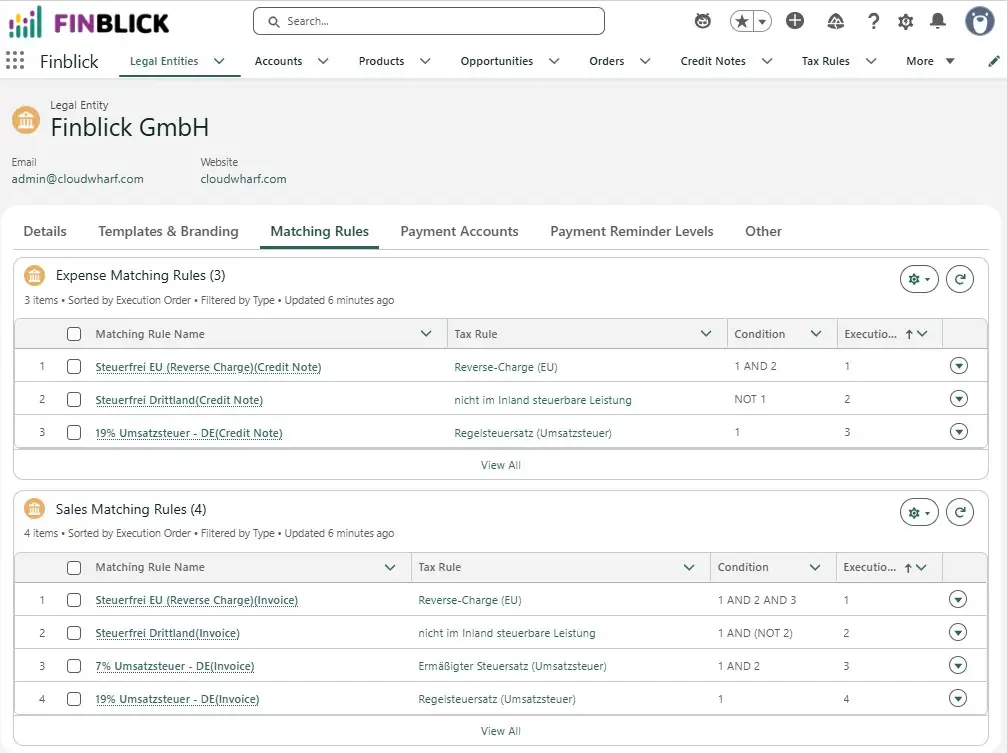
Finblick uses Legal Entity records to separate the companies issuing financial documents within the same Salesforce org. Each Legal Entity can hold its own company information, configuration, and document number sequences.
Tax treatment can also be configured through Matching Rules.
Salesforce ZUGFeRD and XRechnung Generation
For a German invoice, the user can select ZUGFeRD or XRechnung as the output format on the Invoice and generate the document.
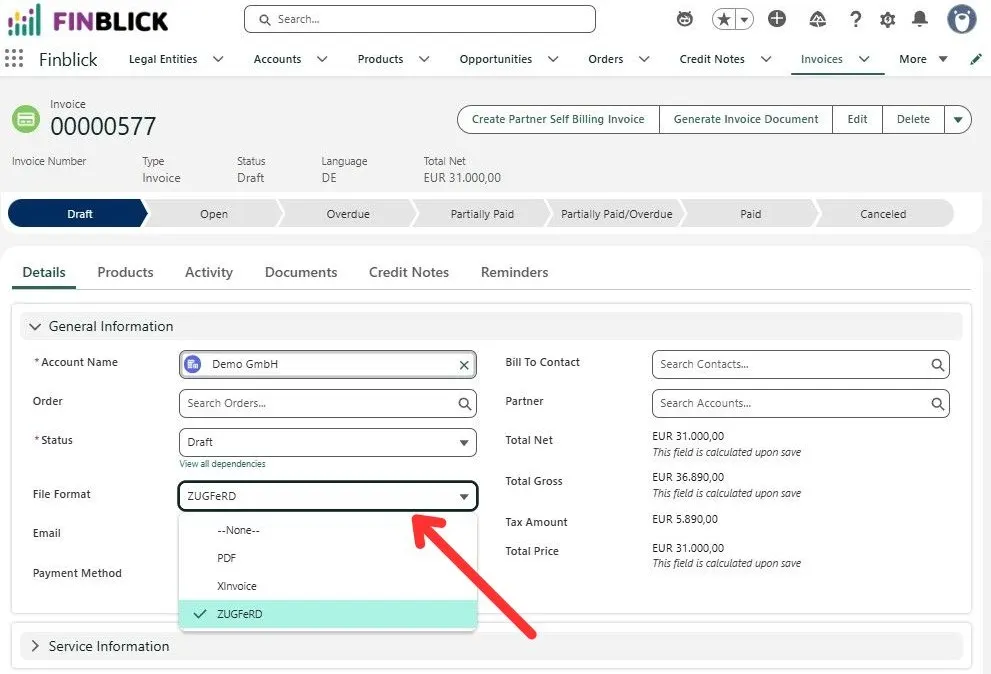
Finblick generates both formats from Salesforce invoice data. In a ZUGFeRD Salesforce process, the relevant invoice values must be available in defined fields so they can be written into the machine-readable XML structure.
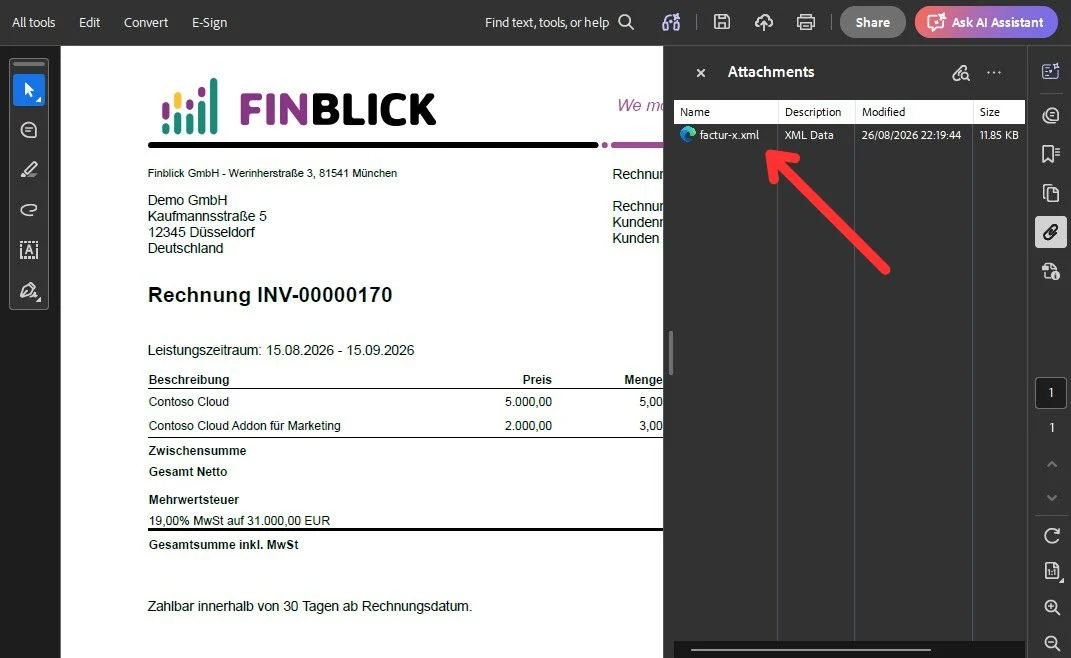
Finblick’s Accounts Payable functionality also supports receiving incoming e-invoices.
Flow, Apex, and Invoice Corrections
Fields such as email address, due date, and service dates can be populated manually or through Flow or Apex.
Finblick supports full cancellation through a cancellation invoice and partial corrections through Credit Notes.
For overdue invoices, Finblick also provides configurable Dunning Management, including automated payment reminders.
How to Keep the Salesforce E-Invoicing Process Ready
A Salesforce-based invoicing process is ready when the team knows which rules apply, can receive and process incoming e-invoices, maintains the required invoice data, can generate the required structured format, and has a defined transmission method that matches the applicable requirements.
Before production rollout, test representative combinations of Legal Entity, customer country, VAT treatment, invoice type, required output format, and correction scenario. Include incoming e-invoice reception where applicable.
Keep the configuration under review after launch. National deadlines, accepted formats, and technical specifications can change, while ViDA adds further EU-level requirements in the coming years.
Learn more about Finblick and its approach to e-invoicing in Salesforce.