








Salesforce’s core clouds, although extremely important, have been gradually fading into the background as the likes of Agentforce, SIforce, and Data 360 have emerged on the scene. However, in the world of Industries, an unlikely player has quietly been rising to the top.
According to 10K’s 2026 Salesforce Ecosystem Report, Health Cloud is that rising star. Its demand has more than doubled this year, and job openings for Health Cloud work, including for Health Cloud skills, have jumped. So, is this cloud the next big deal in Salesforce?
The Stats
Details from 10K’s report have provided context on the state of Salesforce’s job market, with overall demand down by 13%. This is a considerable decline compared to 2025’s 8% increase in demand, and illustrates the market shifting as artificial intelligence grows in popularity.
Interestingly, AI, data, and specialized industry skills rose sharply in demand while the need for generalist skills dropped. This meant that demand for Sales Cloud roles is down 13%, demand for Service Cloud roles is down 21%, and demand for Marketing Cloud roles is down 28%.
Once again, the market is demonstrating the need for specialist talent for specialist clouds or AI, with Nick Hamm, the Founder and Chairman of 10K, writing in the report: “Though 2026 looks like the first year AI is substituting for labor in the Salesforce ecosystem, the need for talent isn’t going away.”
This is where Health Cloud comes in. The report claims that both Health Cloud and Revenue Cloud have seen their demand more than double in the last year, meaning that it’s up 110% YoY globally and 278% YoY in North America. This is a rise in demand much higher than any of the other Industry Clouds; the closest competitor is Government Cloud at 19% YoY.
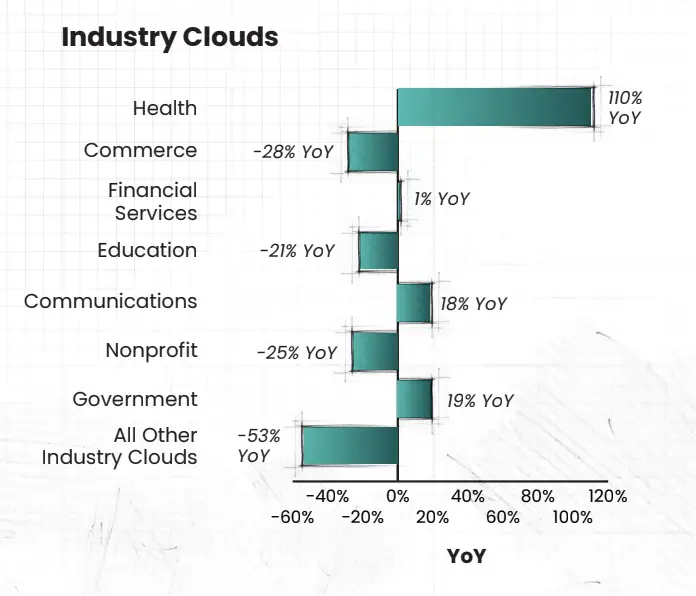
The dividing line here, according to the report, seems to be regulatory burden and data complexity. Sectors like healthcare, government, and financial services have strict compliance regulations, so if they want to invest in AI, they need to ensure the environments have “scaffolding, governance, and human oversight.”
Not only that, but Salesforce’s financial results and investment decisions this year also reflect this. Public Sector Industry Cloud ARR surpassed $200B in Q1 FY27, with public sector Agentic Work Units (AWUs) up nearly 400% QoQ. The company’s dedication to the Govtech sector has also likely influenced this.
Why Health Cloud Specifically?
Health Cloud, like many other Salesforce products and tools this year, has had its own AI revamp. In the Winter ‘26 release, Agentforce was embedded into the eligibility workflow, so agents can pull real-time data from EMRs, clearinghouses, and payers into one interface, reducing manual hand-offs for contact center staff.
There was also a new provider-matching agent that interprets patient preferences like location, specialty, and gender, and suggests matches from a curated provider directory.
In March 2026, six new healthcare-specific agents were announced. The six agents are Referrals & Assessments, EHR Read-Write, Claims & Coverage, Rural Health, Epidemiology Analysis, and Hospital Operations. Agentforce Voice also became HIPAA-ready and able to be used to answer copay, benefits, and eligibility questions.
For large-scale institutions like public hospitals, the Hospital Operations agent was pitched as a command center managing beds, equipment, and nursing staff from a central hub. This launch also included new partnerships with HealthEx, Verily, and Viz.ai.
For people working in this ecosystem, the practical shift is clear. Health Cloud work is moving from configuring data models and care plans toward deploying and governing prebuilt agents. This coincides with the fact that six of the 10 fastest-growing occupations in the United States through 2035 will be in healthcare and social assistance, and the demand for faster, more personalized healthcare is only going to increase.
Health Cloud Jobs
On the job market side, it’s clear to see that the demand for healthcare-specific Salesforce skills is high, especially across the US. With a simple LinkedIn search, roles like Salesforce Health Cloud Solution Owner and Salesforce Consultant in Patient Support Services are just some of the 100+ roles listed for hire.
On Salesforce’s own career website, 375 jobs match the “health cloud” search term at the time of writing. Roles listed include Enterprise Account Executives in Health and Life Sciences, as well as Solution Architects and Technical Architects in multiple locations, working with Health Cloud.
Final Thoughts: Big Deal or Area to Watch?
Health Cloud demand may be up, and the need for interconnected, powerful, agentic healthcare services is also growing. Does this mean that Salesforce’s Health Cloud is the next big deal or just an area to watch in the near future?
10K’s report recommends that Salesforce professionals diversify into agent design and governance, as well as consider the move into regulated industries such as healthcare, financial services, and government.
However, like with any career advice – in Salesforce or otherwise – this should be taken with a grain of salt. Demand may not be as high in your region, and opportunities may not be so fruitful. It’s important to assess the available information and context you have to be able to make good career decisions, but there is no denying that Health Cloud will be one to watch for at least the next six months.